transport
Survey finds broad support for direct train link between Switzerland and London
A YouGov survey found that 58% of respondents in Switzerland support a direct train service to London, while 8% oppose it. Respondents cited lower fares, direct connections and shorter journey times as ways to make rail more attractive than flying.
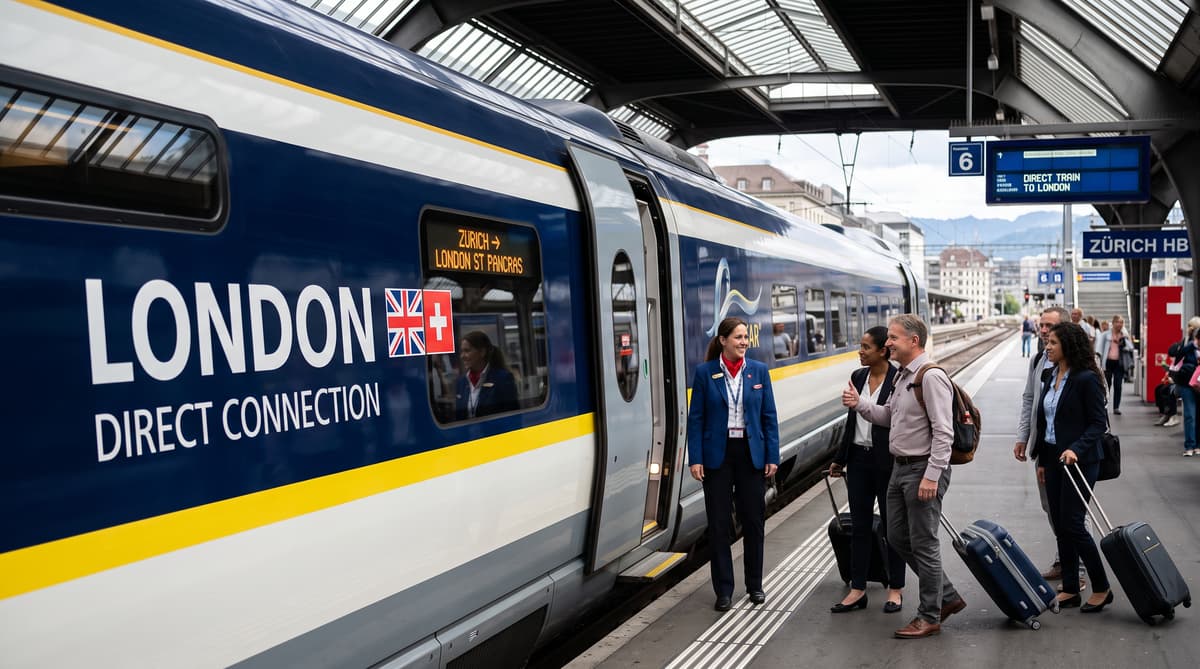
58% of respondents back a direct train service to London, according to a YouGov survey published on October 25, 2026. Just 8% oppose the idea, making a direct rail connection a popular prospect among those surveyed as Switzerland weighs a stronger rail link with the United Kingdom.
YouGov surveyed 1,048 people for the poll, commissioned by the organisations T&E, actif-trafiC and ATE. Their findings point to clear interest in a service that would connect Switzerland and London without a change in Paris. The proposal is also tied to the wider effort to make rail a more attractive option than flying and reduce travel’s impact on the climate.
The survey captures both the appeal of the idea and the practical expectations travellers attach to it. Respondents value rail’s environmental profile and city-centre stations, but many also say price and speed shape their choice. That combination puts the proposed link’s convenience and affordability at the heart of its appeal.
Make Rail Compete on Price and Time
Lower fares led the list of changes that could persuade respondents to choose rail, cited by 61% of those surveyed. Direct connections and shorter journey times each followed at 37%. The results show that support for a London service comes with a clear expectation: it needs to work as a practical alternative for everyday travel decisions, not only as a new route on a map.
Speed remains a strong point for air travel. 79% of respondents said they favour flying because it is fast. Rail has a different set of attractions: 58% said its appeal lies in the experience of travelling by train, 55% pointed to its low environmental impact, and 45% valued stations located in city centres.
Those answers give the proposed connection a distinct pitch. A direct service could address the desire for fewer changes, while rail’s city-centre access and environmental appeal already resonate with many respondents. But fares and journey duration remain central to whether those advantages translate into a preferred way to travel.
Cut the Paris Stop from the Journey
A direct Geneva to London train could take around five hours 30 minutes, according to Victor Thévenet of T&E. The current journey takes more than seven hours, he said, and removing the stopover in Paris would shorten it. The proposed change would address two of the concerns highlighted in the survey: the appeal of direct connections and the importance of travel time.
“By removing the stopover in Paris, the journey time between Geneva and London would be reduced from over seven hours to around five hours 30 minutes,” Thévenet said.
The survey’s results suggest that a simpler journey could matter alongside the service’s environmental appeal. While 55% of respondents cited rail’s low environmental impact as a reason to travel by train, the poll also found that 79% favour flying for speed. A faster, direct rail trip would therefore be relevant to travellers weighing both factors. The estimated time is specific to Geneva and London, the cities named by Thévenet, and illustrates the potential effect of bypassing the Paris transfer.
Prepare for a 2030s Launch
The proposed connection is not expected before the 2030s, despite steps towards cooperation between rail operators. SBB has signed a memorandum of understanding with France’s SNCF and Eurostar, which operates trains through the Channel Tunnel. Obstacles to implementing the service remain, and the poll’s strong support does not itself settle the practical work ahead.
For Swiss travellers, the findings show a substantial appetite for a direct rail option to London. The organisations that commissioned the survey, T&E, actif-trafiC and ATE, asked about both support for the link and what might make respondents choose trains over planes. The answers point to a service judged on familiar terms: ticket prices, journey duration and the ease of travelling without a transfer.
Rail’s appeal also includes its lower environmental impact and central stations, both cited by respondents. The next milestone is the development of the proposed connection through SBB’s cooperation with SNCF and Eurostar. For now, the expected horizon remains the 2030s.