Switzerland
ETH Zurich team builds robots powered by real muscle
ETH Zurich researchers have built small robots powered by living muscle tissue grown from mouse cells on 3D-printed scaffolds. The prototypes can jump, swim, walk and grasp objects, with the new design producing substantially more movement than comparable systems.
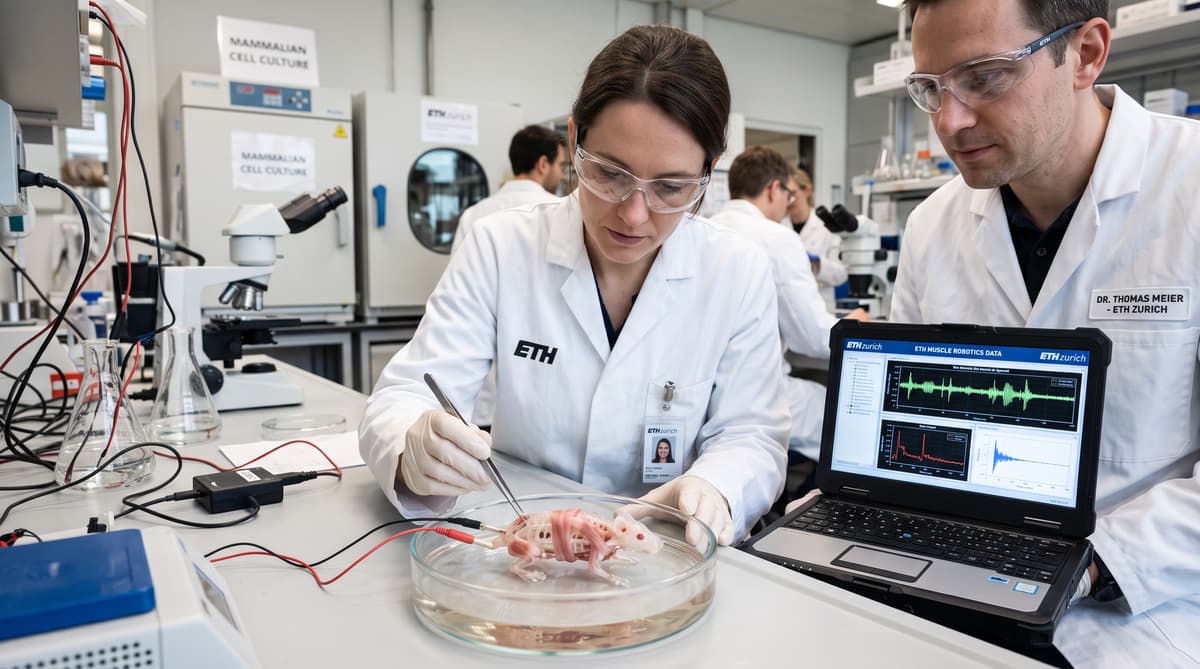
ETH Zurich’s new prototypes put living muscle to work, with small robots able to jump, swim, walk and grasp objects. The team grew the tissue from mouse cells and combined it with a soft hydrogel scaffold, a design that produced substantially more movement than comparable systems. The results were reported on October 22, 2026, and the study appeared in Nature Communications.
The work addresses a problem that has limited laboratory-grown muscle in robotics: tissue often contracts so weakly that its movement is barely visible to the naked eye. ETH’s researchers redesigned the system around the mechanics of that contraction. Their robots show how the shape and support of living tissue can help turn a small muscle movement into a useful action.
The prototypes remain laboratory systems, but their range of movement is notable: one version can jump, while others demonstrate running, swimming and grasping. The central achievement is a design that makes a given amount of muscle produce more motion.
Design the Scaffold for Movement
The researchers designed the muscle and its scaffold as one system from the outset. They used mouse cells to grow the living tissue and a soft hydrogel structure to support it. Rather than choosing a scaffold first and adding muscle later, the team modelled both together on a computer.
An algorithm calculated which shape would give the muscle contraction the greatest mechanical leverage. That geometry matters because the tissue’s contraction is the force that moves the actuator; the scaffold helps translate it into deformation. The team then produced the designed structures with 3D printing.
This approach makes the scaffold part of the robot’s motion system, not simply a holder for the tissue. The resulting actuators are about 1.5 centimetres long. Their combination of living muscle and engineered support gives the contractions a more visible effect than earlier systems with a comparable quantity of muscle. ETH’s design brings computer modelling, additive manufacturing and cell-grown tissue together in a single robotic component.
Measure What the Muscle Can Do
The actuators deform up to 11 times more than previous systems with a comparable amount of muscle. ETH reported several ways that improved motion appears in the prototypes. A jumping robot lifts itself about 5 millimetres, a distance equivalent to roughly one-third of its body length.
A running version reaches 6.2 millimetres per second. Relative to its size, the university said, it is faster than any previously known running bio-robot. Other prototypes can swim, walk and grasp objects, showing that the engineered muscle system can support more than one kind of movement.
These measurements capture performance at the scale of the devices: the actuators are only around 1.5 centimetres long. The jump, running speed and broader set of demonstrated actions reflect the team’s aim of extracting greater mechanical movement from small quantities of living tissue. The comparison with earlier systems is based on those systems having a similar amount of muscle, rather than on a larger muscle mass.
Build a Lifeline for Larger Systems
The muscle-powered robots still rely on nutrient solution to stay alive. That dependence keeps the prototypes within the laboratory for now. ETH researchers say larger systems would need an artificial vascular network to carry nutrients and oxygen to the living tissue.
That requirement points to a key engineering challenge in scaling the approach. A larger robot would need more than a muscle and a carefully shaped scaffold: its tissue would also need a way to receive the materials required for survival. The team identifies artificial vascular transport as essential for future, larger systems.
The current work demonstrates movement in compact devices, but it does not remove the biological needs of the muscle powering them. Its contribution is a design method that improves how effectively contractions move the actuator, paired with prototypes that can jump, run, swim, walk and grasp. The study in Nature Communications sets out that advance alongside the practical requirement for nutrient and oxygen delivery as the system grows.