organised crime
Graubünden prepares action plan to combat organised crime
The Graubünden government is preparing an action plan and commissioning an expert report on organised crime after a parliamentary request. The initiative will assess measures for authorities, businesses and wider society, including checks linked to residence permits.
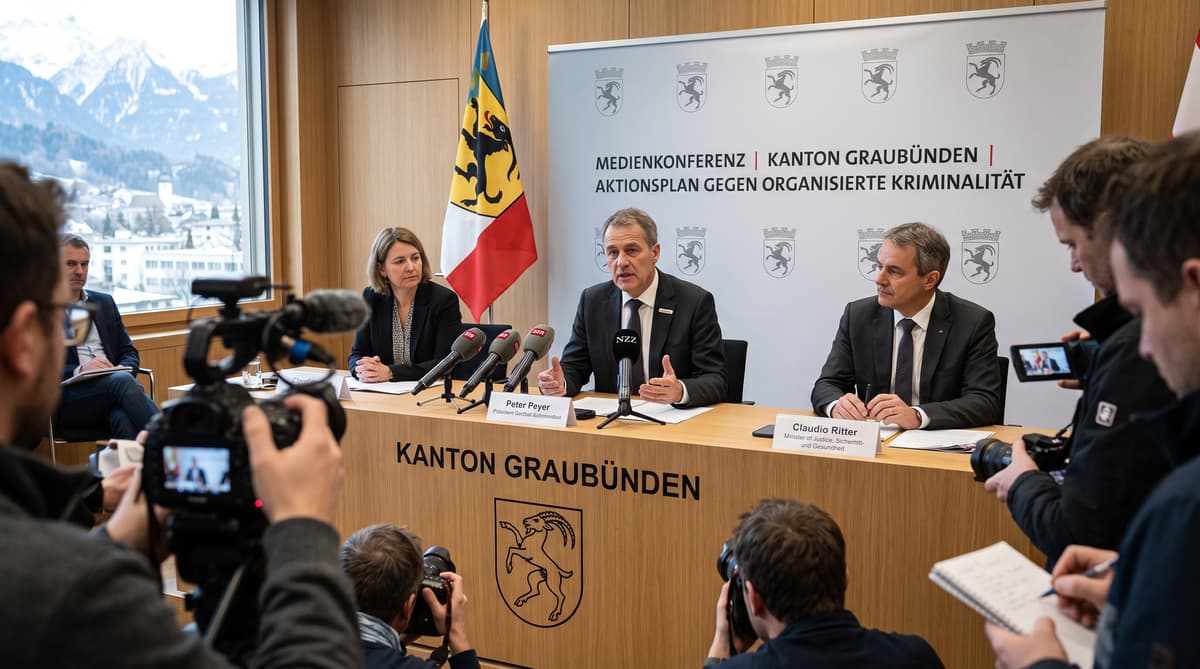
Graubünden is preparing a dedicated action plan and an external expert report on organised crime. The cantonal government announced the move on September 14, 2026, responding to a parliamentary question from Centre Party lawmaker Sandra Maissen. Her intervention followed arrests linked to an international drug operation and concerns about how criminal networks can establish themselves in southern Graubünden.
The report will examine measures for public authorities, businesses and wider society. It will also support implementation of Switzerland’s national strategy against organised crime, with Graubünden saying it intends to play an active role.
The government’s response divides the parliamentary demands into two groups. Two of four requests have already been met, according to the canton. The remaining proposals will be considered through the new action plan, allowing officials to assess how existing controls work and where new instruments may be needed.
The announcement puts a small Alpine canton into a broader Swiss debate about money laundering, residence permits and cooperation between cantonal and federal authorities. Graubünden’s geography, its border connections and the movement of people and capital through the Mesolcina valley have made local oversight a matter of national interest. The action plan is intended to turn that concern into a coordinated programme of measures.
Roveredo arrests expose information gaps
The arrests of seven people in a late February Europol operation brought residence permit checks into sharp focus. Four of those arrested were living in Roveredo, a municipality in the Mesolcina valley, and held valid B residence permits in Graubünden.
The suspects were described in the parliamentary motion as alleged members of the Camorra, the ’Ndrangheta and a Balkan criminal clan. One person had previously been refused a residence permit in neighbouring Ticino. According to the motion, Graubünden authorities did not know about that decision for months.
The case raised questions about how information moves between Swiss cantons and how authorities identify risks when people apply to live in the country. The government said a binding procedure already exists for checking immigration law procedures in other cantons. It also said current information and monitoring systems have proved effective.
Those assurances do not close the political debate. The parliamentary motion argued that a decision in one canton should be visible to another when relevant to public security. The forthcoming expert report is expected to examine how authorities can strengthen coordination while operating within federal rules on residence and data handling. Its findings will help define whether existing procedures require adjustment or closer enforcement.
Moesa tightens permit scrutiny
Graubünden has already expanded checks for some residence permit applications. The canton says a full security check is in place when issuing permits, and that monitoring options allowed by law are used systematically.
For nationals from outside the EU and EFTA, a criminal record extract is normally required. For EU and EFTA citizens, authorities generally request the document when there are grounds for suspicion. Graubünden has introduced a temporary additional measure in the Moesa region: every new permit application from an EU or EFTA citizen must include a criminal record extract.
Moesa is one of 11 administrative districts in Graubünden and includes Roveredo. The regional requirement reflects the particular scrutiny placed on the valley after the international arrests. It also illustrates the practical challenge facing the canton: controls must respond to local risks while remaining consistent with Swiss immigration law and the country’s agreements with the European Union.
The government has asked parliament to treat the residence permit requests that have already been implemented as settled. Whether the Moesa measure remains temporary, expands to other parts of the canton or is replaced by another system will depend on the action plan and the expert assessment. The available information does not indicate a broader permanent rule at this stage.
The plan turns to shell companies
The next phase will focus on companies that can conceal criminal proceeds. Graubünden’s action plan will examine a cantonal monitoring programme for shell companies and businesses considered particularly exposed to money laundering.
The government will also assess whether the canton should establish a central reporting office. Such an office could provide a clearer channel for information from authorities, financial institutions and businesses, although the source material does not specify its proposed powers, staffing or legal structure.
The discussion is especially relevant to the Mesolcina valley, which the parliamentary motion identified as a longstanding money laundering hub. The government’s approach recognises that organised crime is not addressed through police operations alone. Company registers, permit systems, financial reporting and cooperation with businesses all form part of the prevention framework.
Any new monitoring regime would have to distinguish between legitimate commercial activity and structures that warrant further scrutiny. It would also need to clarify which agency receives reports, how cases are escalated and how information is shared with federal and other cantonal authorities. Those details remain to be developed. The expert report is expected to provide recommendations for authorities, businesses and society, giving parliament a basis for deciding which proposals should move forward.
Local action joins the national strategy
The cantonal plan will connect Graubünden’s local response to Switzerland’s national organised crime strategy. The government said it wants to participate actively in implementing the federal approach, rather than treat the issue as a series of isolated local cases.
That coordination will matter in a canton where criminal activity can cross municipal, cantonal and national borders quickly. The Roveredo arrests involved an international investigation, while the parliamentary dispute exposed the consequences of incomplete information between Ticino and Graubünden. The proposed action plan can therefore serve as a framework for cooperation across migration authorities, police services, financial institutions and businesses.
Graubünden has asked parliament to defer the two requests that still require examination. It has also asked lawmakers to regard the two already implemented measures as completed. The next steps are the commissioning of the external report, the design of the action plan and a further parliamentary assessment.
For residents and businesses, the eventual effect will depend on the recommendations adopted. Possible changes include closer company monitoring, new reporting arrangements and continued checks on residence applications in high risk areas. The government has announced the direction of travel. The details, legal safeguards and resources will determine how far the canton’s response reaches.