Politics
Swiss Citizens to Vote on Joining UN Nuclear-Ban Treaty
A successful popular initiative, backed by over 135,000 signatures, will trigger a nationwide referendum on whether Switzerland should formally accede to the UN Treaty on the Prohibition of Nuclear Weapons, challenging the country's current stance.
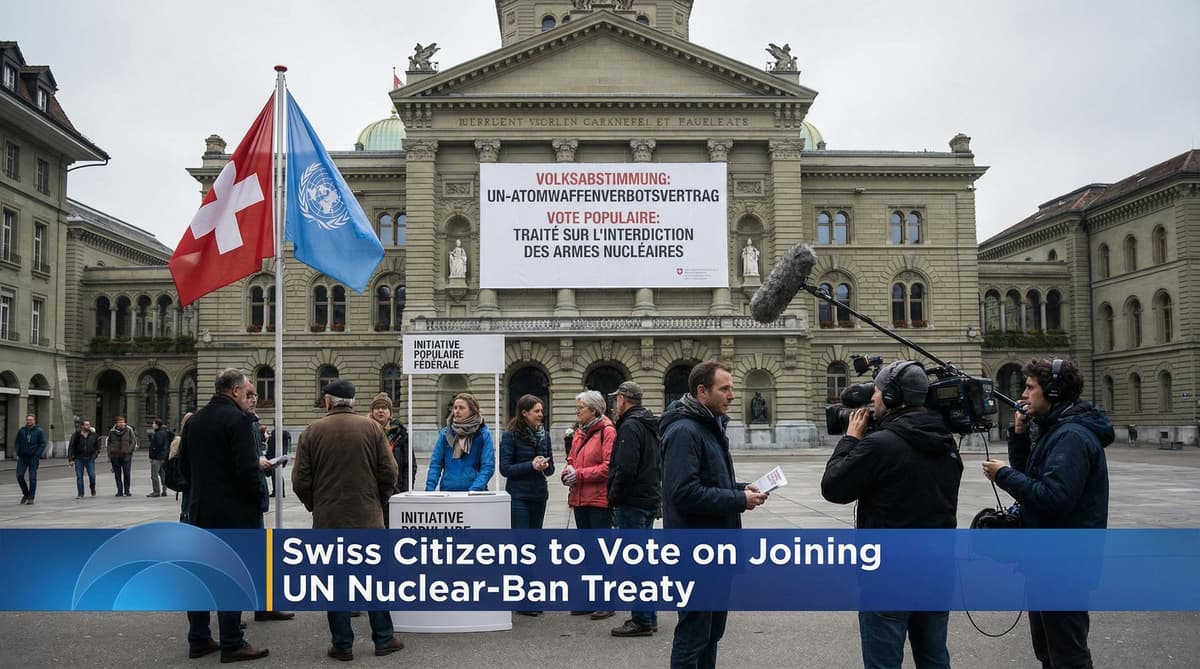
A staggering 135,000 signatures have slammed onto the desks of the Federal Chancellery, forcing a confrontation that the Swiss government can no longer ignore. On December 23, 2025, the Alliance for a Nuclear Weapons Ban successfully triggered a nationwide referendum, demanding that Switzerland formally accede to the UN Treaty on the Prohibition of Nuclear Weapons (TPNW). This is not merely a petition; it is a thunderous mandate from the populace that directly challenges the Federal Council's cautious foreign policy.
The coalition driving this surge is formidable. Backed by the Socialist Party, the Greens, the Evangelical People’s Party, and heavy-hitting civil society groups like the Group for a Switzerland without an Army (GSoA) and Greenpeace, the initiative has mobilized citizens at a critical juncture. Noemi Buzzi of the GSoA declares that this mass mobilization sends "a strong signal for disarmament" precisely when nuclear rhetoric is escalating globally. The Swiss public has thrown down the gauntlet: they demand a vote on whether the nation stands for total abolition or strategic hesitation.
The Global Divide: 99 Against the Giants
While 99 states have already signed or ratified the TPNW, a stark and dangerous reality persists: the nuclear-armed powers remain dangerously defiant. The treaty, which entered into force in 2021, imposes a sweeping, uncompromising ban on the testing, stockpiling, and use of nuclear arsenals. Yet, the world's nuclear titans—including the United States, Russia, China, and France—have categorically refused to join. They are joined in their boycott by every single NATO member.
The contrast is jarring. While nearly 100 nations push for a nuclear-free world, the machinery of deterrence grinds on. Germany, a close neighbor, continues to host approximately 20 American nuclear weapons, underscoring the proximity of the threat. Lisa Mazzone, president of the Greens, argues that "prohibition and abolition are the only credible response," but the geopolitical landscape remains fractured. Switzerland's potential accession would place it firmly in the camp of humanitarian disarmament, directly opposing the strategic doctrines of the world's military superpowers.
Bern vs. The People: A Collision Course
The Federal Council is now grappling with a direct rebuke of its authority. In March 2024, the government explicitly declined to sign the treaty, arguing that its "practical effect would be limited" without the participation of nuclear states. They contend that Switzerland can wield more influence within the existing Nuclear Non-Proliferation Treaty (NPT). However, the initiative committee frames this refusal as a moral failure. Fabian Molina, a Socialist National Council member, warns that "Switzerland’s credibility suffers if it retreats on nuclear disarmament."
This referendum represents a high-stakes clash between pragmatic diplomacy and humanitarian idealism. The government insists on a path of gradual disarmament involving nuclear states, while the initiative's backers argue that the Federal Council has ignored a parliamentary mandate for years. The upcoming vote will force Bern to decide whether to continue its cautious alignment with Western powers or to break rank and champion a total ban, regardless of the diplomatic fallout.
Neutrality on the Edge
Switzerland's famed neutrality is being put to the ultimate test. While Bern hesitates, fellow neutral nations Austria and Ireland have already surged ahead, signing the treaty and leaving Switzerland in an awkward diplomatic limbo. By joining the TPNW, these nations have signaled that neutrality does not mean passivity in the face of existential threats. The Swiss electorate must now decide if they will follow suit or remain on the sidelines.
The implications are profound. Accession would legally bind Switzerland to never assist in nuclear activities—a stance that could complicate relations with NATO partners who rely on nuclear deterrence. Yet, proponents argue that true neutrality demands a rejection of weapons of mass destruction. As the vote approaches, the Swiss people are not just deciding on a treaty; they are redefining what it means to be a neutral humanitarian power in a re-arming world. The outcome will resonate far beyond the Alps, signaling whether Switzerland will lead or follow in the fight for global survival.