Technology
Swiss solar-powered plane altitude record confirmed
A solar-powered electric plane flown by Swiss pilot Raphael Domjan reached 9,640 metres in 2025, a record now confirmed by the World Air Sports Federation. The achievement sets a new benchmark for solar-powered aviation.
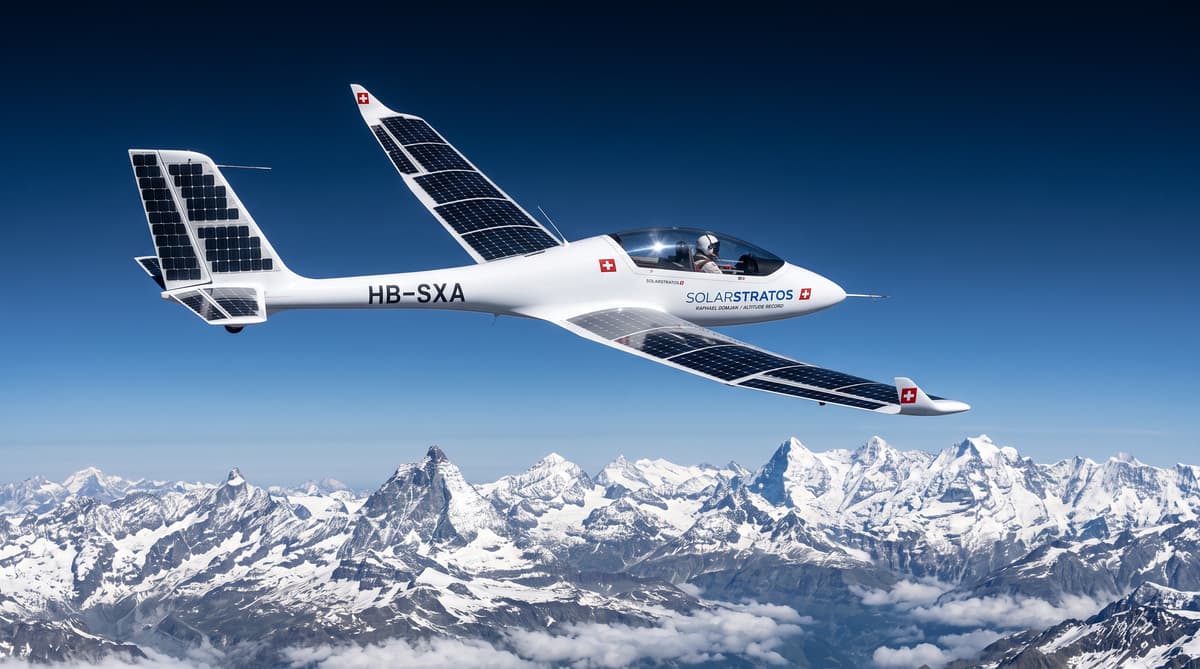
9,640 metres above Sion has now become the benchmark for crewed solar-powered electric flight. The World Air Sports Federation, known by its French acronym FAI, confirmed Raphael Domjan’s record after reviewing the flight data, giving a 2025 achievement formal international standing.
Domjan reached the altitude on 12 August 2025, departing from Sion airport in Valais. The flight lasted five hours and nine minutes, and warm-air thermals helped the aircraft gain height during the climb. The verified result exceeded the previous certified record of 9,235 metres, which had stood for 15 years.
The confirmation came as the FAI held its 120th general conference in Lausanne. On Wednesday, the federation awarded Domjan the Louis Blériot Medal, an honour established in 1936 and named after the French aviation pioneer. The recognition places a Swiss-developed aircraft and pilot at the centre of a specialised field where endurance, weight control and atmospheric conditions all determine what electric propulsion can achieve.
For Switzerland, the record links Valais aviation with a project that has spent more than a decade testing the limits of solar flight. It also gives the SolarStratos programme a verified platform for its next target: reaching the stratosphere with a crewed aircraft.
Build the climb around efficiency
The record gained 405 metres over the previous certified mark. That margin may appear modest on a chart, but altitude places strict demands on every part of a solar aircraft. The air becomes thinner, temperatures fall and the available energy must support propulsion, instruments and the pilot while the aircraft continues to climb.
SolarStratos used warm-air thermals during the flight from Sion. These rising air currents can provide lift without requiring the aircraft to spend additional electrical power to maintain altitude. Their use reflects the close relationship between the project and the conditions around the Swiss Alps, where complex terrain and changing air movements shape flight planning.
The aircraft’s performance also depends on its unusual proportions. The carbon-fibre plane is 9.6 metres long, with a 24.8-metre wingspan. Its wings carry 22 square metres of high-specification solar panels. The broad span supports low-speed flight, while the lightweight structure combines carbon fibre for strength and reduced mass.
SolarStratos can take off from speeds of 50 kilometres per hour, reaches a maximum of 140 kilometres per hour, and cruises at around 80 kilometres per hour. Those figures describe an aircraft built for efficient ascent and sustained flight, rather than the speed associated with conventional aviation.
Put the flight through international scrutiny
Five hours and nine minutes in the air turned a specialist test flight into a certified aviation milestone. The FAI’s review matters because records under its authority require more than a project announcement. Flight data must be examined and the attempt must meet the federation’s rules before the result receives international recognition.
That process took several months. The SolarStratos team said the ratification completed the verification and certification required to establish the altitude officially. The decision also clarifies the record’s place in aviation history: SolarStratos is now recognised as the highest-flying crewed electric and solar-powered aircraft.
The FAI’s decision came during its general conference in Lausanne, giving the Swiss project a domestic setting for a major international validation. Domjan received the Louis Blériot Medal during the gathering. The award recognises the record flight and a programme that SolarStratos says has involved more than 10 years of research, testing and commitment.
Formal certification does not change the flight’s altitude or duration. It changes how the achievement can be measured against earlier attempts and future flights. A verified figure of 9,640 metres gives researchers, engineers and other aviation teams a clear reference point as electric aircraft development moves toward higher operating ceilings.
Aim for the stratosphere
The stratosphere begins roughly 360 to 2,360 metres higher than the altitude Domjan has already reached over Switzerland. Its lower boundary is generally placed at around 10,000 to 12,000 metres at Swiss latitudes, although the exact height varies with climatic conditions. SolarStratos is aiming to cross that boundary in a crewed electric and solar-powered aircraft.
The next stage will demand more than a higher climb. At greater altitude, the aircraft must manage thinner air, reduced lift and colder conditions while preserving enough electrical energy for propulsion and onboard systems. The project’s current design offers a foundation for that effort, with a long carbon-fibre fuselage, a broad solar-covered wing and a single propeller.
SolarStratos frames the goal as a flight without a drop of fossil fuel. The ambition remains a technology demonstration rather than a replacement for commercial aviation. The aircraft carries one pilot, flies at modest speeds and relies on a carefully controlled combination of solar generation, low weight and atmospheric lift.
The confirmed record gives the team a stronger technical and public reference as it prepares for future tests. It also gives Swiss aviation a visible example of how Valais infrastructure, Alpine conditions and specialised engineering can support experiments in low-carbon flight.
Carry the Swiss experiment forward
Switzerland now holds a certified 9,640-metre reference point for crewed solar-electric aviation. The record does not resolve the wider challenges facing zero-emission flight, including energy storage, payload limits, weather dependence and the infrastructure required for routine operations. It does establish what a lightweight, solar-powered aircraft can accomplish under carefully selected conditions.
The project’s Swiss setting remains important. SolarStratos made its record attempt from Sion, an airport surrounded by the terrain and atmospheric patterns of Valais. The flight used warm-air thermals, while the aircraft’s wide wings and low-speed profile helped it remain aloft efficiently. Those choices show how local geography can shape aviation research as directly as materials and motors.
Domjan’s medal and the FAI’s certification also extend the project’s visibility beyond its home base. The record provides an independently validated result for the next phase of testing and for conversations about electric propulsion in aviation.
SolarStratos must still reach the stratosphere before its central ambition is complete. Until then, the confirmed flight stands as a measured achievement: 9,640 metres, five hours and nine minutes, and a Swiss-built aircraft that has pushed crewed solar flight above its previous certified ceiling.