Climate change
Can climate lawsuits force companies and governments to act?
A new podcast examines how communities and campaigners are using courts to pressure governments and companies over climate change. The discussion includes a case brought in Switzerland against cement group Holcim by residents of an Indonesian archipelago.
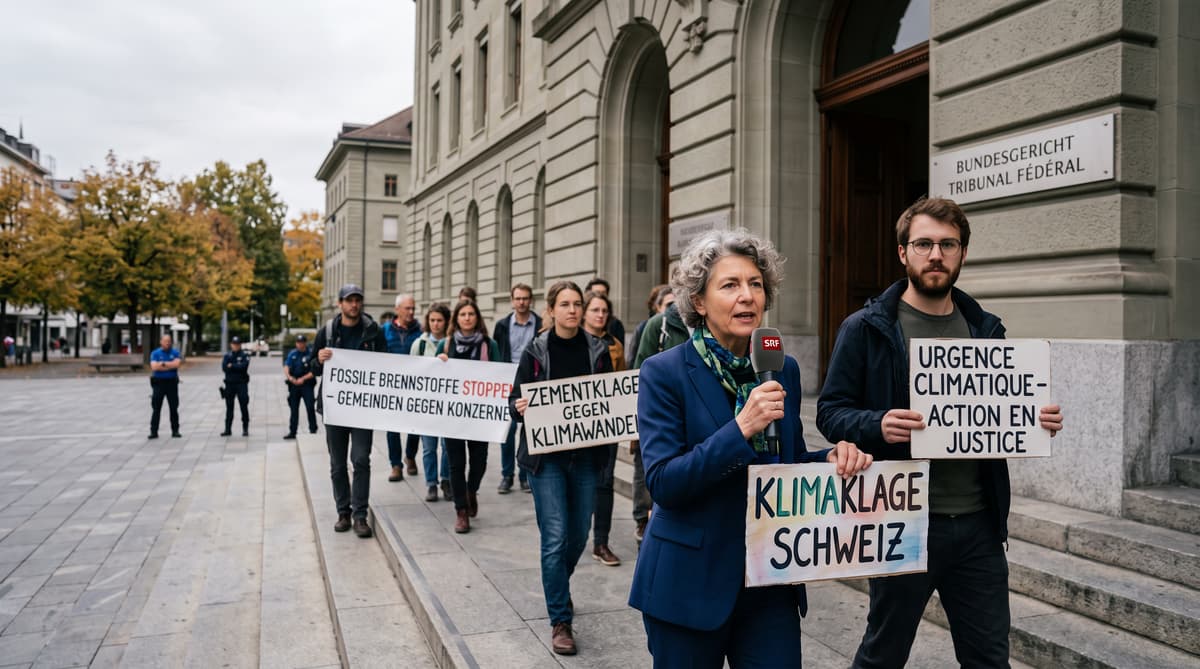
Climate litigation is moving disputes over emissions into courtrooms. Communities affected by a changing climate, campaigners and lawyers are increasingly asking judges to examine what governments and companies knew, what they did, and whether their actions meet legal duties.
That shift is the focus of a new episode of SWI swissinfo.ch’s science podcast, The Swiss Connection. Host Jo Fahy speaks with climate journalist Luigi Jorio about the growing use of lawsuits and with Christina Voigt, a leading expert in environmental law and climate litigation.
The episode also examines a case brought in Switzerland by residents of an Indonesian archipelago against Holcim, the Swiss cement group. The residents are challenging the company over its alleged contribution to climate change. The case links a Swiss-based multinational to people living far from Switzerland who say climate impacts have direct consequences for their communities.
The source material does not report a final ruling or a damages award. It presents the case as part of a wider effort to use legal systems to demand accountability. For campaigners, court proceedings can create scrutiny, compel disclosure and force institutions to defend their climate policies in public. For judges, the disputes raise difficult questions about evidence, responsibility and the limits of judicial power.
Indonesian Residents Challenge Holcim
The Holcim case brings a distant climate impact into a Swiss legal setting. Residents of an Indonesian archipelago are using a Swiss court to challenge Holcim, a company headquartered in Switzerland and one of the world’s major cement groups. The podcast presents their action as a test of whether people exposed to climate harm can seek redress from a company operating across borders.
The case matters because cement production is closely tied to greenhouse gas emissions, while the effects of global warming are felt through local changes in coastlines, weather patterns and living conditions. The source does not specify the residents’ precise legal claims, the court’s jurisdictional ruling or the amount of compensation sought. Those details remain important to any assessment of the case’s prospects.
Cross-border litigation also creates practical hurdles. Claimants must establish a legal connection between corporate conduct and specific harm. They may face questions about jurisdiction, causation, admissible scientific evidence and the responsibilities of a parent company for activity across its corporate network.
A Swiss proceeding can nevertheless draw attention to how global businesses manage climate risks. It also gives Swiss courts a role in a debate that reaches well beyond national borders, while keeping the legal process anchored in Swiss procedure and standards of proof.
What Judges Can Decide
Climate lawsuits ask judges to apply existing law to a rapidly changing scientific reality. Christina Voigt, described by SWI as one of the world’s leading experts in environmental law and climate litigation, joins the podcast to explain why claimants are turning to courts and how effective that strategy has been.
Legal action can take several forms. People may challenge a government’s climate policy, seek stronger protection of rights, or bring claims against companies over alleged contributions to climate change. Each route depends on national law. Courts must determine whether claimants have standing, whether the issue belongs before a judge and whether the evidence meets the required standard.
Scientific attribution has become central to these disputes. Researchers can increasingly assess how emissions contribute to particular climate risks, but connecting a company’s conduct to a specific injury remains legally complex. A court may accept that climate change is real while still finding that a claimant has not proved the elements of a particular claim.
The podcast’s framing is cautious. It asks what results litigation has produced rather than presenting lawsuits as a guaranteed solution. Court victories can lead to policy changes or closer corporate scrutiny. Losses can clarify legal boundaries, expose gaps in regulation and direct campaigners toward different strategies.
Switzerland Faces the Next Wave
Courts can pressure institutions, but they cannot carry the entire ecological transition. That conclusion is reflected in the related SWI discussion, titled “We cannot rely only on judges to drive the ecological transition.” The limits are structural: judges decide the disputes brought before them, while governments set broad policy and companies control investment, production and corporate strategy.
A ruling can still have consequences beyond one claimant. It may require a government to reconsider a policy, compel a company to disclose information or establish a legal interpretation that influences later cases. Even proceedings without a final victory can keep climate responsibility in public view and give affected communities a formal route to challenge powerful institutions.
For Switzerland, the Holcim case carries particular relevance. Swiss-based companies operate in international markets, and decisions made at corporate headquarters can affect communities thousands of kilometres away. Swiss courts may therefore face more claims that connect domestic corporate structures with overseas environmental harm.
The podcast leaves listeners with a practical picture of climate litigation: it is one tool among many. Its impact depends on the strength of the evidence, the wording of national law, the willingness of courts to hear the claim and the response of governments and companies after judgment. The episode is available through The Swiss Connection, SWI’s English-language podcast, Apple Podcasts and Spotify.