Switzerland
ICRC president warns of deepening global humanitarian crisis
The ICRC says humanitarian aid is being undermined by falling funding, declining political support and weakening respect for international humanitarian law. President Mirjana Spoljaric says protecting civilians in conflicts such as Gaza and Ukraine ultimately depends on political will.
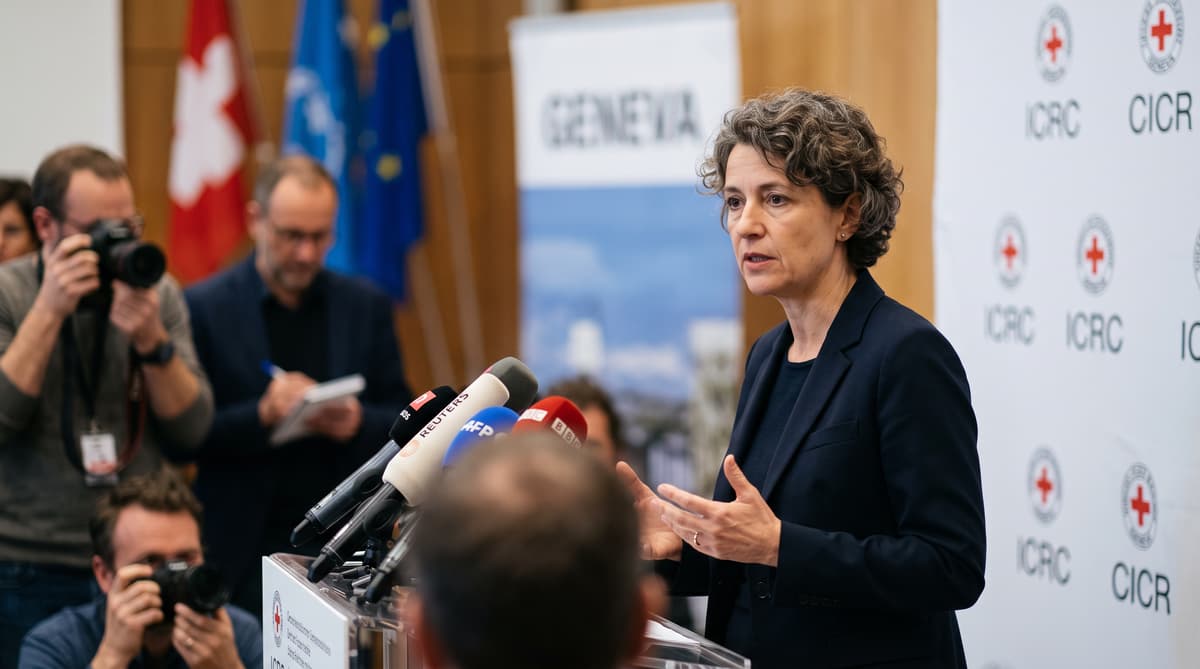
Millions of people are displaced and tens of thousands have been killed as violations of humanitarian law spread across conflicts, according to Mirjana Spoljaric, president of the International Committee of the Red Cross. In an interview with Swiss public broadcaster SRF, she said the humanitarian system is being squeezed by falling funding, weaker political backing and a more flexible interpretation of the rules designed to protect civilians.
Her warning comes as the wars in Gaza and Ukraine continue to test the Geneva Conventions and the institutions responsible for applying them. Spoljaric said governments understand the severity of the situation, including in Gaza, but awareness has not produced enough action.
“As soon as we start talking about international humanitarian law, it becomes clear that countries need to adapt their military strategies so the situation on the ground improves,” she said. “That’s when dialogue becomes difficult, because it’s highly political.”
The ICRC, headquartered in Geneva, works in some of the world’s most dangerous war zones. Its ability to protect detainees, reunite families and reach civilians depends on access negotiated with armed actors and on states respecting the legal framework that governs war. Spoljaric said both conditions are under pressure.
Open the Routes to Civilian Recovery
Spoljaric says Gaza needs more than food deliveries. She argued that restrictions on machinery and dual-use goods are preventing the repair of essential infrastructure and limiting the civilian response to the war.
Dual-use goods are products developed for civilian or industrial purposes that could also be diverted for military use. They can include equipment for construction, water systems, communications or surveillance. Governments subject their export to authorisation because of the security risks, but those controls can also obstruct reconstruction and public services in conflict areas.
“Food aid is not enough,” Spoljaric said. “What is needed are machines or dual-use goods, but it is forbidden to import them.” She called for pressure on influential states, including the United States and Israel, to lift restrictions that block those supplies.
Her comments place responsibility beyond humanitarian agencies. Aid organisations can distribute food, medicine and emergency shelter, but they cannot decide whether borders open, commercial imports resume or damaged water and sanitation systems are rebuilt. Those decisions belong to governments and military authorities.
For the ICRC, civilian protection also depends on sustained access and dialogue with all parties. Spoljaric said political leaders must translate their stated support for humanitarian principles into decisions that change conditions on the ground in Gaza and elsewhere.
Turn Diplomatic Support Into Compliance
The ICRC’s international law initiative has the backing of 118 states, a figure Spoljaric cited as evidence that governments still recognise the value of the Geneva Conventions. The test will be whether that support changes military conduct and diplomatic decisions.
A summit in Jordan in December is expected to put international humanitarian law on the political agenda. Several heads of state have confirmed that they will attend. The meeting will take place as governments face accusations that they interpret the rules selectively, particularly when military operations produce large-scale civilian harm.
Spoljaric described “all-too-flexible” interpretations of humanitarian law and wanton destruction as widespread. The ICRC president did not identify a single conflict as the sole source of the problem. She said the pattern is visible across current wars, where civilian displacement, deaths and damage to vital infrastructure continue.
The Geneva Conventions set limits on the conduct of hostilities and require parties to distinguish between civilians and combatants. They also protect wounded soldiers, prisoners and people who cannot take part in fighting. Enforcement remains largely dependent on states, courts and political pressure.
Switzerland, as depositary of the Geneva Conventions and host to major humanitarian organisations in Geneva, has a particular diplomatic stake in the Jordan summit. Its influence will depend on whether it can help move governments from declarations to implementation.
Keep Humans Responsible for Lethal Force
Autonomous weapons could make life-and-death decisions without human command, a prospect Spoljaric says demands an outright ban. She and UN Secretary-General António Guterres recently renewed their call to curb systems that can identify and strike targets with limited or no direct human control.
Artificial intelligence is already reshaping military planning, surveillance and targeting. The ICRC president said a growing number of states are concerned about where warfare is heading if the technology is allowed to develop without firm limits. Her position focuses on the point at which a machine determines whether a person lives or dies.
The debate raises practical and legal questions. Can a weapon reliably distinguish a civilian from a fighter in a crowded urban area? Who is accountable when an autonomous system makes a fatal error? How can commanders demonstrate that an attack met the requirements of distinction, proportionality and precaution?
Existing humanitarian law applies to new weapons, but states still have to assess whether particular systems can be used lawfully. Spoljaric argues that some autonomous systems should be prohibited before deployment becomes widespread.
For Switzerland, the issue fits within its long-standing role in humanitarian diplomacy and arms control discussions. Any international agreement would require major military powers, technology producers and smaller states to accept meaningful human responsibility for lethal force.
Make Geneva’s Influence Count
Spoljaric links the erosion of humanitarian law to economic and social damage well beyond the battlefield. When governments place force above rules, she said, investment in people and institutions becomes harder and civilians lose the security needed to study, work and rebuild.
“The principle of ‘might before right’ undermines economic development, investment in human capital and social progress,” she said. In her view, the rule of law provides the conditions for children to attend school, young people to pursue vocational training and adults to find decent work.
That argument gives Switzerland a direct interest in the debate. Geneva hosts the ICRC, the United Nations Office at Geneva and a dense network of humanitarian and diplomatic organisations. Swiss foreign policy has long promoted international law, civilian protection and negotiated access in war zones. The country also serves as depositary for the Geneva Conventions.
The coming months will show whether states use that diplomatic infrastructure to reinforce the rules or allow further exceptions to become normal practice. The Jordan summit offers one opportunity. Funding decisions, export controls and military policy will provide more immediate evidence of political priorities.
Spoljaric’s message is directed at governments with influence over conflicts and supply routes. Humanitarian agencies can document suffering and deliver assistance, but political decisions determine whether civilians receive protection, essential goods and a realistic path to recovery.