Business
Roche buys rights to Chinese cancer-drug portfolio for $510 million
Roche is paying $510 million for global rights to a portfolio of antibody-drug conjugates developed by China’s Hansoh Pharma. The cancer treatments combine antibodies with chemotherapy molecules, with Roche taking over development after the first clinical phase.
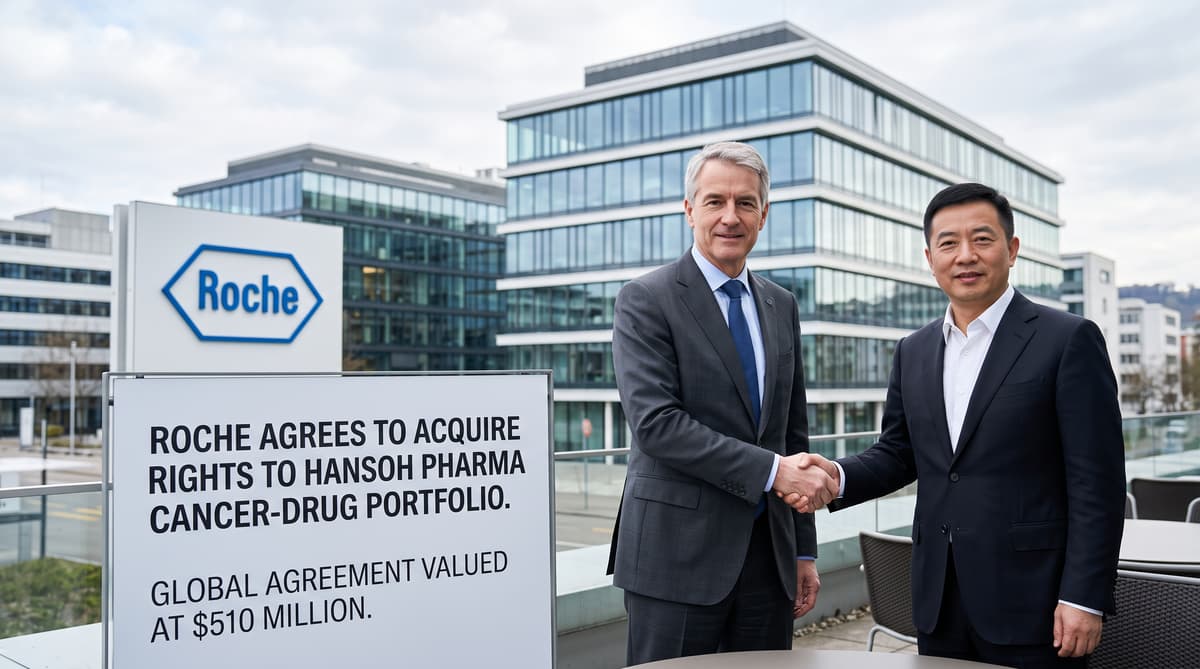
Roche is committing $510 million to secure a new pipeline of Chinese cancer medicines. The Basel-based pharmaceutical group has acquired rights to a portfolio of antibody-drug conjugates developed by Hansoh Pharma, a Shanghai-based drugmaker. The agreement gives Roche access to candidates that pair an antibody with a chemotherapy molecule, a design intended to deliver treatment more selectively to tumour cells.
Roche will transfer $400 million when the contract is signed and pay a further $110 million after one year. The deal also includes potential milestone payments of up to $15 billion, tied to development progress, regulatory approvals and commercial performance. Hansoh will receive additional commissions on revenue, although the companies have not disclosed the rate.
The transaction, announced on October 19, 2026, strengthens Roche's efforts to expand its oncology pipeline through partnerships. It also underscores the growing importance of Chinese pharmaceutical research to multinational companies seeking late-stage or emerging cancer assets. Roche will take responsibility for the portfolio after its first clinical phase, placing the Swiss group in charge of development and commercial strategy across most global markets.
Track the Money and Milestones
The deal's immediate cash value is $510 million, while its headline upside depends on clinical and commercial success. Roche's payment structure limits the initial outlay compared with the agreement's potential value. Hansoh receives $400 million at signing, followed by $110 million one year later. Further payments would depend on the portfolio clearing the demanding stages of drug development.
The agreement provides for up to $15 billion in milestones, according to Hansoh's announcement cited by Keystone-SDA. Those payments may be triggered by development results, regulatory decisions or sales achievements. The contract also includes commissions on any future revenue, but the companies have not disclosed the percentage.
That structure places much of the financial risk after the initial transaction. Roche gains the right to develop and commercialise the treatments without paying the full potential value at the outset. Hansoh, meanwhile, retains a role in the early research programme and stands to benefit if the medicines advance. The source does not identify the individual drug candidates in the wider portfolio, their target cancers or their current trial results. Those details will be important for assessing how much of the milestone value could ultimately be realised.
Split Development Across Markets
Hansoh will control the medicines through the completion of Phase I, then Roche will take over most global development. The handover gives the Chinese company responsibility for the earliest clinical work, while Roche assumes the larger international programme once the first clinical phase is complete. The agreement excludes mainland China, Hong Kong, Macao and Taiwan from Roche's territory.
The division reflects the practical complexity of global drug development. Early trials establish basic safety, dosing and initial signals of efficacy. Later phases require larger patient populations, regulatory submissions and commercial planning across multiple healthcare systems. Roche brings experience in these stages, as well as established oncology operations in Switzerland, Europe and other markets.
The Swiss company has already tested the partnership model with Hansoh. Exactly one year before the latest transaction, Roche paid an initial $80 million for rights to HS-20110. That drug was then undergoing Phase I trials in China and the United States for colorectal cancer and other cancers. The earlier agreement gave Roche a foothold in Hansoh's research base. The new portfolio deal broadens that relationship, while leaving Hansoh with commercial rights in the excluded Asian markets.
Watch the Trials Shape Roche's Return
Roche is adding Chinese-origin oncology research to a pipeline facing the long timelines and high failure rates of cancer drug development. Antibody-drug conjugates have attracted pharmaceutical interest because they combine the targeting function of an antibody with the cell-killing action of chemotherapy. Their clinical value will depend on the specific drug design, tumour type, dosing and trial results, none of which the source discloses for the new portfolio.
For Switzerland, the agreement links Basel's global pharmaceutical infrastructure with a research base in Shanghai. Roche will be responsible for development outside the four excluded markets once the assets pass their first clinical phase. That could bring future trials, regulatory work and manufacturing decisions into a wider international network, although the agreement does not specify where those activities will take place.
The next concrete markers will be clinical data, regulatory filings and decisions on which candidates deserve larger trials. Roche's previous HS-20110 partnership offers evidence of continuing engagement with Hansoh, but it does not establish that the newly acquired portfolio will succeed. Patients and investors will have to wait for trial disclosures before judging whether the $510 million commitment produces medicines that reach hospitals and cancer clinics.