Zurich
Zurich sets framework for 35-hour working-week pilot
Zurich has approved the legal framework for a one-year pilot allowing selected shift workers, including police, public transport staff and carers, to work 35 hours a week instead of 42 without a pay cut. The city has not yet decided which department will host the trial.
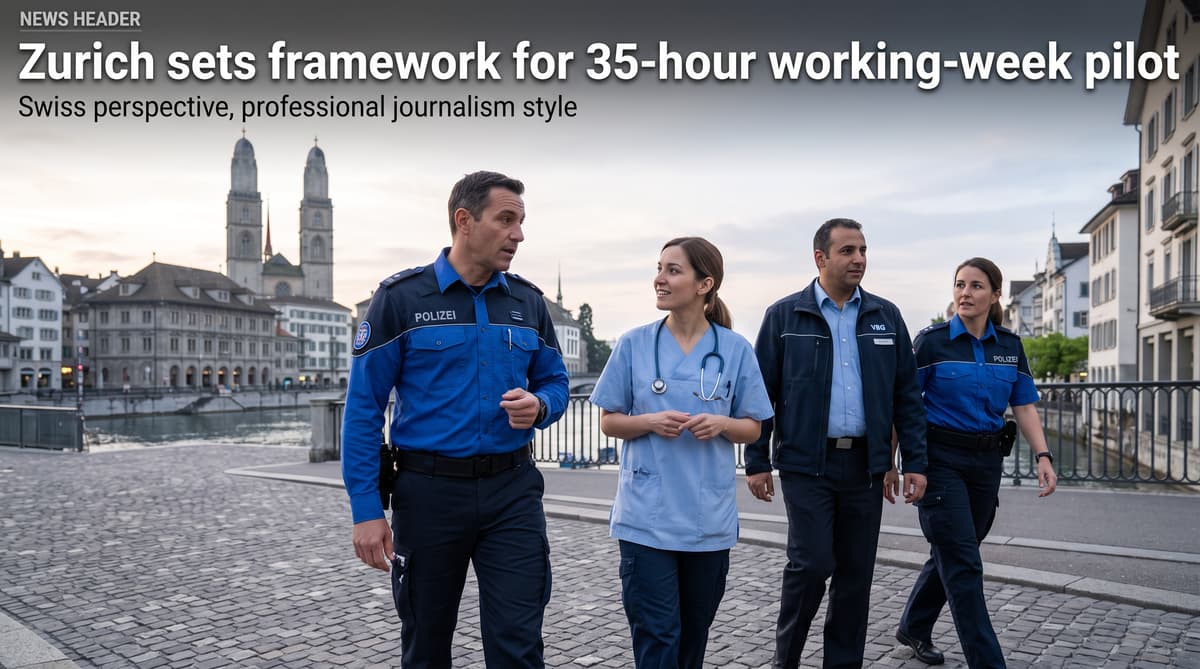
Zurich is putting a shorter working week to the test—and the experiment begins with a seven-hour cut. The city government has approved the legal framework for a one-year pilot that would allow selected shift workers to work 35 hours instead of 42, without losing pay. That amounts to a reduction of roughly 16.7% in weekly hours, one of the most consequential labour-policy trials yet proposed by Switzerland’s largest city.
The target group is deliberately practical rather than symbolic: police officers, public transport employees and carers are among the workers who could take part. These services run around the clock, making them a far tougher test than a conventional office-based four-day week. Zurich has not yet chosen the department that will host the trial, and the proposal still goes before a city-parliament committee next Wednesday.
The framework arrives after more than three years of political and administrative wrangling. City councillors first backed the demand in March 2023 by 60 votes to 57, after David Garcia Nuñez of the Alternative List argued that Zurich needed to ease the pressure on workers. The city now moves from slogan to scrutiny: can fewer hours deliver healthier working lives without weakening essential public services?
Shift Workers Face the Real-World Test
The pilot’s biggest question is not whether workers want fewer hours—it is whether the city can keep the public service moving. Shift work leaves little room for easy savings. A police roster cannot simply close for an afternoon; trams must run, and care homes cannot pause when staffing becomes tight.
That is why the city’s directive treats the trial as a controlled test. It will apply only to a selected group and run for one year, with an option to extend it by up to another year. Officials can then examine staffing levels, service quality, sickness absence, scheduling and financial consequences before considering any broader decision.
The approach also acknowledges a legal and political tension. Participants may receive different working conditions from other municipal employees, but the city argues that this unequal treatment is deliberate and lawful because the pilot is designed to test a model that could eventually benefit a much wider workforce. It is not, officials say, a special privilege handed to one group.
The unresolved department matters. A trial in transport, policing or care would expose different pressures—and produce very different lessons. Until Zurich names the host, the headline reform remains a framework rather than a functioning roster.
The CHF110 Million Question
A full rollout could cost Zurich up to CHF110 million and demand as many as 1,500 extra employees. Those figures turn a popular work-life-balance idea into a hard question about public finances and Switzerland’s strained labour market.
The estimate applies if the shorter week were extended across the entire city administration with no reduction in pay. The pilot itself will be narrower, but its results will be judged against precisely this larger possibility. If productivity gains offset the lost hours, the city could build a case for expansion. If services require substantial replacement staff, the financial arithmetic could stop the reform in its tracks.
Daniel Leupi, a Green Party councillor who had warned about the proposal during debate, called it a “massively resource-intensive experiment.” He also questioned whether Zurich’s human-resources department could manage the scheme and challenged the city’s ability to recruit enough people. His warning lands in a country already confronting shortages in several skilled occupations.
The contrast is stark: workers could gain time, recovery and potentially better health, while the city could face higher payroll and recruitment costs. Zurich is therefore testing not only a timetable, but whether public-sector productivity can rise fast enough to finance it.