Partners Group
Partners Group reshuffle fails to reassure investors
Partners Group has replaced CEO David Layton with veterans Roberto Cagnati and Juri Jenkner as co-chief executives after weaker first-half earnings and a warning on performance fees. Investors reacted negatively, sending shares down sharply and extending the firm’s difficult year.
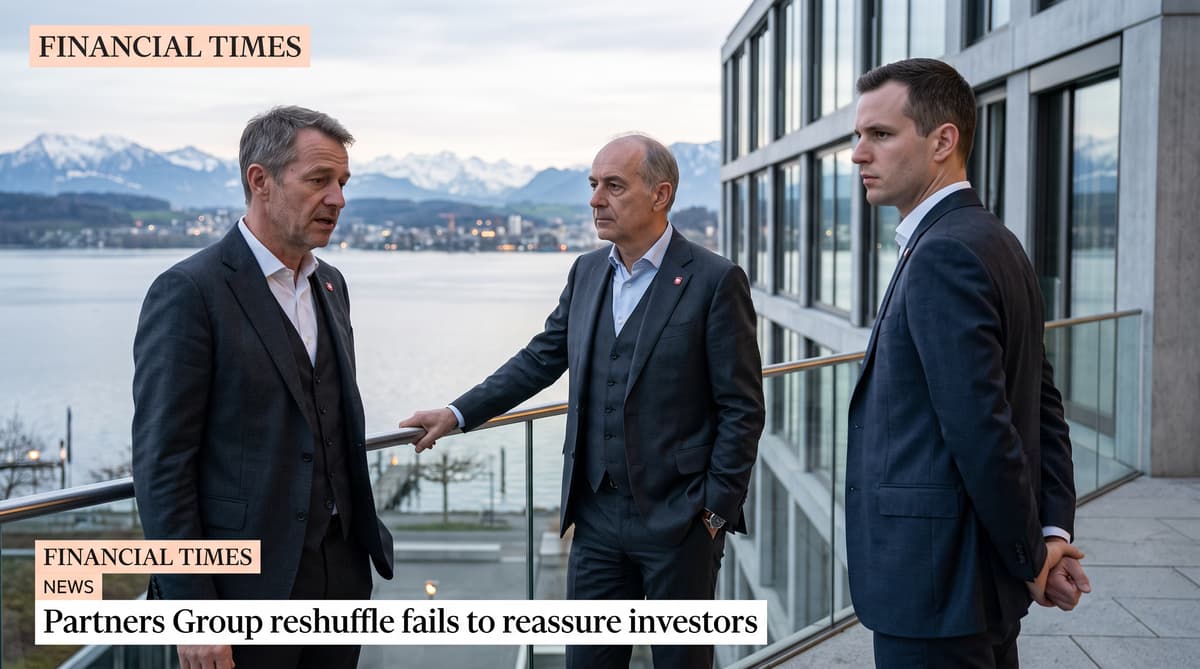
Partners Group shares fell as much as 8.6% on September 1, extending the 2026 decline to almost 32%. The market reaction put a sharp price on investor disappointment after the Zug-based private markets firm announced two new co-chief executives and weaker first-half results.
Roberto Cagnati and Juri Jenkner, both long-serving executives who joined Partners Group in 2004, will take over the top operating role. David Layton, CEO for the past eight years, will become chief investment officer. The transition preserves seniority and institutional knowledge, but it offers investors limited evidence of a change in direction.
The timing makes the announcement especially consequential. Partners Group has faced withdrawals from evergreen funds, concerns about private-market valuations and a prolonged slide in its stock. Revenue fell 7% to CHF 1.12 billion in the six months to June. Profit declined 13% to CHF 502 million, missing the CHF 521 million consensus estimate cited by Citigroup analyst Nicholas Herman.
For a Swiss-listed asset manager that built its reputation on disciplined expansion, the reshuffle has landed as a test of credibility. Investors are being asked to accept continuity while waiting for evidence that earnings and fund flows can stabilise.
Fee Warning Deepens the Earnings Problem
Performance income fell 39%, forcing Partners Group to lower its 2026 forecast. The firm now expects performance income to contribute roughly 20% to 25% of total revenue, compared with its earlier range of 25% to 40%.
The company attributed the decline to several sizeable exits that were accelerated to capture market momentum. That explanation points to timing, but it does not remove the pressure on near-term earnings. Performance fees can vary substantially depending on when investments are sold and how markets value private assets. The revised range gives investors less visibility over a revenue stream that has been central to the firm's profitability.
Citigroup analyst Nicholas Herman said investors would respond cautiously to both the management announcement and results below consensus. Partners Group said the updated outlook depends on the timing of selected active direct exit processes, leaving the second half exposed to transaction conditions.
The firm's base business still produced substantial scale. Clients added CHF 16 billion in new commitments during the first half, lifting assets under management to CHF 186 billion. That fundraising result supports the broader franchise, yet the earnings mix remains vulnerable when exits slow or fee-generating realisations move into a later period.
Evergreen Funds Put the Model Under the Microscope
Evergreen funds account for about 30% of Partners Group's assets, making them the focal point of the firm's current troubles. The products give investors access to private markets while allowing withdrawals at periodic intervals. They also expose the manager to redemption pressure when confidence weakens or liquidity becomes a concern.
Partners Group pioneered evergreen funds in the early 2000s and had approximately CHF 56 billion in such products at the end of 2025. Earlier this year, a wave of redemption requests hit the funds. The company is now considering reducing their overall size for wealthy investors, while keeping its investment approach broadly unchanged.
The challenges reflect a wider loss of confidence in private markets. Investors have questioned valuation methods, exit prospects and the pace at which private assets can be sold. Partners Group's model depends on maintaining trust across these issues, particularly as it expands beyond traditional institutional clients.
Layton acknowledged that the firm had been too concentrated in certain segments and said it was working on diversification. That admission gives the new leadership team a clear operational task. Cagnati, who was recently head of portfolio solutions and chief risk officer, brings direct experience of product and risk management to the transition.