trade
Swiss exporters poised for major tariff breakthrough in China
Switzerland and China have concluded negotiations on a revised trade agreement that would eventually remove tariffs on 99.8% of current Swiss exports to China, creating a significant opportunity for Swiss exporters.
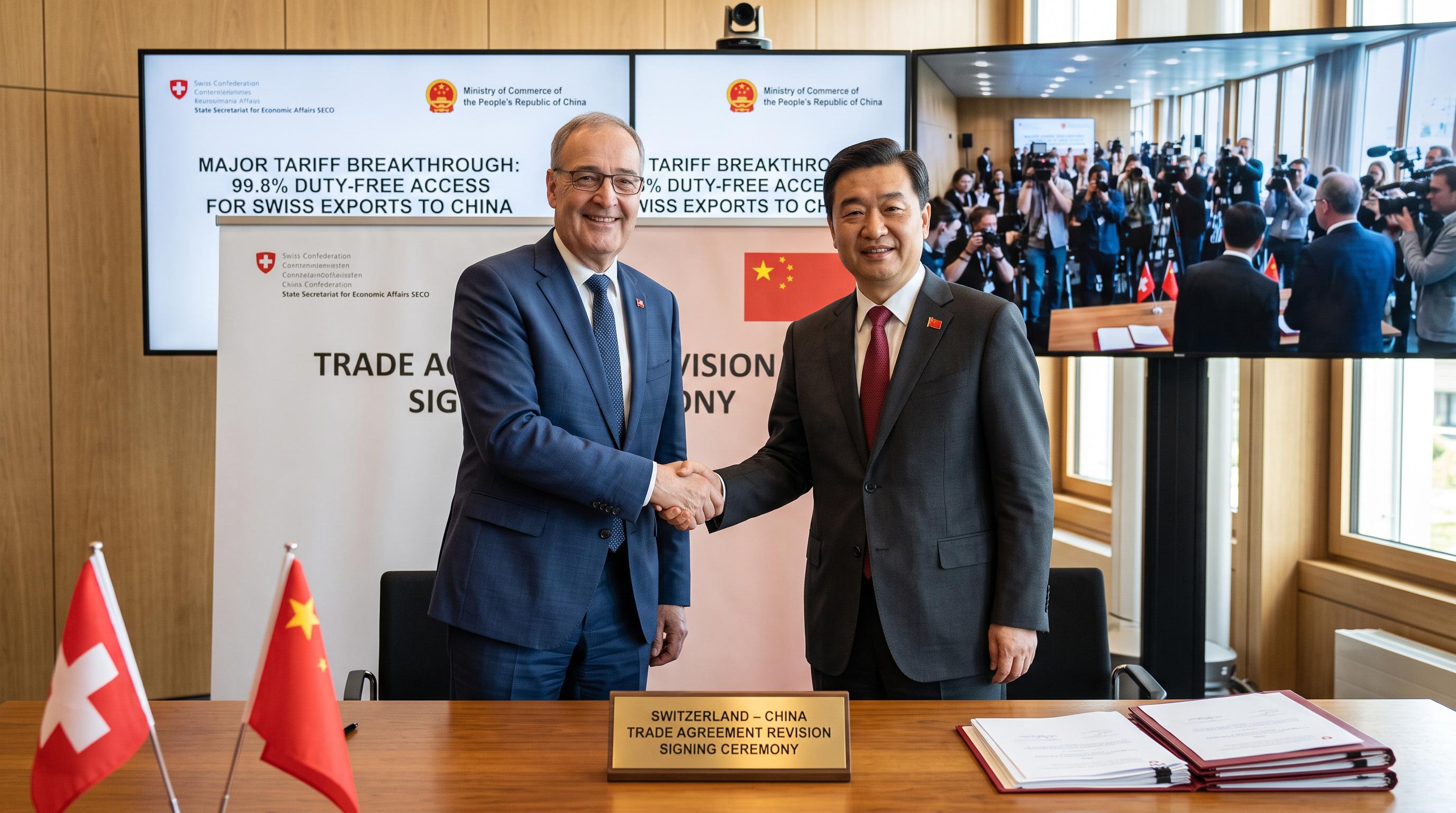
Bern Seals a Wider Route Into China
99.8% of current Swiss exports to China would eventually qualify for duty free access under a revised trade agreement concluded by Bern and Beijing. Guy Parmelin, Switzerland’s economy minister, and Wang Wentao, China’s commerce minister, announced the conclusion of negotiations in Bern on Thursday, marking the biggest tariff expansion since the original agreement entered into force in 2014.
The Swiss government estimates that the deal could reduce customs costs for Swiss exporters by around CHF 244 million a year. Roughly three quarters of the new exemptions would apply as soon as the agreement takes effect. The countries expect to sign the final agreement formally this year, subject to approval by the Swiss Parliament.
The package gives Swiss companies a wider route into China’s large consumer and industrial market at a time when American tariffs and geopolitical uncertainty are altering global trade flows. It also updates a deal that left major gaps for important Swiss products.
For exporters in watchmaking, pharmaceuticals, food production and specialty manufacturing, the expected change is practical. Lower border costs can improve margins, reduce prices for Chinese buyers or support investment in distribution and service networks. The agreement’s benefits will arrive at different speeds, however, with some sensitive products facing long transition periods.
The Deal Closes Long Standing Gaps
The current agreement leaves 46.2% of Swiss goods exports outside duty free treatment, while the revised text would close almost all of that gap. Switzerland became the first European country to conclude a free trade agreement with China, and the accord has helped deepen economic ties with Switzerland’s third largest trading partner since 2014.
Its tariff coverage, however, remained uneven. Only 53.8% of Swiss goods exports currently enter China without customs duties. Switzerland has already removed tariffs on imports of industrial goods from China, creating an imbalance that Swiss negotiators sought to address during two years of talks.
Swiss watches received limited tariff concessions under the existing framework. Pharmaceutical products benefited only partially, while cheese and coffee continued to face barriers. The revised agreement extends concessions across those categories, potentially giving companies in several Swiss regions more predictable access to Chinese customers.
The value of the change will depend on how firms use it. Large exporters may pass savings through supply chains or expand local sales operations. Smaller producers, particularly in food and luxury goods, could gain from lower landed costs but will still face Chinese regulations, certification requirements and competition from established domestic and international suppliers. Tariff relief opens the door. It does not remove the commercial work behind it.
Sensitive Products Follow a Slower Clock
Swiss cheese will have to wait as long as ten years for some tariff reductions to be fully implemented. The agreement extends concessions to cheese, coffee, watches and pharmaceutical products, but the timetable will vary by product and tariff line.
The long phase in for cheese reflects the sensitivity of agricultural trade. Swiss dairy producers operate under higher domestic costs and strict quality standards, while China protects parts of its food market. A gradual reduction gives producers, importers and retailers time to adjust contracts, volumes and pricing.
Coffee and dairy products also carry a distinct Swiss identity in China, where origin, quality and premium positioning can influence purchasing decisions. Lower tariffs could make those products more competitive, although transport costs, refrigeration, distribution and local demand will continue to shape final prices.
Watchmakers and pharmaceutical companies face different conditions. Their exports depend less on agricultural quotas and more on regulatory approval, intellectual property protection, after sales service and consumer confidence. The revised agreement may improve the cost base, but companies will still need to navigate China’s market rules.
The Swiss government’s estimate of CHF 244 million in annual savings covers the export economy broadly. Individual benefits will depend on the speed of implementation and each company’s product mix. For cheese in particular, the commercial payoff will build over time rather than arrive on the first day.
Bern Links Market Access to New Standards
The revised agreement adds labour and environmental commitments that Switzerland says go beyond the tariff schedule. Bern sought stronger language on forced labour, fundamental labour rights and environmental protection during the negotiations with Beijing.
According to the Swiss economics ministry, the two countries agreed to implement conventions of the International Labour Organisation and uphold fundamental labour rights. Switzerland says this is the first time China has accepted provisions of this kind in one of its free trade agreements. The text will place the commitments inside the broader framework governing bilateral commerce.
The environmental chapter covers the transition to cleaner energy and the circular economy. The Swiss government described it as one of the most ambitious environmental chapters included by either Switzerland or China in a trade agreement.
Those provisions will attract scrutiny in Parliament. Earlier committee discussions were broadly favourable, but labour rights and environmental safeguards remained contentious. Lawmakers will need to assess how the commitments are worded, how compliance would be monitored and what remedies would be available if concerns arise.
The agreement therefore combines immediate commercial measures with obligations that may shape future trade policy. Swiss exporters gain improved access, while the government must demonstrate that the new standards have practical force. Parliamentary approval will determine whether the negotiated package moves from Bern’s announcement to Swiss law and business practice.
Parliament Holds the Final Lever
Parliament holds the next decision, and the agreement cannot take effect until Swiss lawmakers approve it. The final text is expected to be signed this year after Guy Parmelin and Wang Wentao signed a memorandum of understanding in Bern on Thursday.
The timing places Switzerland’s China policy within a wider trade realignment. The United States has imposed new tariff pressures, supply chains remain exposed to geopolitical shocks and major economies are competing to present themselves as reliable commercial partners. China has recently promoted itself as a supporter of multilateral trade, including at the World Economic Forum in Davos earlier this year.
Switzerland has long relied on open markets and rules based commerce. China’s position as its third largest trading partner makes the relationship economically important, while the agreement’s labour and environmental chapters give Parliament additional grounds for debate. Committee discussions have been broadly positive, but support is not unconditional.
If approved, the revised agreement would give Swiss exporters a clearer tariff advantage than they currently enjoy. Companies would still face exchange rate movements, Chinese regulation and changing demand. The first gains would come from the exemptions introduced at entry into force, while cheese and other sensitive products would follow their agreed schedules. For Swiss industry, the next milestone is parliamentary approval, followed by the work of turning tariff access into sales.