Switzerland
Young Swiss women still earn less despite education gains
The income gap between young Swiss women and men has narrowed substantially across generations, but women born in 1995 still earned 14% less than men. Researchers also found that differences in working hours and labour-force participation have declined.
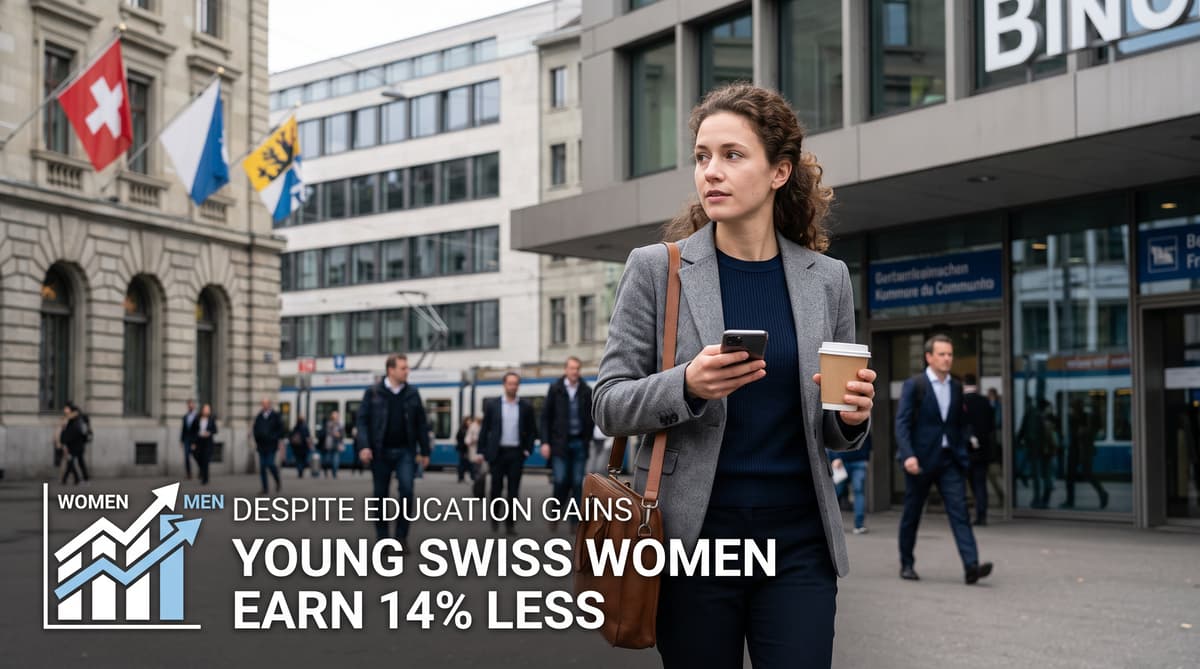
Women born in 1995 still earned 14% less than men, even after a generation of gains in education and employment. The figure comes from a study by the University of Lausanne and the Fors Centre of Excellence in Social Sciences, published in Social Change in Switzerland and reported on October 13, 2026.
Daniel Oesch and Oliver Lipps examined data on more than 215,000 people aged 25 to 34 from Swiss Labour Force Surveys conducted between 1991 and 2024. Their findings show a substantial reduction in the gap across generations, while confirming that equal qualifications have not produced equal incomes.
For women born in 1965, total earned income was 55% lower than men’s income at the same stage of life. The corresponding gap for the 1995 cohort was 14%. The researchers describe that progression as a “catch-up”.
The shift also reflects changes in employment patterns. Differences in labour-force participation and weekly working hours have narrowed, and women have moved into occupations with greater earning potential. Switzerland’s younger women now hold a clear educational advantage, yet income parity remains out of reach during the years when careers and family decisions often begin to intersect.
Education Changes the Starting Line
Women held a 54% to 48% advantage in tertiary qualifications in 2025. The figures cover university degrees, qualifications from universities of applied sciences and higher vocational education. Young Swiss women have moved ahead in formal education, changing the profile of the workforce entering professional and technical jobs.
The study also found that women are increasingly choosing occupations with higher earning potential. That shift helps explain why the income gap among younger cohorts is far smaller than it was for their parents’ generation. It also puts Switzerland in a stronger position in international comparisons.
Among the cohorts examined in France, Sweden, Britain and the United States, Switzerland’s 1995 cohort recorded the smallest income gap. The result places the country near the front of a broader shift in women’s labour-market participation and educational attainment.
Education alone, however, does not determine total earned income. The researchers compared income over the course of working life at a defined age range, rather than looking only at hourly pay. Career progression, the number of hours worked and time spent outside paid employment all shape that measure. The gains in qualifications have therefore narrowed the gap without removing the structural differences that still affect earnings.
Hours and Wages Move Closer
The difference in weekly working hours fell from 17 hours to less than four. The change marks one of the clearest signs of convergence between women and men in the Swiss labour market. The gap in standardised hourly wages also declined, from almost 20% to less than 5%.
These figures matter because total income reflects more than the wage attached to one hour of work. A person working fewer hours, taking a longer break from employment or remaining outside the labour force accumulates less income even when hourly pay is similar. The study shows that these differences have diminished substantially for younger generations.
Switzerland has also faced international scrutiny over unexplained wage differences. A 2024 Swissinfo report noted the country’s efforts to address the issue. The new study adds a longer historical view, showing how employment behaviour and education have changed together since the cohorts born in the 1960s entered adulthood.
The remaining 14% gap among women born in 1995 cannot be explained by a single indicator in the study. It reflects the combined effect of occupation, working time, labour-force participation and family formation. The narrowing trend is clear, but progress has been uneven across different groups of women.
Parenthood Reopens the Divide
Parenthood remains the sharpest dividing line in the data. Among childless women, the income gap narrowed from 27% for the 1965 cohort to 7% for the 1995 cohort. Among parents, the gap also declined, but it remained 51% for the younger cohort.
The comparison shows how quickly earnings trajectories diverge after family formation. It does not attribute the difference to one cause, and the study does not present parenthood as a single employment experience. Families make decisions about working hours, childcare and career breaks within Switzerland’s labour-market and household systems. Those decisions affect cumulative income over time.
The figures also explain why an overall 14% gap can coexist with strong progress among childless women. The average combines groups with very different working patterns and family responsibilities. Women can enter adulthood with higher qualifications, move into better-paid occupations and work hours closer to men’s, yet still see their income fall behind after becoming parents.
For Switzerland, the next stage of the trend will depend on whether the gains seen before parenthood continue after it. The 1995 cohort offers evidence of major progress. Its experience also shows where the largest difference in income remains.
Track Progress Beyond Early Careers
The youngest cohort studied has the smallest comparative gap, yet it has not reached equality. That result gives Switzerland a mixed but measurable outlook. Young women now exceed young men in tertiary qualifications, work closer to men’s weekly hours and face a standardised hourly wage gap of less than 5%. Their total earned income still trails men’s by 14%.
The University of Lausanne and Fors Centre findings suggest that education and labour-market participation can shift the direction of inequality over decades. They also show the limits of progress when career paths separate after parenthood. The gap among parents in the 1995 cohort remains far larger than the gap among childless women.
The study covers people aged 25 to 34, so it captures an important period without describing an entire working life. Later promotions, additional children, career changes and retirement outcomes could widen or narrow the differences that researchers observed at this age.
For policymakers, employers and households, the figures identify the pressure point clearly: the transition from education and early employment into family life. Switzerland has moved from a 55% gap for the 1965 cohort to 14% for the 1995 cohort. Whether the next generation closes the remaining distance will depend heavily on what happens after young women become parents.