pensions
Swiss voters face VAT decision over 13th pension payment
Voters will decide on November 29 whether to raise VAT by 0. 4 percentage points to help fund Switzerland’s new 13th annual OASI pension payment. The extra pension will be paid from December 2026 regardless, but its long-term financing remains unresolved if the proposal fails.
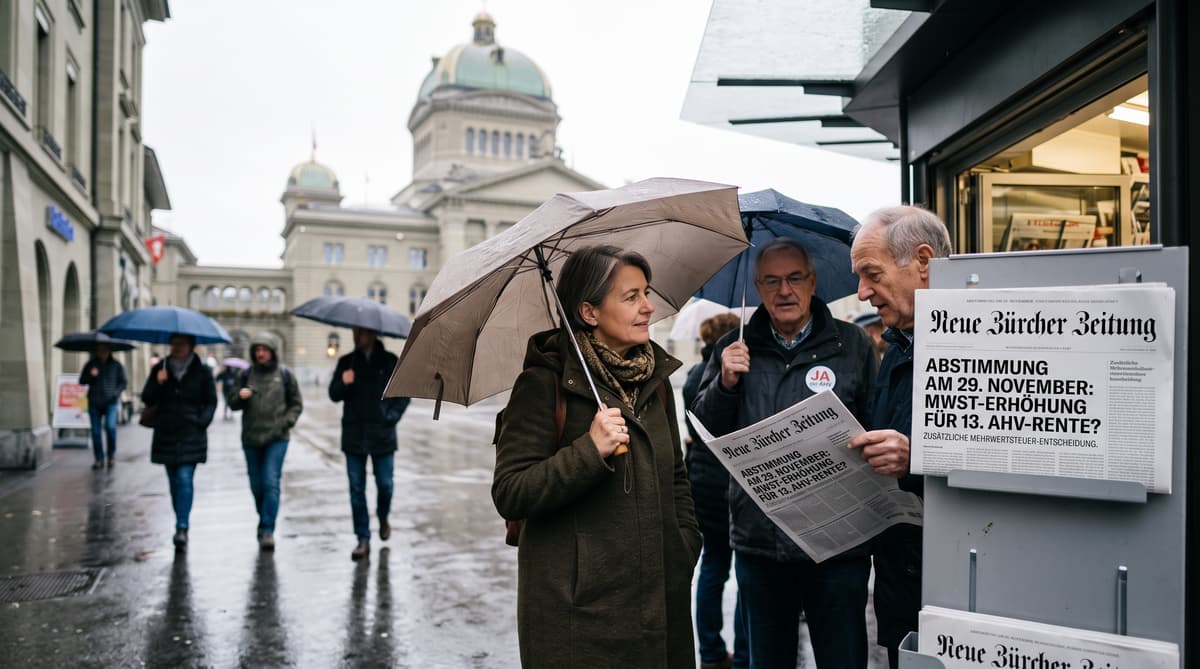
Around 2.5 million OASI recipients will receive an extra payment in December 2026, whatever voters decide on November 29. The referendum concerns the bill that follows: how Switzerland will finance a new annual pension payment approved by the electorate in March 2024.
The 13th payment will add about CHF 4.2 billion a year to the cost of the Old Age and Survivors’ Insurance system. Parliament’s proposal would provide roughly CHF 1.4 billion of that amount through a VAT increase starting in 2028. The standard rate would rise from 8.1% to 8.5%, while the hotel rate would move from 3.8% to 4%.
The reduced rate on basic goods, including food, medicines and books, would stay at 2.6%. Health insurance premiums would remain outside the VAT system. Social affairs minister Elisabeth Baume-Schneider has presented that design as a compromise that limits the burden on essential household spending.
The payment itself reflects the result of a nationwide vote in which 58.2% of voters backed the pension increase. The financing vote now places the cost of that decision directly on the ballot, with consequences for retirees, workers, consumers and businesses.
Track the OASI numbers
The proposed VAT increase would narrow the projected 2035 OASI deficit from almost CHF 5 billion to around CHF 3 billion. Government estimates show that the tax would improve the system’s position, though it would not finance the full annual cost of the 13th payment.
The pressure comes from the structure of Swiss pensions. OASI operates largely on a pay-as-you-go basis, meaning current contributions help pay current retirees. Employees and employers provide about 70% of OASI revenue. The federal government covers just over 20% of expenditure through general funds and selected taxes, while VAT and casino tax contribute about 9% of revenue.
The system ended 2025 with a CHF 4.4 billion surplus, supported partly by earlier financing measures. That result does not remove the longer-term challenge. The number of retirees is increasing, and pension payments are regularly adjusted to living costs. The annual cost of the 13th payment is expected to pass CHF 5 billion from 2035.
Baume-Schneider warned that reserves could fall below the statutory minimum of one year’s expenditure in 2027 if no new revenue arrives. By 2035, reserves would cover an estimated 50% of annual spending without the tax increase, compared with 70% if it passes.
Measure the household cost
The tax proposal shields the reduced VAT rate, while ordinary purchases would carry the higher charge. For consumers, the standard rate would increase by 0.4 percentage points. The change applies to most goods and services, including spending by households and operating costs faced by companies.
The government says leaving the reduced rate at 2.6% will protect consumption of essentials such as food, medicines and books. Hotels would face a separate increase from 3.8% to 4%. The measure would send all additional revenue to social security, according to Baume-Schneider.
Opponents argue that the increase would still weaken purchasing power and raise costs for small and medium-sized businesses. The Free Democratic Party, known as PLR or FDP, launched its campaign against the proposal in late September. It supports spending cuts and structural reforms, including a possible rise in the retirement age.
The tax would not settle every financing issue. Parliament’s VAT plan covers only part of the 13th payment, and the government has included further funding options in its OASI 2030 consultation. Those options could involve another VAT increase, higher social security contributions, or a combination of both. The November vote therefore sets a funding direction, rather than closing the pension debate.
Watch the minister defend her position
The November vote exposes a political reversal for Elisabeth Baume-Schneider. Before entering the Federal Council, the Social Democratic politician supported her party’s campaign for a 13th annual state pension. As the minister responsible for pensions, she later opposed the measure because of its cost. She now defends both the payment and the tax plan intended to fund part of it.
Baume-Schneider told reporters in Bern that rejecting the proposal would create serious consequences for OASI finances. She has described Parliament’s package as moderate and socially acceptable, pointing to the unchanged reduced VAT rate and the direct allocation of new revenue to social security.
Her opponents say voters approved a benefit without a credible funding plan. PLR and FDP campaigners have called for spending restraint and reforms that would address the system’s structure, including the retirement age. Any retirement age change would require approval by Parliament and voters, making it a longer political process than a tax decision.
The minister has argued that OASI needs new money immediately. The referendum will test whether voters accept a broad consumption tax as the first answer to the pension system’s growing bill.
Prepare for the next pension fight
A rejection would leave the 13th payment in place while sending Parliament back to the financing table. Retirees would still receive the first extra payment in December 2026, with a maximum annual increase of CHF 2,520 for a single pensioner and CHF 3,780 for a married couple, according to SWI swissinfo.ch.
The immediate benefit would therefore survive the referendum. The unresolved issue would be how to cover its rising cost as the retiree population grows and annual payments increase. Without the proposed VAT revenue, the Federal Council expects OASI reserves to deteriorate more quickly and the deficit to widen by 2035.
Approval would provide a recurring revenue stream, but it would leave a projected gap of around CHF 3 billion in 2035. Further measures would still be required through the OASI 2030 reform process. A rejection would force the government and Parliament to seek an alternative under greater financial pressure.
Swiss voters will be choosing between a defined tax contribution and an open financing process. The outcome will shape the next phase of the pension debate, including arguments over consumption taxes, payroll contributions, federal spending and the retirement age.