Switzerland
Switzerland launches its first public robotaxi service
Switzerland’s first publicly available robotaxi service has begun operating in Zurich’s Furttal valley. Three electric autonomous cars are serving around 100 designated stops across four municipalities in a pilot project.
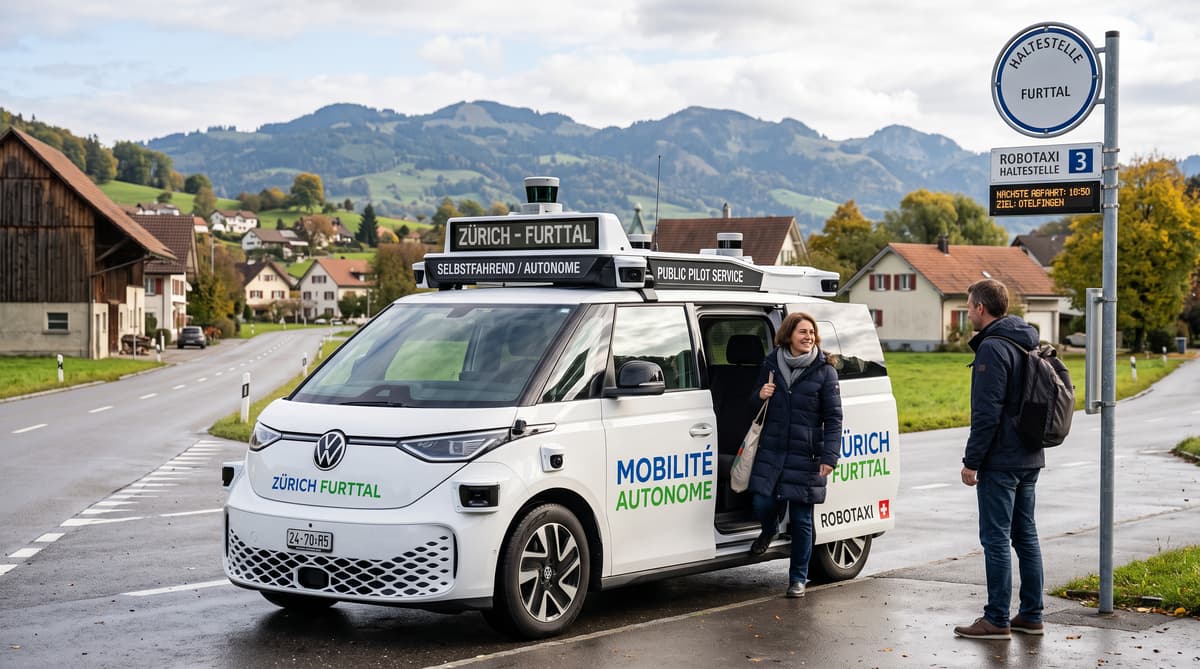
Three electric cars are now carrying paying passengers through Zurich’s Furttal valley, marking Switzerland’s first robotaxi service open to the public. The Iamo pilot links around 100 designated stops in Boppelsen, Dänikon, Hüttikon and Otelfingen, four municipalities north of Zurich.
Book a Ride, Follow the Stops
Passengers book through the Iamo app, whose name means “intelligent automated mobility”. The app is available through Apple’s App Store and Google Play. After registering, a user selects a journey and travels from one of the designated stops rather than requesting a vehicle at any roadside location.
The cars currently carry up to three passengers each and run daily from 1pm to 5pm. That limited timetable gives the project a controlled operating environment while organisers gather experience with real passengers, local roads and connections to existing transport.
Swiss Transit Lab runs the project with the cantons of Zurich and Aargau and Swiss Federal Railways. Pascal Kern, head of Zurich’s Office for Mobility, says the authorities want to introduce the technology gradually. The approach reflects the pilot’s current role: this is a public service, but it remains a tightly defined test with a fixed service window, mapped stops and human oversight.
Users also need to account for a key restriction. Iamo is not part of Switzerland’s public transport fare system, so GA and Half Fare travelcards cannot be used. The app booking process and separate pricing keep the experiment distinct from regular rail and bus journeys.
Test the Fare, Link the Valley
A 10 kilometre Iamo journey costs about CHF 8.50, compared with roughly CHF 44 in a conventional Zurich taxi. The pilot charges a basic fare of CHF 4.70, followed by CHF 0.38 per kilometre. That price could make short connections more accessible in communities where regular taxi travel is expensive.
The Furttal location was chosen partly because organisers see a potential role for autonomous transport in less densely populated areas. The valley already has a suburban railway line, allowing the project to examine whether robotaxis can connect residents with conventional public transport. A car that links a village stop to a railway station could address the first or last part of a journey without requiring a full-size bus on every route.
The fare comparison comes with practical limits. The service only runs in four municipalities and during a four-hour daily window. Iamo also sits outside the public transport tariff system. Holders of Swiss GA and Half Fare travelcards must pay the separate robotaxi fare.
Those boundaries make the pilot easier to measure. Operators can track demand, booking patterns and connections with rail before deciding whether the model can work across a broader rural or suburban network.
Keep a Human in the Loop
The cars are not yet operating without a person ready to intervene. A safety driver remains behind the wheel during trips in ordinary traffic, and the front passenger seat is kept empty. That arrangement gives the project a human safeguard while the technology operates on public roads with paying passengers.
The trial followed preparatory work that began in summer 2025, when the project team produced a detailed map of the operating area. In November 2025, Switzerland’s Federal Roads Office, known as Astra, authorised automated driving for the trial. The tests that followed were largely uneventful, according to the project information.
Swiss regulators have taken a cautious route into automated passenger transport. China and the United States already have fully driverless taxis carrying paying passengers in some cities. Apollo Go and Waymo have built larger commercial operations, with substantial fleets and millions of rides. Their progress gives Swiss operators a reference point, while the Furttal pilot must still demonstrate how automated vehicles perform within Switzerland’s regulatory and transport environment.
The current service therefore combines automation with supervision. Its public launch provides evidence from everyday journeys, while the safety driver remains a visible part of the system for passengers and other road users.
Prepare the Next Vehicle
The next step could be an automated minibus supervised from a distance. Swiss Transit Lab plans to move beyond the current cars and introduce minibuses that could operate without a safety driver inside. Trained staff would supervise those vehicles remotely, but the expansion would require another approval from Astra.
That proposal would test a different operating model. The present service places a trained person in every vehicle and limits the cars to three passengers. A remotely supervised minibus could carry more people and potentially serve a wider route, although it would also place greater demands on monitoring, intervention procedures and public confidence.
For Zurich and Aargau, the Furttal pilot offers a practical setting for that work. The four municipalities combine village roads, ordinary traffic and access to a suburban railway line. They also represent the type of lower-density area where a flexible service could complement fixed-route transport.
The project’s immediate task is to build a record of safe and useful journeys. Passenger demand, reliability, the relationship with rail and the response of other road users will shape the next regulatory decision. Switzerland’s first public robotaxi has begun on a small scale, with the larger question of automated regional transport still ahead.