Switzerland
Great St Bernard Tunnel to add solar panels covering half its energy needs
The Swiss section of the Great St Bernard Tunnel is to receive 1,000 solar panels, with the installation expected to generate about 450 megawatt-hours of electricity a year. The project is intended to cover roughly half of the tunnel’s energy needs.
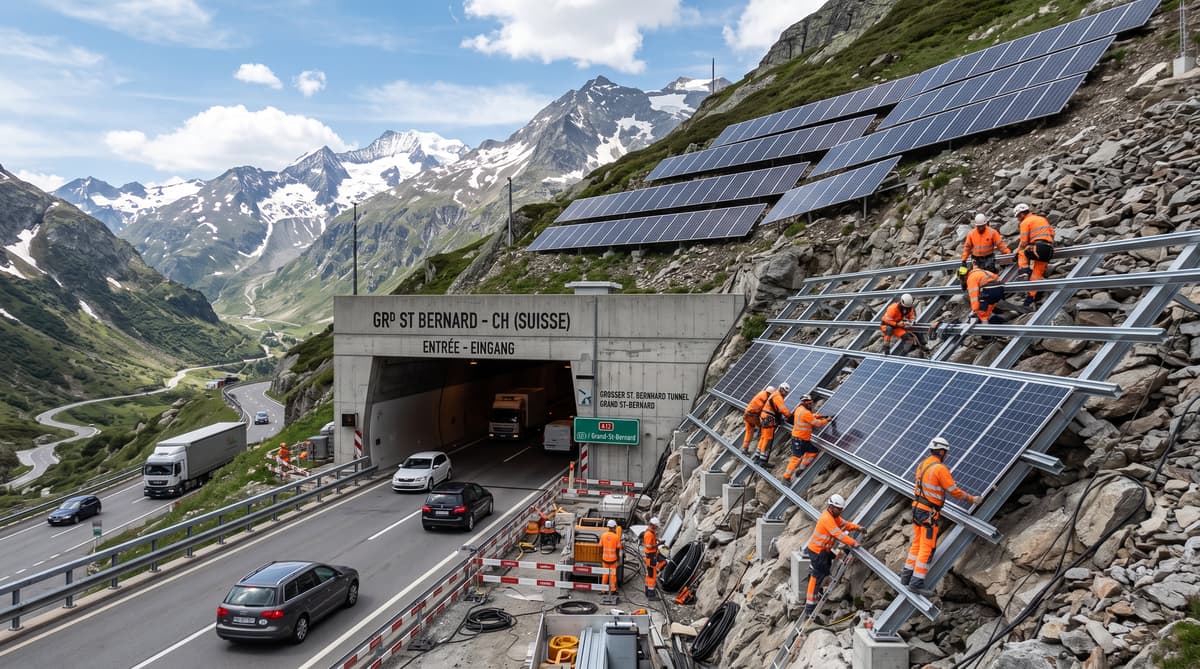
By the end of 2026, around 3,000 square metres of solar panels should be producing power beside the Great St Bernard Tunnel. Tunnel du Grand-St-Bernard SA is installing the panels on the Swiss approach road to the cross-border route in Valais, with the full project scheduled for completion during 2027.
The company plans to install 1,000 panels across 7,000 square metres. Once complete, the installation is expected to generate 450 megawatt-hours of electricity annually, covering roughly half of the tunnel’s energy requirements.
That demand comes from the systems that keep the infrastructure operating safely, including lighting, ventilation and electromechanical equipment. The tunnel company has already tested the concept in a trial phase that ran from 2022 to 2025.
The project adds locally generated electricity to a facility that operates in a demanding Alpine environment. Its panels will be tilted at 60 degrees, a design suited to the high mountain site. The first construction phase is now under way, giving the company an additional source of power as it manages the tunnel’s substantial year-round electricity consumption.
Build the System in Phases
The installation will reach 7,000 square metres in two stages, with the first 3,000 square metres targeted for operation by December 2026. The remaining 4,000 square metres are due to be completed over the course of 2027.
Tunnel du Grand-St-Bernard SA is carrying out the work with its own staff. The company puts the total cost at about CHF 2 million, making the project a direct investment by the tunnel operator rather than a utility-led development.
The panels will sit on the approach infrastructure on the Swiss side, where the company has suitable flat roof space. Their 60-degree tilt reflects the conditions at an altitude of about 1,900 metres, where snow, winter access and changing daylight patterns shape the design of any energy project.
Baptiste Cavin, the company’s maintenance and projects engineer, said the site’s existing roof area offered a practical opportunity. The phased schedule also allows the operator to bring part of the system online quickly while completing the larger installation. The planned annual output of 450 MWh will be used alongside the tunnel’s existing electricity sources.
Power Tunnel Systems Locally
Tunnel operations require a steady supply of electricity, even when traffic and weather conditions change. Lighting guides vehicles through the route, ventilation manages air quality, and electromechanical systems support the tunnel’s day-to-day operation.
Cavin described the planned solar farm as “a welcome winter supplement” to the company’s current generation. The wording reflects the role of the project within a broader energy system. Solar output will vary with weather and daylight, while the tunnel’s equipment must remain available whenever the route is open.
The operator already generates renewable power through a hydroelectric station inside the tunnel. That facility uses water from a small dam built on the road over the Great St Bernard Pass. The new solar installation will add another source without changing the tunnel’s core transport function.
The company estimates that the combined solar output will cover about 50% of the tunnel’s energy needs. The figure also shows why relatively small infrastructure sites can matter in local energy planning. A transport facility with existing roof and approach-road space can produce electricity close to where it is consumed, reducing the need to source all of its power elsewhere.
Put Alpine Sunshine to Work
The Great St Bernard area is regarded as well suited to solar generation because of the high cumulative sunshine recorded at elevation. The installation will be located near other Alpine energy projects, including Romande Energie’s floating solar park at Lac des Toules.
Tunnel du Grand-St-Bernard SA has stressed that its project is separate from that floating facility. The tunnel company is financing and executing its own installation, using its staff and its existing infrastructure. That distinction matters in a region where large solar developments have generated debate over landscape, land use and the best locations for new power capacity.
Switzerland has accelerated plans for Alpine solar parks to increase winter electricity production, but several projects have faced delays and local opposition. The tunnel installation follows a more contained model, placing panels on infrastructure already associated with transport operations.
For Valais, the project provides a modest but measurable addition to regional renewable generation. Its planned 450 MWh annual output will depend on mountain weather, maintenance and the performance of the panels through winter. The operator expects the system to be fully installed during 2027, extending the tunnel’s existing use of renewable energy.