privacy
Swiss cities debate bans on smart glasses at public pools
Swiss cities are debating whether to prohibit camera-equipped smart glasses in public swimming pools. Politicians in Wil, Lucerne and Basel say it is increasingly difficult to tell whether swimmers are being photographed, raising privacy and safeguarding concerns.
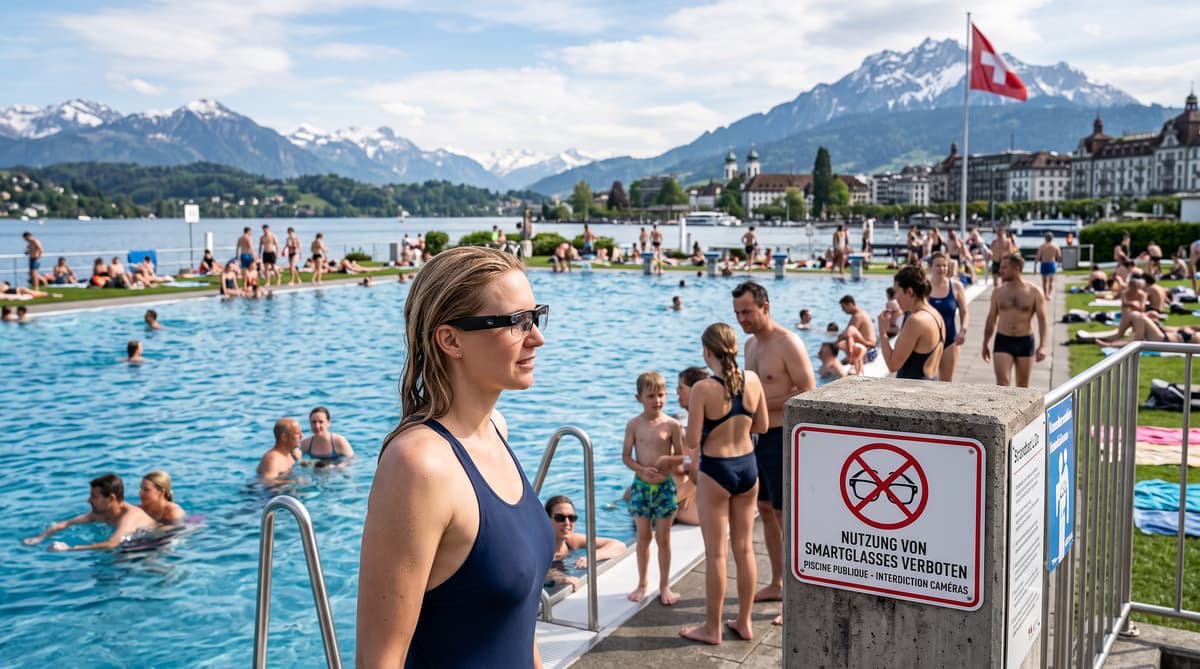
Three Swiss cities are now weighing pool bans as smart glasses become harder to identify. In Wil, in the canton of St Gallen, a motion is pending in the city parliament to prohibit the devices in public swimming pools. Politicians from all parties have signed it. Similar proposals are being pursued in Lucerne and Basel.
The concern centres on a simple change in public behaviour. A person holding a smartphone toward the pool is visible to other swimmers and staff. A person wearing camera equipped glasses may appear to be doing nothing more than watching the water. Some models can photograph, film and record conversations. They may also send files directly to a smartphone or cloud service.
That uncertainty has particular consequences in places where people undress, swim and move through crowded areas. Politicians and safeguarding advocates say women, teenagers and children could be exposed without knowing whether a lens is active. Outdoor pools present an added challenge because staff and visitors may have to monitor large, open spaces.
The debate was reported by Swiss public broadcaster SRF on August 24, 2026, and has already moved beyond individual pool rules. Swiss politicians are asking whether existing privacy expectations can keep pace with consumer technology.
Wil, Lucerne and Basel Weigh Local Bans
Wil's proposed ban has drawn support across the political spectrum. Meret Grob, a Green Party member of the city parliament and one of the motion's initial signatories, said technological development is moving faster than public awareness of its risks.
“I don't think people have really grasped yet that smart glasses can also be used for malicious purposes,” Grob told SRF. Her concern is not limited to whether a recording is later published. The difficulty begins earlier, when people nearby cannot establish whether they are being filmed at all.
The issue has also reached Lucerne's political debate. Cantonal parliamentarian Rahel Estermann said Switzerland should examine the role of smart glasses in society more broadly. Basel is considering similar restrictions, adding a third major urban centre to the discussion.
No Swiss case involving secret filming with smart glasses is known so far. That fact is shaping the debate in two ways. Authorities have no established pattern of incidents to measure, yet politicians are also aware that the technology is becoming less conspicuous. A local ban could give pool operators a clear basis to ask someone to remove the glasses, even when staff cannot prove that a recording is taking place.
German Cases Shape the Safeguarding Debate
Germany has already recorded the type of incident Swiss politicians fear. Several cases involving photographs of women in swimwear have made headlines there, with images posted on social media. Cologne responded by banning smart glasses in public swimming pools.
That example is influencing the Swiss discussion, although the legal and administrative response remains unsettled. A ban would have to be communicated clearly to visitors and applied by pool staff who may not be able to distinguish an ordinary pair of sunglasses from a device with cameras, microphones and wireless connectivity.
Michel Kunz, president of the Swiss Association of Lifeguards, supports a national prohibition. “The best solution would be a nationwide ban,” he told SRF. Kunz also acknowledged that enforcement would be difficult to complete. Even so, he said a nationwide rule would establish a basis for action when someone violates it.
The enforcement question is central for municipalities. Staff would need practical guidance, signs and a consistent procedure for complaints. They would also need to avoid treating every visitor wearing dark glasses as a suspect. The technology's appearance, rather than a confirmed recording, is driving the proposed restrictions, which raises questions about proportionality and how far pool rules should extend.
Switzerland Considers the Next Step
The federal debate is now following the municipal campaigns. Swiss politicians are calling for closer examination of the impact of smart glasses on data protection and privacy. Wil has not yet decided whether to introduce its proposed ban, and the positions in Lucerne and Basel remain under discussion.
The devices are likely to become more common in the coming years. That prospect gives local authorities a reason to consider rules before incidents become established, while critics of broad restrictions could point to the absence of known Swiss cases. The disagreement is therefore likely to focus on prevention, enforceability and the rights of visitors who use wearable technology for legitimate purposes.
For pool operators, the immediate challenge is practical. They must protect swimmers in spaces that are open, crowded and difficult to monitor, while applying rules that visitors can understand. A citywide policy could make enforcement more consistent than a patchwork of informal requests. A national policy could go further, but would require agreement on privacy standards and enforcement powers.
The Swiss discussion will probably extend beyond swimming pools. Smart glasses can operate in streets, public transport and other places where people cannot easily see a camera. The decisions taken in Wil, Lucerne and Basel may become an early test of how Swiss public institutions respond to wearable recording technology.