climate
Swiss Study Warns of Intensifying Alpine Summer Storms
Research shows extreme rainfall events in Alps could double in frequency with 2-degree temperature rise, raising flooding concerns
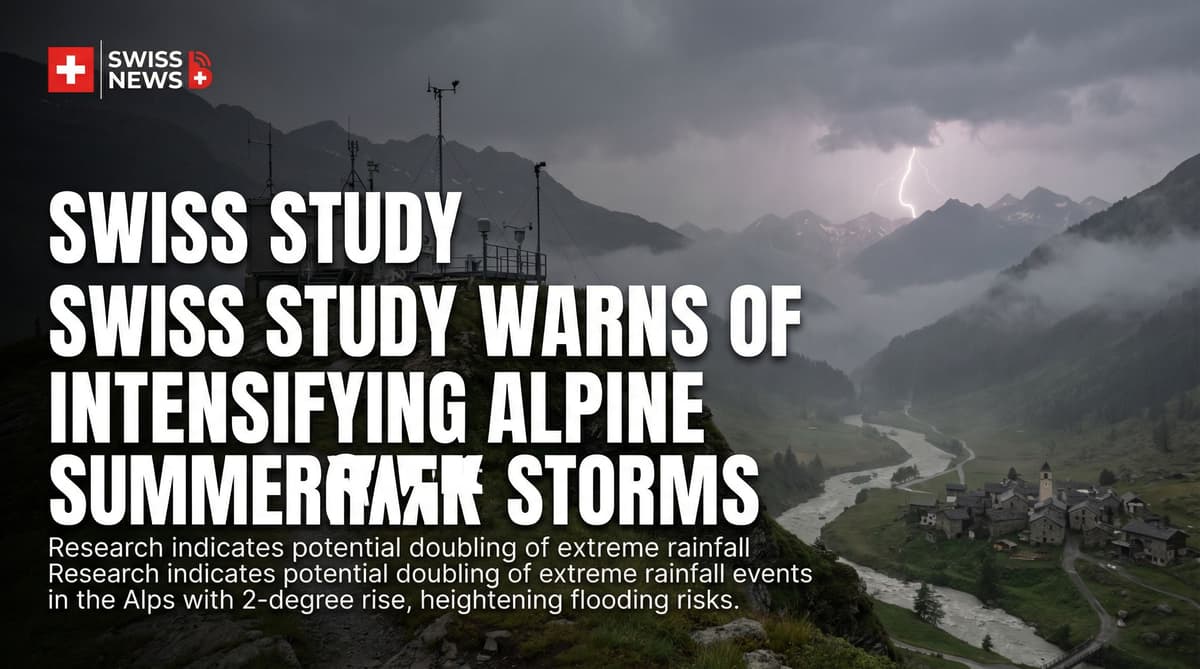
A staggering doubling of extreme rainfall events looms over the Swiss Alps, marking a critical turning point for the region's climate future. A groundbreaking study by a Swiss-Italian research team has delivered a stark warning: if global temperatures rise by just two degrees, the frequency of short, violent summer storms in the Alps will increase by 100%. This is not a distant projection but an imminent shift in the atmospheric reality of our mountains. The research, published in the prestigious journal npj Climate and Atmospheric Science, underscores that the serene Alpine summer is rapidly becoming a relic of the past.
The implications are immediate and severe. As the climate warms, the intensity of these events surges, threatening infrastructure and communities that were never built to withstand such frequent barrages. The University of Lausanne (Unil) and the University of Padua have shattered the illusion of stability, presenting evidence that demands urgent attention. We are no longer discussing theoretical risks; we are confronting a volatile new normal where the sky opens up with twice the ferocity we have historically known.
The 50-Year Storm Myth Collapses
What we once called a 'once-in-a-generation' storm is rapidly becoming a routine hazard. The statistical landscape of Alpine weather is being rewritten, with the study revealing that heavy rainfall events previously expected only once every 50 years will now strike every 25 years. This dramatic compression of risk timelines means that communities will have half the time to recover between major disasters. The safety margins that Swiss engineers and planners have relied upon for decades are evaporating.
This acceleration is relentless. By slashing the recurrence interval in half, the climate crisis is effectively doubling the stress on our flood defenses and emergency response systems. The researchers emphasize that this shift is not linear; it is an exponential ramp-up of danger. While policy debates often focus on long-term horizons, this data proves that the definition of 'extreme' is being recalibrated right now. The rare, catastrophic storms of the 20th century are transforming into the standard summer weather patterns of the 21st.
Thermodynamics of a Moisture Bomb
The physics driving this surge are as simple as they are devastating: heat is fuel. The reason for this alarming increase lies in the atmosphere's capacity to hold water; warm air stores significantly more moisture, turning the sky into a loaded weapon. When this moisture is released, it results in explosive thunderstorm activity. The researchers from Unil highlight that even a modest average temperature rise of one degree is problematic, acting as a catalyst for these high-energy events.
The Alps are in the crosshairs because this region is warming faster than the global average. This 'Alpine Amplification' means that Switzerland is experiencing the effects of climate change more acutely than lowland areas. The mountains are acting as a heat trap, accelerating the thermodynamic processes that generate violent storms. We are witnessing the creation of a moisture feedback loop, where rising heat leads to heavier rains, which in turn increases the risk of flash flooding and landslides across the cantons.