Mercosur
Swiss alliance launches referendum challenge to Mercosur trade deal
An alliance opposing Switzerland’s free-trade agreement with the Mercosur bloc has begun collecting signatures for a referendum. Opponents say the deal could encourage rainforest destruction, forced labour and pressure on Swiss agriculture; they have until January 21, 2027, to gather 50,000 valid signatures.
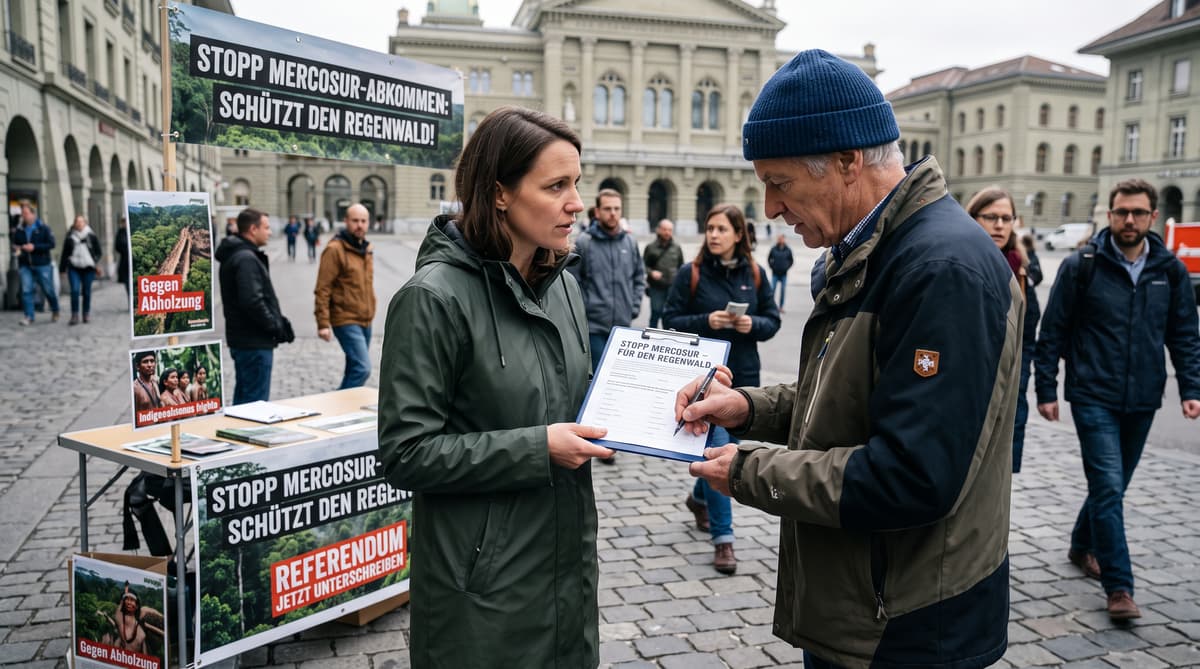
The referendum campaign has started with 50,000 signatures in its sights. Representatives of the alliance opposing Switzerland’s free-trade agreement with the Mercosur bloc appeared in Bern on Tuesday to launch the collection drive. They say the pact could deepen the environmental and social costs linked to South American industrial agriculture, while exposing Swiss farmers to greater competitive pressure.
The alliance must deliver 50,000 valid signatures by January 21, 2027 to the Federal Chancellery. If it reaches that threshold, the agreement will face a nationwide referendum process, adding a public vote to a trade debate already moving through federal institutions.
The timing gives campaigners a little over three months to build support across Switzerland. Their case combines rainforest protection, labour rights and agricultural policy, issues that often carry different constituencies in the country’s urban centres, rural regions and farming communities.
The agreement between EFTA, which includes Switzerland, and Mercosur was signed on September 16, 2026. The challenge now shifts the discussion from diplomatic negotiations and parliamentary approval to signature sheets, public meetings and the ballot box.
Put rainforest risks on the ballot
The alliance places rainforest loss at the centre of its argument. At the Bern media event, opponents warned that expanded trade could encourage production systems associated with deforestation in Mercosur countries. They specifically pointed to large-scale soya cultivation and intensive cattle farming, sectors repeatedly linked by environmental groups and researchers to pressure on rainforest regions.
The campaign’s claim rests on the agreement’s potential to create additional incentives for imports of food produced through those systems. The source material does not quantify expected changes in trade volumes or deforestation rates, and the alliance has not cited a forecast for the pact’s environmental impact. Its warning focuses on the direction of incentives and the difficulty of tracing risks through complex supply chains.
The debate also reaches beyond forest cover. The alliance says the expansion of industrial agriculture can displace long-established communities and notes recurring reports of forced labour on plantations. Those concerns give the referendum effort a wider scope than a dispute over tariffs. They connect the agreement to the conditions under which imported food is grown, harvested and brought to Swiss consumers.
Switzerland’s vote, if triggered, would therefore test how voters weigh trade access against environmental and labour safeguards.
Put Swiss farmers at the centre
Swiss agriculture faces a parallel challenge in the referendum campaign. Opponents argue that the agreement could increase imports of food produced at lower environmental and labour costs, placing additional pressure on domestic farmers. The alliance has presented the issue as a question of market conditions as well as sustainability.
The Council of States approved the Mercosur agreement on September 15, 2026, according to Swissinfo’s related report. It also allocated CHF 517 million to Swiss agriculture, a measure that signals the scale of political concern around the sector’s adjustment to changing trade conditions. The available source does not specify how that funding will be distributed or whether it is directly tied to the referendum campaign.
Swiss farming organisations and policymakers now face a debate that reaches into food standards, import competition and the future of production in a high-cost agricultural economy. The alliance will seek to turn those concerns into signatures, while supporters of the agreement can point to parliamentary backing and the financial support approved for agriculture.
The campaign’s effectiveness will depend on whether voters see those measures as adequate protection or as evidence that the trade deal carries costs requiring compensation.
Race the January deadline
The next deadline is administrative, but the political test will be national. The alliance must collect and submit 50,000 valid signatures before January 21, 2027. Invalid entries would not count, making verification and organisation as important as public visibility. The campaign has begun in Bern, but its success will depend on reaching voters across the country and sustaining attention through the winter.
A referendum would give Swiss citizens the opportunity to decide whether the EFTA Mercosur agreement should proceed. The vote would follow the agreement’s signature and parliamentary consideration, extending scrutiny of a pact negotiated over years. A related Swissinfo report described the EFTA Mercosur deal as the result of eight years of negotiations and noted that environmental protections were included in the talks.
That context will shape the coming campaign. Supporters are likely to emphasise improved market access and the negotiated safeguards. Opponents will focus on enforcement, supply chains, rainforest destruction, labour conditions and the effect on Swiss agriculture.
For now, the immediate measure of momentum is simple: how quickly the alliance can turn its Bern launch into valid signatures before the Federal Chancellery deadline.