Switzerland
Switzerland reaches tariff breakthrough in upgraded China trade deal
Switzerland and China have concluded negotiations on an upgraded trade agreement that would eventually remove tariffs on 99.8% of current Swiss exports to China. The article should explain the agreement’s timetable, likely beneficiaries and strategic trade-offs, including Switzerland’s effort to deepen economic ties with China while managing geopolitical and supply-chain risks.
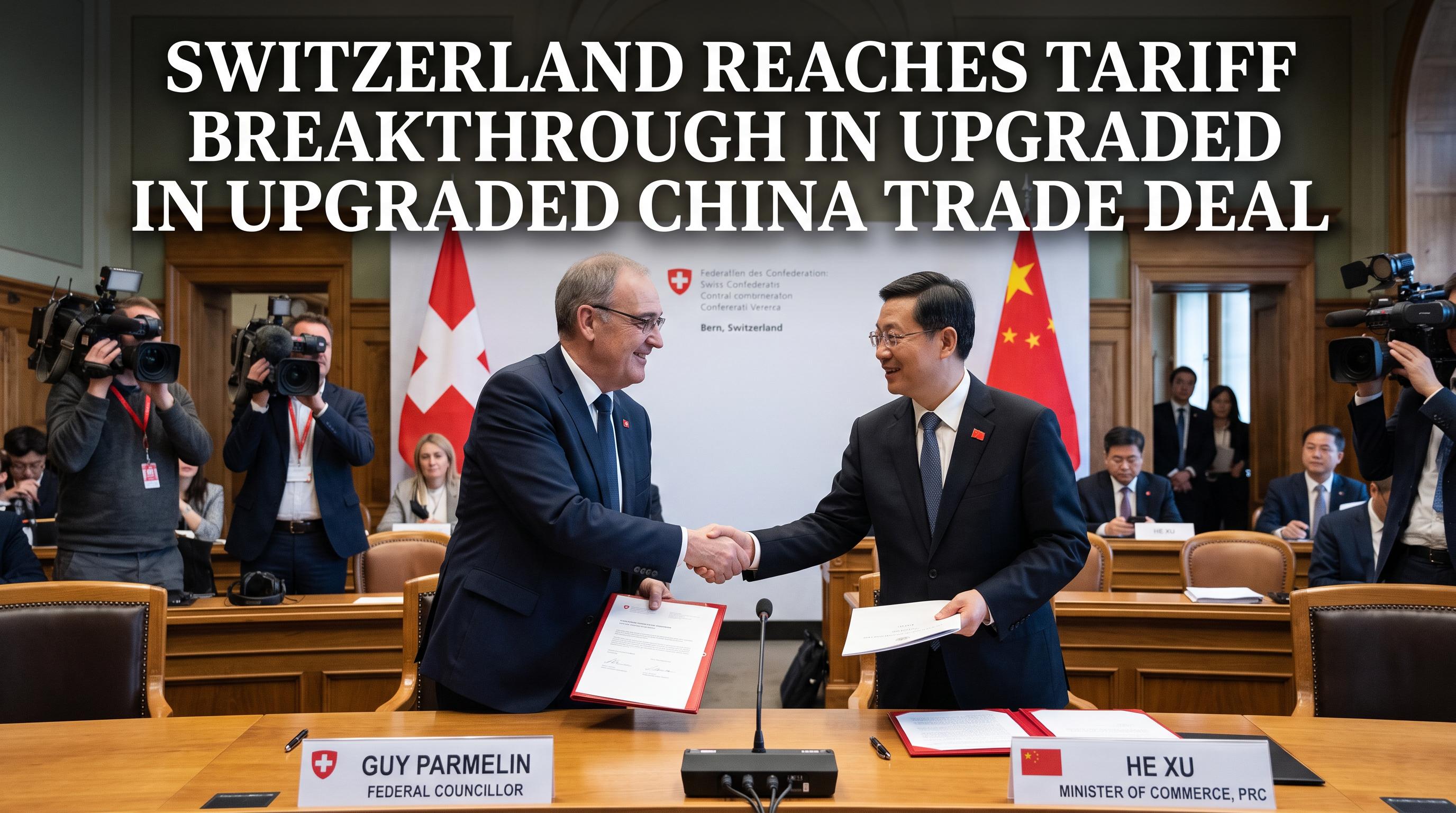
Bern Locks In a Tariff Breakthrough
99.8% of current Swiss exports to China would eventually become duty free, giving Bern a major commercial result after two years of negotiations. Economy Minister Guy Parmelin and China’s commerce minister, Wang Wentao, announced the conclusion of talks in Bern on Thursday and signed a memorandum of understanding.
The agreement is expected to be signed formally later this year. It will then require approval by the Swiss Parliament before it can enter into force. Around three quarters of the new tariff exemptions would take effect immediately once implementation begins, according to the Swiss government.
The figures mark a substantial expansion from the existing arrangement. Switzerland became the first European country to conclude a free trade agreement with China, which has applied since 2014. That pact helped deepen commercial ties with Switzerland’s third largest trading partner, but it left many Swiss products facing duties.
Bern estimates that the upgraded terms could reduce Swiss exporters’ costs by about CHF 244 million annually. The agreement arrives as American tariffs and wider geopolitical uncertainty pressure governments and companies to reassess trade routes, market access and economic dependence.
Watchmakers and Food Producers Eye Relief
Swiss watches, pharmaceuticals, cheese and coffee stand among the clearest potential beneficiaries, although the gains will arrive at different speeds. Swiss watches have received few tariff exemptions under the current deal, while pharmaceutical products have secured only partial relief. The revised agreement extends concessions to both sectors.
For watchmakers, lower border costs could improve pricing flexibility in a highly competitive Chinese market. Pharmaceutical companies would gain broader access for products that have so far faced incomplete tariff treatment. Food producers could also see improved conditions, particularly in cheese and coffee exports.
The agreement sets a longer timetable for sensitive agricultural products. Some cheese tariff reductions will be phased in over as long as 10 years, reflecting the political and commercial care surrounding food markets. That schedule limits the immediate effect for dairies and specialty producers, even as it gives them a clearer route to expanded access.
The tariff changes will not remove every obstacle facing exporters. Companies will still need to manage Chinese regulations, certification requirements, distribution networks and demand conditions. The financial benefit estimated by Bern will therefore vary by product, firm and speed of implementation.
Bern Adds Labour and Environmental Guardrails
Labour rights and environmental rules became part of the bargain, adding political weight to an agreement negotiated primarily to lower tariffs. Switzerland sought stronger provisions on forced labour and environmental protection during the talks.
The economics ministry said China agreed to implement International Labour Organization conventions and uphold fundamental labour rights. Bern described this as the first time China has accepted such provisions in one of its free trade agreements. The claim gives the revised pact importance beyond its customs schedules, although the practical value will depend on enforcement and monitoring after ratification.
The environmental chapter covers the transition to cleaner energy and the circular economy. Switzerland called it one of the most ambitious environmental chapters included by either country in a trade agreement. Those commitments could matter to Swiss companies that face growing pressure to document labour conditions, emissions and resource use across international supply chains.
The provisions also create a point of debate in Parliament. Earlier committee discussions were broadly favourable, but labour safeguards and environmental protections remained contentious. Lawmakers must weigh the commercial gains against questions about implementation, transparency and Switzerland’s ability to hold its partner to agreed standards.
Parliament Holds the Final Say
Parliament now holds the decisive vote, and the agreement’s timetable depends on more than the announcement in Bern. Switzerland and China have concluded negotiations, but the pact must be formally signed this year and then submitted to the Swiss Parliament.
Committee discussions have been broadly positive, yet the debate has exposed the agreement’s central trade off. Swiss exporters want faster and wider access to China, while lawmakers and civil society groups have pressed for credible protections on labour and the environment. The final text will face scrutiny against those expectations.
The political setting is unusually fluid. American tariffs are reshaping trade patterns, and geopolitical tensions are pushing companies to examine exposure to individual markets and suppliers. China has sought to portray itself as a defender of multilateral trade, including at the World Economic Forum in Davos earlier this year. Switzerland’s decision places its own economic diplomacy within that wider contest.
For Bern, deeper commercial ties with Beijing offer measurable benefits, including the projected CHF 244 million in annual savings. They also require careful management of strategic risk. The agreement can widen market access without resolving every concern around supply chains, political dependence or the resilience of Swiss industry.
Exporters Prepare for the Long Implementation
The revised deal would complete a market opening that began in 2014, but its benefits will unfold gradually. Switzerland already removed tariffs on imports of Chinese industrial goods, while the existing agreement left a much larger share of Swiss exports subject to Chinese duties. The new terms narrow that imbalance for Swiss goods.
The immediate effect will be strongest for products covered when the agreement enters into force. Other sectors, particularly cheese, will follow staged schedules extending to 10 years. Exporters will need to plan investment, production and distribution around that timetable rather than expect a single overnight change.
The agreement also gives Swiss companies a clearer framework for operating in China at a time when global trade rules are under pressure. Watches, medicines, food products and other exporters may gain room to compete on price or reinvest savings in compliance and market development. Smaller firms could benefit if larger distributors pass on improved access and if regulatory procedures remain workable.
Switzerland’s strategy is therefore practical and measured: deepen ties with a major trading partner, secure tariff relief and attach labour and environmental commitments, while continuing to monitor geopolitical and supply chain risks. The next test moves from negotiation to ratification and implementation.