Politics
Swiss voters face four federal proposals in November ballot
Swiss voters are due to decide on four federal proposals on November 29, covering pension funding, fireworks restrictions, taxation of married couples and arms exports. The Federal Council has published its official voting explanations ahead of the ballot.
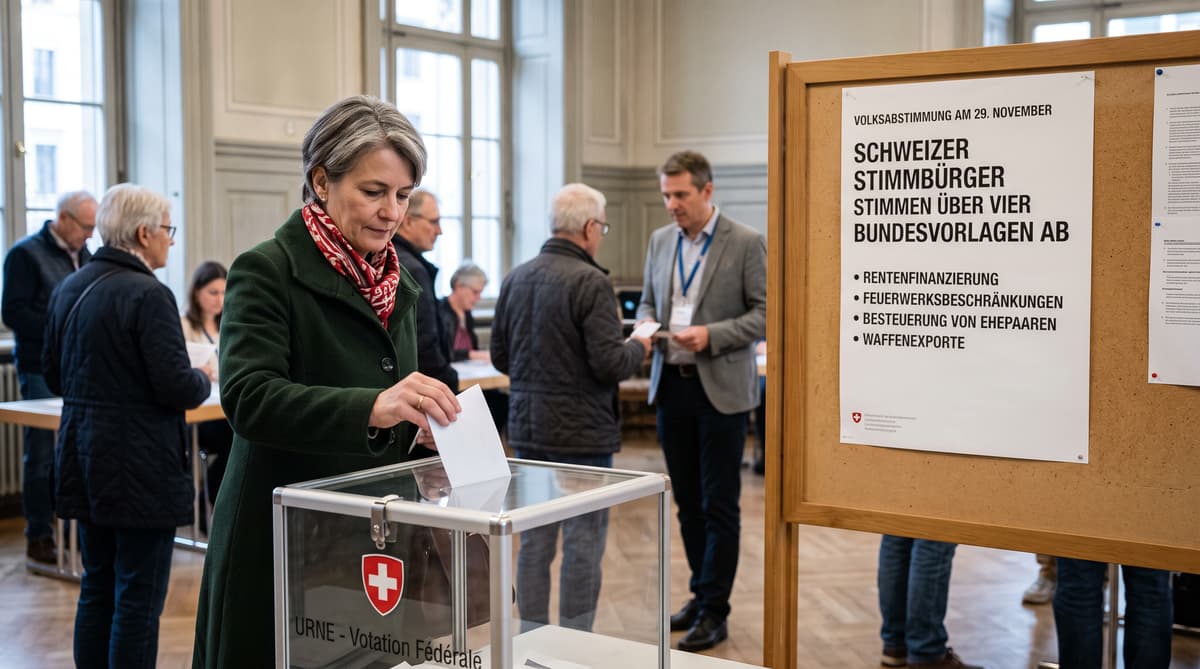
Four federal proposals will go before voters on November 29, putting household costs, public safety and Switzerland’s defence policy on the same ballot. The Federal Council has released its official voting explanations in German, French and Italian, setting out the arguments ahead of the nationwide decision.
The questions reach into everyday life in different ways. One would increase value-added tax to help fund the 13th annual state pension. Another would prohibit the sale and use of noisy fireworks. A third would establish constitutional rules for taxing married couples. The fourth would loosen some restrictions on arms exports.
The ballot follows a busy voting calendar. On September 27, voters rejected initiatives on food production and neutrality, according to the account of the previous round. Now the electorate faces a fresh set of choices, with government and parliament recommending approval of the pension funding and arms export proposals, and rejection of the fireworks and married-couples initiatives.
The Federal Council’s explanations are available as voting booklets in the country’s three main official languages. Each proposal also carries distinct consequences: a tax change, new limits on fireworks, a different approach to couples’ federal tax bills, or revised rules for the arms industry. The November vote will determine which of those changes Switzerland takes forward.
Put a price on pension funding
The pension measure would raise VAT by 0.4 percentage points and could bring in about CHF 1.4 billion annually. The increase would begin no earlier than 2028. The reduced VAT rate on essentials, including food and medicines, would remain unchanged.
The vote concerns how to help pay for the 13th annual state pension, which voters have already approved. The Federal Council and parliament recommend a yes vote, arguing that the pension system needs additional revenue and that VAT distributes the cost across generations.
Opponents in parliament say the long-term financing question should form part of a broader pension reform. They point to measures such as raising the retirement age as possibilities for that wider debate. The November proposal, however, is focused on a specific source of additional revenue: a higher standard VAT rate.
For households, the change would affect spending subject to the increased rate, while leaving the reduced rate on essentials untouched. The projected annual revenue would cover part of the extra pension cost, rather than the full amount. Voters will therefore decide whether to use consumption tax as one part of the financing plan for a benefit already set to be paid.
Draw a line under noisy fireworks
The fireworks initiative targets noise, not every kind of display. It would ban the sale and use of fireworks that make noise, while quieter varieties would remain available. Cantons could grant exceptions for events considered important to a wider region, but private individuals would not be allowed to set off noisy fireworks at those events.
Lawmakers would have to define which products fall within the ban. Supporters argue that a national rule would reduce noise and pollution and help prevent fires and accidents. They also cite effects on people and animals. The Federal Council and parliament recommend a no vote, saying existing rules are sufficient and cantons and municipalities already have powers to impose restrictions.
The proposal would set a countrywide baseline, while leaving room for limited exceptions at qualifying regional events. Its practical reach would depend partly on how authorities classify fireworks and apply the rule. For residents, the change would most directly affect the sale and private use of noisy products, including around celebrations.
The disagreement is over whether a federal ban is needed alongside local controls. Voters will decide whether to adopt the initiative’s national restriction or retain the current approach endorsed by the government and parliament.