Switzerland
SWISS Begins Rollout of High-Speed Starlink Wi-Fi Across Its Fleet
SWISS is beginning to roll out Starlink-powered high-speed internet across its fleet.
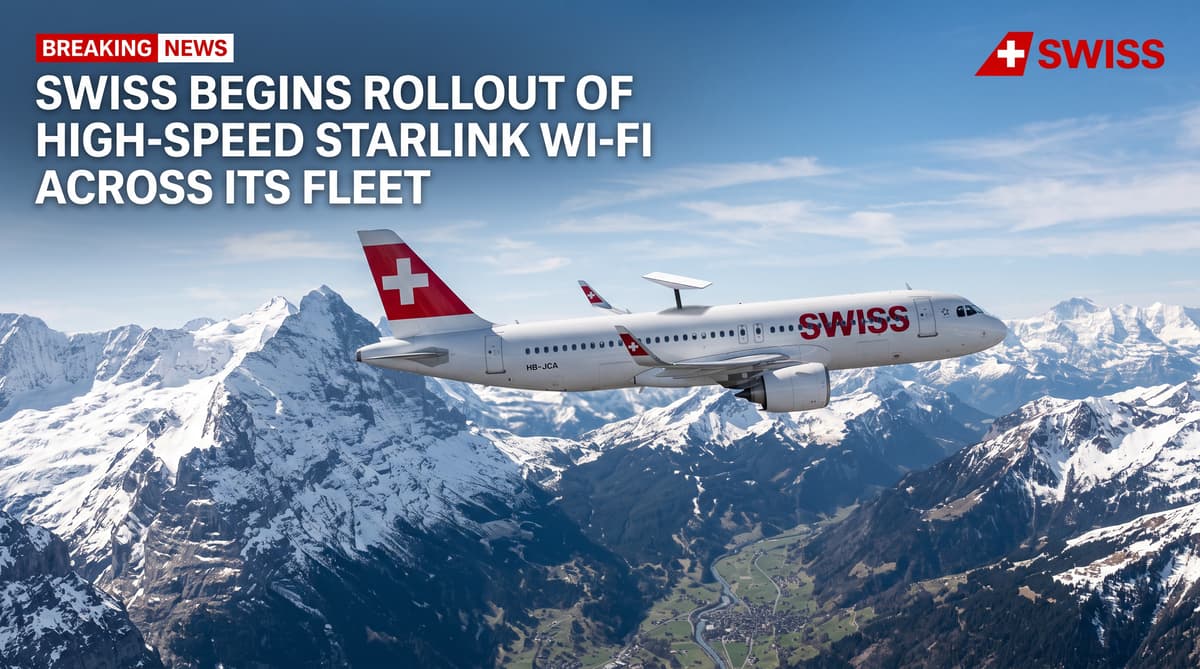
September 28 marked SWISS’s first scheduled flight with Starlink-powered Wi-Fi. The Airbus A320neo flying from Zurich to Thessaloniki opened a rollout that will gradually bring satellite broadband to Switzerland’s national airline fleet.
SWISS plans to add the system to three more aircraft from the Airbus A320 family before extending the installation programme across the rest of its aircraft. The airline expects the full fleet to be equipped by the end of 2029, making the launch an early step in a multiyear programme rather than an immediate fleetwide upgrade.
For passengers departing Switzerland, the change addresses one of the most visible weaknesses of air travel: inconsistent internet access once the aircraft leaves the ground. Starlink uses a large network of satellites in low Earth orbit to provide broadband connectivity. SWISS says the service will support messaging, photo sharing and a broad range of online services in flight.
The first aircraft entered service on a European route linking Zurich with Thessaloniki. Further installations will determine how quickly the new experience reaches passengers on other SWISS routes and aircraft types.
Passengers Get a Connected Cabin
Miles & More members and Travel ID users will receive the service free of charge in every travel class. That access policy gives the rollout a broad reach, from economy passengers sending messages to business travellers working during a flight.
SWISS says passengers will be able to send messages, share photographs and use a wide range of online services while airborne. The airline describes the connection as “fast and reliable internet bandwidth” and says performance should improve as the system becomes more widely established across its fleet.
The practical value will vary by passenger and route. A traveller can stay in contact with family, a visitor can share images from a Swiss departure, and a professional can handle routine online tasks without waiting for landing. The source material does not specify streaming policies, speeds, data limits or whether every service will function identically on every aircraft.
The requirement to hold a Miles & More or Travel ID account also makes the rollout part of SWISS’s wider digital passenger relationship. The airline is attaching a tangible onboard benefit to two existing loyalty and identity platforms while extending the same stated availability across economy, business and first class.
SWISS Turns Connectivity Into a Fleet Strategy
SWISS has set a four-year horizon for completing the fleetwide installation. The timetable gives the airline room to introduce the system aircraft by aircraft, starting with the A320 family and expanding gradually across its operation.
That pace matters because passengers do not experience an airline’s technology strategy as a single launch. They experience it at the seat assigned on a particular flight. During the rollout, one aircraft may offer Starlink connectivity while another operating a similar route may not yet have the system. SWISS has not published a detailed aircraft-by-aircraft schedule in the information available for this report.
The airline says connectivity will become faster and more reliable as deployment progresses. Starlink’s low Earth orbit network is designed to provide broadband service through satellites closer to Earth than traditional geostationary systems, although the source material does not provide technical performance figures for SWISS flights.
Reliable onboard internet has become a competitive feature for airlines serving international travellers. SWISS’s decision to make access free for eligible users across all classes gives the company a clear passenger-facing proposition while it works toward the 2029 completion target.