Culture
Isabelle Huppert reflects on celebrity in Locarno film ‘All About Corinne’
Isabelle Huppert discusses acting and celebrity culture in Marc Fitoussi’s Locarno film ‘All About Corinne’, a comedy that blurs the boundaries between reality and fiction.
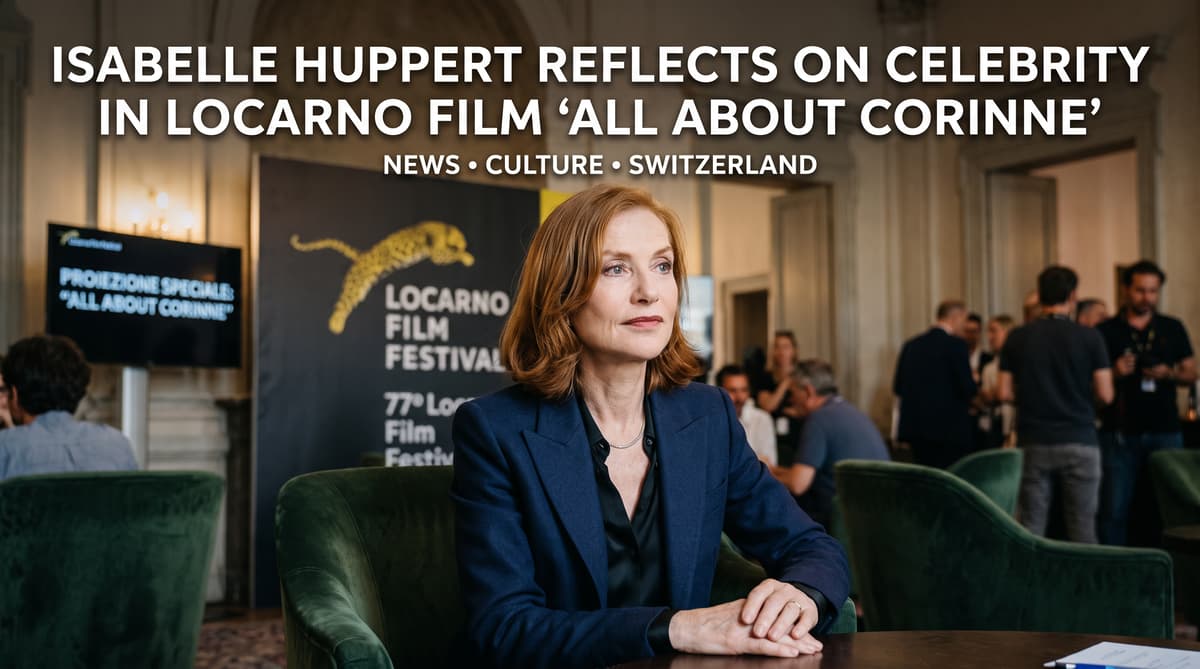
The 2026 Locarno Film Festival closed with Isabelle Huppert pretending to be invisible. On Piazza Grande, where thousands of spectators gather before one of cinema's largest screens, Marc Fitoussi presented Ni vue, ni connue, released internationally as All About Corinne. The world premiere placed one of France's most recognisable actors inside the least glamorous corner of a film set: the life of an extra.
Huppert plays Corinne Maclou, a determined woman who moves from one shoot to another while chasing the part that might finally demonstrate her ability. Her ambition gives the comedy its engine. The joke also carries a precise observation about the film industry, where visibility depends on status, access and the approval of people who control the next call sheet.
Locarno has built its reputation on independent and adventurous cinema, yet its Piazza Grande programme reaches a broad public. Fitoussi's film sits comfortably between those two identities. It offers a star-led comedy for a large outdoor audience while turning its attention toward workers usually positioned at the edge of the frame. The result gives the festival's closing night a distinctly industry-focused subject.
Huppert Turns Celebrity Inside Out
Huppert's star power gives Corinne's struggle its sharpest edge. The actor has delivered major performances for filmmakers including Claude Chabrol, Michael Haneke and Paul Verhoeven. Seeing her navigate the uncertainty of background work creates an immediate comic tension, especially when the audience knows the performer behind the fictional hopeful.
Fitoussi does not build the film around a simple disguise. The gap between Huppert's public image and Corinne's professional position remains visible, and that gap allows the comedy to examine celebrity without treating it as a sacred institution. Corinne is overbearing, determined and awkward. Her hunger for recognition is both funny and recognisable, particularly in an industry where thousands of people wait for a line, a close-up or a meaningful credit.
The film also draws on Huppert and Kiberlain's earlier willingness to play with their own images. Both appeared as versions of themselves in episodes of Dix pour cent directed by Fitoussi. That earlier work established a shared language of self-deprecation. All About Corinne extends it into a feature film, giving the performers room to question the distance between the person audiences know and the character a production asks them to construct.
Fitoussi Mirrors the Film Industry
The film keeps reality and fiction in constant motion. Kiberlain, Diane Kruger and Ana Girardot play fictionalised versions of themselves, while Huppert inhabits Corinne, a character whose professional frustrations collide with the actress's formidable reputation. That arrangement makes every scene carry two identities at once: the role on screen and the public image attached to the performer.
After meeting on a film set, Corinne and Kiberlain's character begin spending time together. Their friendship develops through tension and humour, shaped by differences in personality, income, social position and professional security. The relationship gives the film a human scale. Celebrity culture becomes something the characters encounter in practical situations, from access to work to the confidence of being recognised.
Fitoussi has returned to entertainment as a subject throughout his career. His first feature, La vie d’artiste, arrived in 2006. He later contributed to the television series Ça, c’est Paris! and directed episodes of the award-winning Dix pour cent, a show deeply invested in the behaviour of actors and agents. All About Corinne continues that interest while placing the extra, rather than the headline star, at the centre of the frame.