fuel prices
Swiss diesel prices hit a new record high
Diesel has reached a national average of CHF2.41 per litre, surpassing its previous record, while petrol prices are also rising. Report on the immediate effect on motorists, transport operators and household costs, and explain the international factors behind the increase.
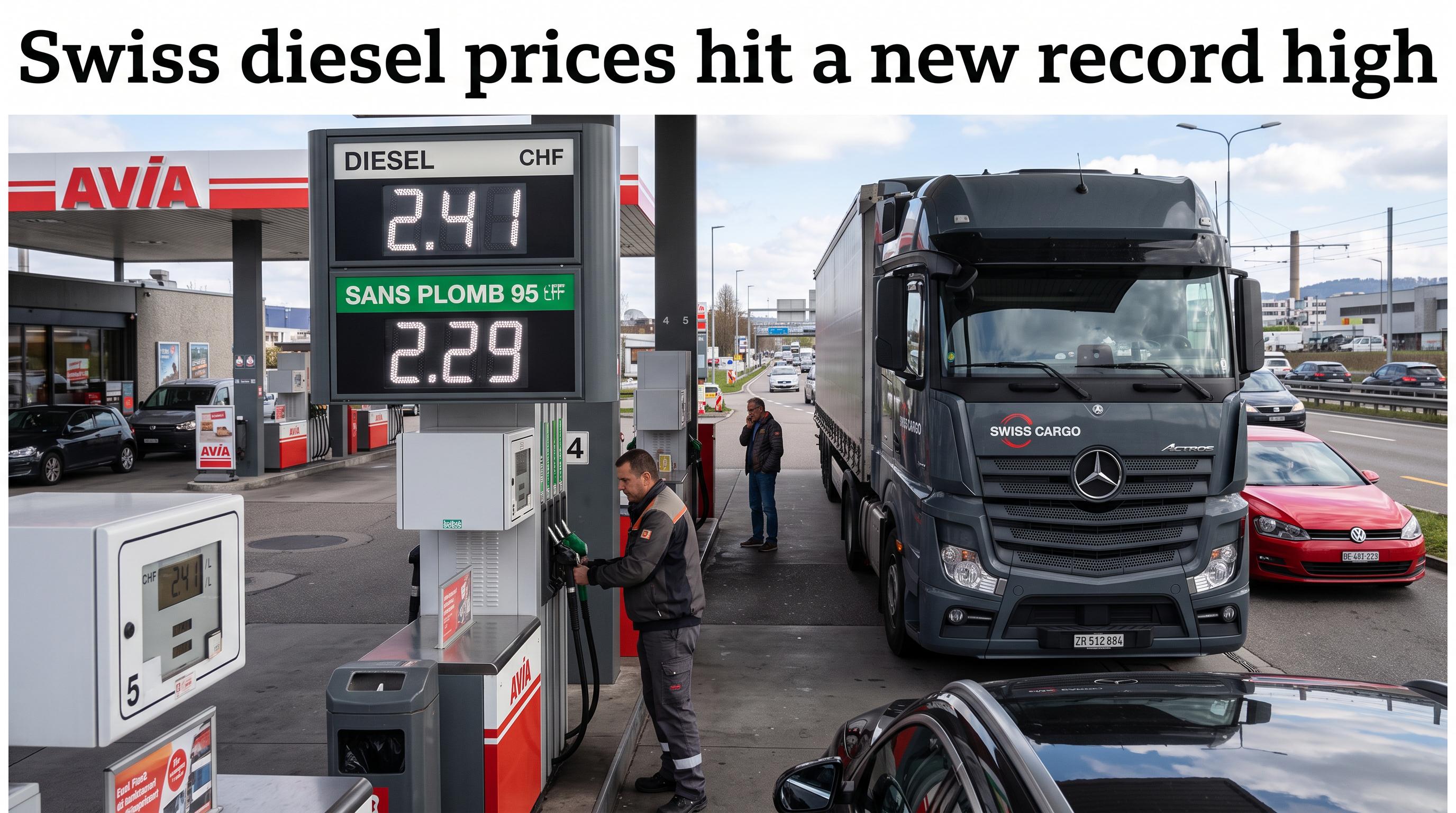
Diesel Sets a New Swiss Record
Diesel has reached CHF 2.41 per litre across Switzerland, setting a new national average record and moving beyond the previous peak recorded in 2022. The figure, reported by Touring Club Switzerland on 18 September 2026, marks a sharp change for motorists who began the year paying about CHF 1.78 per litre.
The increase amounts to 35% since January. A driver filling a 60 litre tank now pays roughly CHF 144.60, compared with CHF 106.80 at the start of the year. That is an additional CHF 37.80 for the same quantity of fuel.
Petrol is following the same upward path. Unleaded 95 now averages CHF 2.10 per litre, five centimes more than a week earlier. Its price remains below the 2022 record of CHF 2.31, although the annual increase has reached 27%, from CHF 1.65 in January.
The immediate pressure reaches beyond the forecourt. Commuters, tradespeople and families using cars for school, shopping or regional travel are absorbing higher running costs. Businesses that depend on vans and trucks face a direct increase in the cost of each delivery and service call, with those expenses likely to feed into household bills.
Freight Firms Pass On the Pressure
Transport operators are paying more for every kilometre, and diesel’s importance extends far beyond private cars. Freight companies, construction firms, farmers and municipal services rely heavily on the fuel to move goods and operate machinery. For those businesses, fuel is a recurring operating cost that cannot be removed simply by reducing one journey.
The impact varies according to vehicle type, distance and the ability to pass costs on to customers. A regional delivery operator may face higher charges on every route, while a construction company must account for fuel used by excavators, generators and heavy vehicles at worksites. Small firms with limited negotiating power are particularly exposed when contracts fix prices in advance.
Households feel the effect through several channels. Higher transport bills can raise the cost of food, building materials and parcels, while workers who drive long distances see less disposable income after each pay cheque. Rural communities and residents in areas with weaker public transport have fewer immediate alternatives.
Diesel demand also reflects industrial use. The fuel is closely linked to heating oil and supports construction, freight and other commercial activity. Falling sales of diesel cars therefore do little to reduce pressure across the wider diesel market. The squeeze is economic as well as personal, reaching supply chains before products arrive in Swiss shops.
Global Shocks Tighten the Diesel Market
International supply disruptions are tightening the market for diesel and petrol at the same time. The TCS links the latest rise to the war in Iran and interruptions to oil shipments in the Middle East, developments that have increased pressure on energy markets and raised concerns about reliable deliveries.
Russian exports of diesel and petrol have also fallen sharply, according to the TCS. Damage to oil infrastructure and refineries has further constrained supply. When fewer refined products reach international markets, buyers compete for available cargoes, and the higher wholesale cost eventually reaches Swiss filling stations.
Diesel is particularly exposed because it serves several major sectors at once. It powers freight vehicles, construction equipment and industrial machinery. In countries with limited railway electrification, diesel also fuels trains. Remote communities can depend on diesel generators for electricity and air conditioning. A jump in natural gas prices can create another source of demand when countries switch to petroleum products for power generation.
Consumers and companies may stockpile fuel when shortages appear likely, adding to short term demand. Refineries cannot rapidly solve the imbalance by producing much more diesel. Shifting output away from petrol requires substantial investment and cannot be done quickly in response to a single market shock.
Rhine Disruption Adds a Swiss Premium
Switzerland is facing domestic bottlenecks alongside the international disruption. The Cressier refinery in the canton of Neuchâtel, which supplies about 30% of the country’s petroleum products, was shut for several days. Even a temporary interruption matters in a market already relying on constrained imports.
Water levels on the Rhine have created a second problem. Low water has hampered shipping for months, limiting the amount of fuel and other goods that vessels can carry between Rotterdam and Basel. The normal route remains open, but its economics have changed dramatically.
Transporting goods on that corridor now costs more than CHF 220 per tonne, compared with a typical rate of CHF 22 to CHF 28. The TCS estimates that the higher Rhine costs alone add about 15 centimes to a litre of fuel in Switzerland. That calculation shows how a logistics problem far from a petrol station can appear directly on a price display.
The Rhine is central to Swiss imports because Basel connects the country to the wider European shipping network. When water levels restrict capacity, companies must use more expensive alternatives, including road and rail. Those replacement routes require additional planning and can raise costs for fuel distributors and other industries.
Swiss Drivers Recalculate the Road Ahead
The record price strengthens the financial case for efficiency and electrification, although the transition will not be immediate for every Swiss driver or business. Electric cars can reduce exposure to petrol and diesel prices, particularly for motorists who charge regularly at home or at predictable public rates. Electricity costs are also expected to fall for most Swiss households in 2027, according to the linked report.
The economics depend on more than the price at the pump. Buyers must consider vehicle costs, charging access, driving distance and whether their building allows a private charging point. Rural households, apartment residents and operators of heavy vehicles may face greater barriers. Electric trucks and machinery are developing, but diesel remains deeply embedded in freight, construction and agriculture.
For policymakers and companies, the latest figures highlight the value of resilient supply chains and lower energy consumption. Better rail connections, efficient logistics and less fuel intensive fleets can reduce exposure to disruptions on international routes and the Rhine. Operators will also watch refinery availability and shipping conditions for signs that the pressure is easing.
For now, the immediate calculation is straightforward. Diesel has risen by 35% since January, petrol by 27%, and every additional centime affects commuting, deliveries and production. Swiss households and businesses will have to budget for that higher energy cost while waiting for supply conditions to improve.