Climate
Swiss startup takes on methane emissions from cattle
A Swiss startup is working to reduce methane emissions from cattle, a potent greenhouse gas produced by livestock farming. Cutting methane is seen as an important part of limiting global warming.
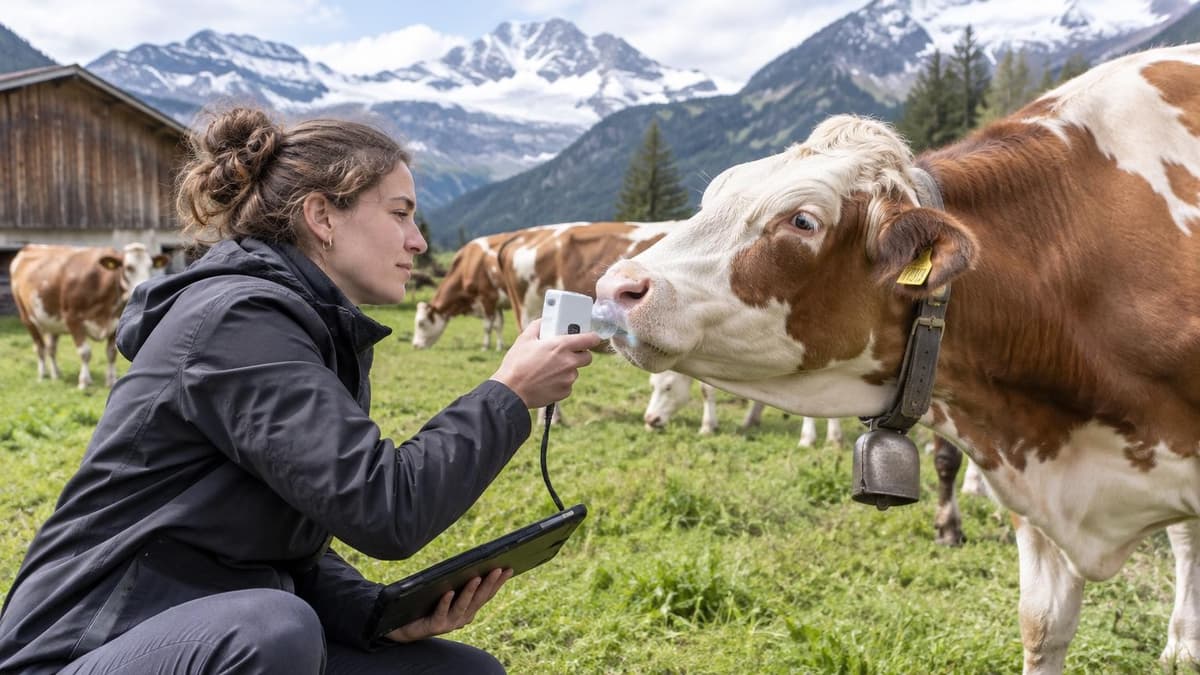
Cattle barns are a major front in the effort to cut methane, and a Lausanne startup is testing a way to treat the gas where it is produced. Sixteen44, based at EPFL Innovation Park, has trialled a methane-capture device at the Strickhof experimental farm in Lindau, canton Zurich. The company says the system reduced methane levels in the barn by 60% to 70%.
Methane is produced by bacteria in the digestive systems of cattle and other ruminants as they ferment plant fibres. The gas leaves animals mainly through the mouth as they exhale or belch. Livestock farms account for around one-third of global human-caused methane emissions, making cattle a significant focus for climate policy.
Methane remains in the atmosphere for less time than carbon dioxide, but its warming effect is stronger. Researchers say deep cuts to methane emissions are important for keeping global warming well below 2°C, the goal set out in the United Nations’ Paris Agreement. Sixteen44 is betting that treating emissions inside the barn can contribute to that effort.
Solve the dilution problem
The challenge is the gas’s low concentration: methane makes up less than 5% of the air in cattle barns. That dilution makes it difficult to capture and reuse economically. The problem extends beyond livestock, according to William Ramsay, chemist and Sixteen44 co-founder. “This is the situation for most of the methane emitted around the world,” he told Swissinfo.
The company’s approach is to treat the air without first separating out the methane. Ramsay says the startup’s test at Strickhof was the world’s first demonstration plant capable of treating the highly diluted emissions typical of cattle farming. The system was tested at the experimental farm in Lindau, where Sixteen44 evaluated its device in an operating cattle shed.
“We need to tackle this low-concentration methane if we want to make a meaningful impact on the climate,” Ramsay said. The company’s trial focuses on a source of emissions that is both widespread and difficult to handle with conventional capture methods. Its results, if sustained in farm conditions, would make the barn itself a site for methane treatment.
Convert methane in the barn
Sixteen44’s device uses electrical discharge and a catalyst to convert methane into water and carbon dioxide. The system, which the company says is fitted to cows and resembles a ventilation unit, uses plasma oxidation. An electrical discharge creates highly reactive particles, accelerating a reaction that can also occur naturally.
Cyril Brunner, an expert in greenhouse gases and CO₂ removal at ETH Zurich, described the role of the catalyst: “The main advantage of methane oxidation is that methane can be converted simply by bringing it into contact with a heated catalyst.” The process avoids a separate step to extract methane from the surrounding air, which requires substantial energy and is a key limitation for carbon-capture technologies.
Sixteen44 says its device operates at around 40°C. The company contrasts that with 400°C to 500°C for other technologies designed to remove low-concentration methane. The lower operating temperature, according to Ramsay, means lower energy consumption. The test therefore brings together two practical aims: treating dilute methane without isolating it first, and keeping the system’s operating temperature down.
Put the trial in climate context
The Lindau trial puts a Swiss-developed approach to methane reduction into a working cattle shed. Sixteen44 says the device lowered barn methane levels by 60% to 70% during testing. That result addresses emissions from livestock farming, which contributes around one-third of human-caused methane worldwide. The company’s immediate target is the dilute gas circulating in barns, rather than methane separated from the air elsewhere.
The climate stakes extend beyond agriculture. Methane is present in the atmosphere at lower concentrations than carbon dioxide and remains there for a shorter period, yet it has a much stronger warming effect. Cutting methane is considered an effective way to limit warming in the short term, and major reductions are needed to keep the Paris Agreement’s goal of holding warming well below 2°C within reach.
For Switzerland, the project connects research and climate technology with the country’s agricultural sector. Sixteen44 has moved its device from development into a demonstration at Strickhof, an experimental farm in canton Zurich. The company’s test centres on whether methane can be treated directly in the conditions where cattle emissions accumulate.