European Union
Swiss upper house advances new package of agreements with EU
Switzerland’s Council of States has broadly endorsed the country’s new package of agreements with the European Union while adding tougher provisions on referendums and immigration. The upper house’s decision brings the bilateral package closer to its next parliamentary and potentially popular vote hurdles.
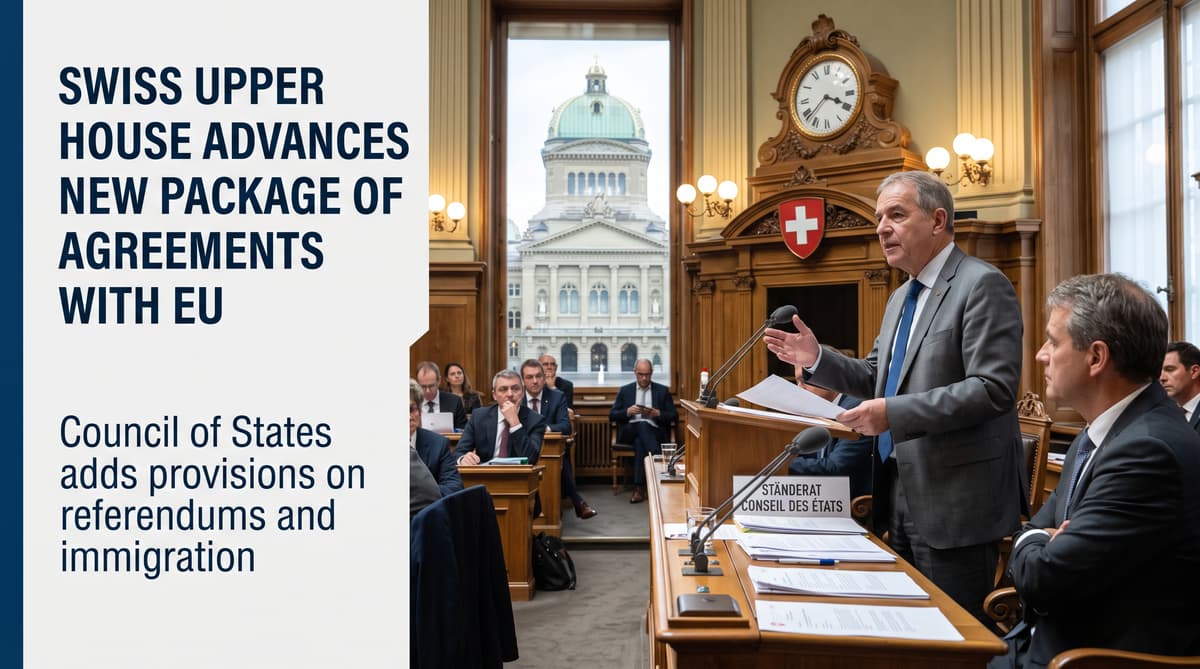
After roughly 24 hours of debate, the Council of States has moved Bilaterals III to the next stage of scrutiny. Switzerland’s upper house broadly accepted the new package of agreements with the European Union, while adding conditions on direct democracy, immigration and the future status of EU nationals.
The decision matters because Switzerland’s access to the European single market rests on a network of bilateral agreements rather than EU membership. The existing system covers areas including free movement, trade and transport. As EU rules have developed, Brussels has pressed Bern to establish clearer arrangements for updating agreements, resolving disputes and monitoring state aid.
The package follows the collapse of an earlier institutional framework agreement in 2021, when Switzerland ended negotiations. Bilaterals III seeks to stabilise the relationship while responding to Swiss concerns over wages, migration and sovereignty.
The upper house has not completed the parliamentary process. The National Council, parliament’s larger chamber, is expected to debate the package during the winter session. The electricity agreement, one of its most consequential elements, remains outside the current decision and will come before senators in December.
Senators Raise the Referendum Bar
A mandatory referendum would give Switzerland’s cantons a decisive role in approving the EU package. Senators backed legislation requiring a popular vote and also supported a separate constitutional amendment to secure that requirement.
Under the upper house position, Bilaterals III would need two majorities: a majority of Swiss voters and a majority of the cantons. The Federal Council had supported an optional referendum, which would require only a nationwide majority. The change raises the political threshold for ratification and places the package firmly within Switzerland’s federal system of direct democracy.
The referendum debate reflects the sensitivity of the agreements. The package would shape how Switzerland updates parts of its relationship with the EU, including arrangements linked to market access and regulatory oversight. It would also commit public funds over several years.
The constitutional route could add another layer to the process. Parliament must agree on the final text before voters and cantons can decide. The National Council will therefore examine both the substance of the agreements and the upper house’s approach to the referendum during the winter session.
Parliament Sets CHF 3.3 Billion Aside
The upper house approved CHF 3.3 billion in commitment credits for Switzerland’s future contribution to European cohesion. Payments would be made between 2030 and 2036 if the package enters into force.
The largest share, CHF 2 billion, would support efforts to reduce economic and social disparities. A further CHF 273.4 million would fund migration-related projects. Senators also approved an additional one-off commitment of roughly CHF 1 billion. The total creates a substantial financial component to the agreement alongside the regulatory provisions governing Switzerland’s relationship with the EU.
The commitments would connect Switzerland to European cohesion measures while preserving parliamentary control over the approved credits. Their inclusion gives the National Council another major issue to assess when it takes up the package.
The financial plan also helps explain why the agreement will face a public test if the mandatory referendum provision survives. Swiss voters would be asked to consider a package that combines market access, institutional rules, immigration safeguards and a long-term contribution to European development. The electricity agreement, which could affect the country’s energy market and cross-border power cooperation, remains pending.