artificial intelligence
Four in five people in Switzerland now use AI
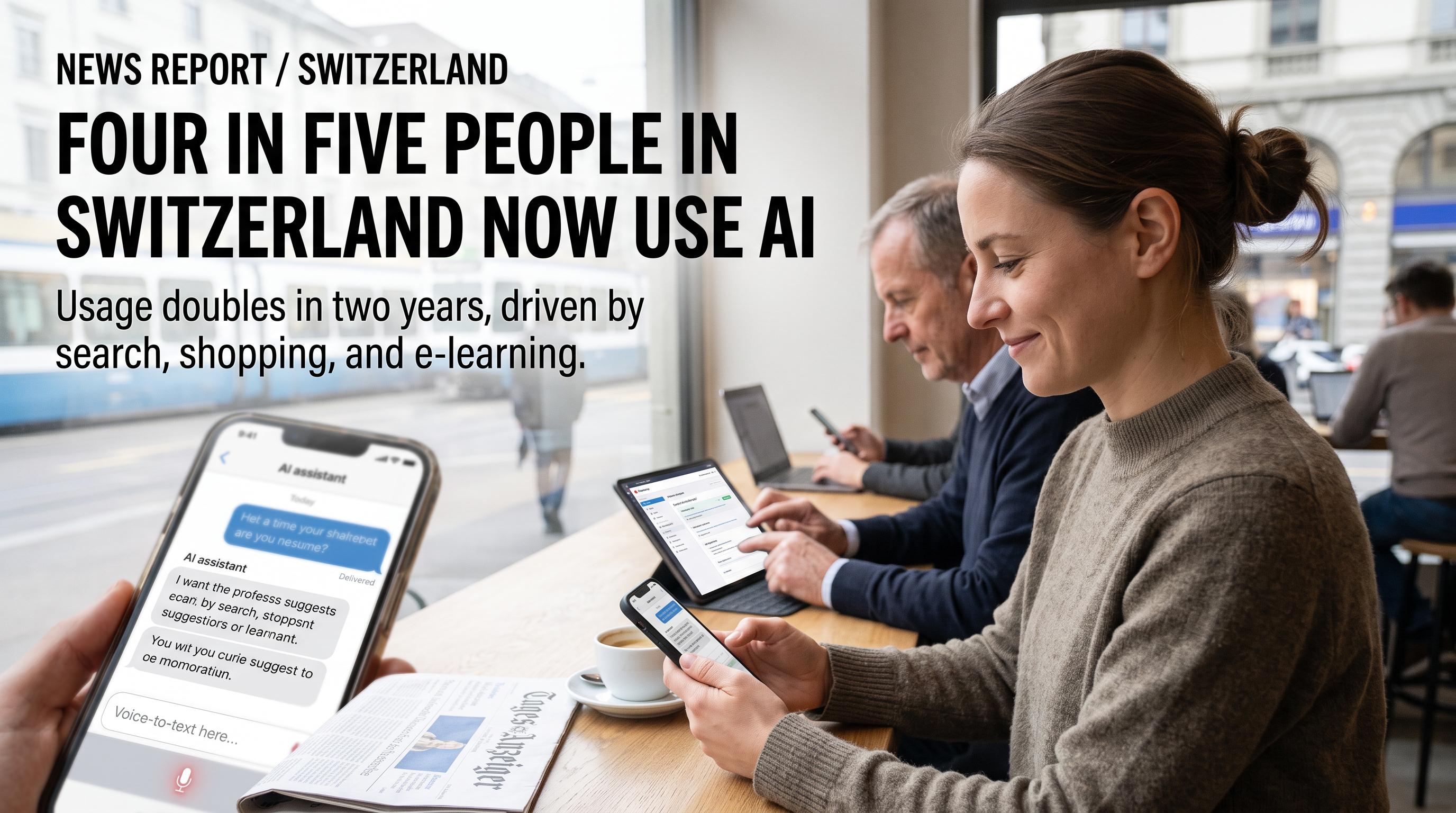
A new Swiss survey finds that four in five people now use artificial intelligence, twice the level recorded two years ago. AI is increasingly used for search, shopping advice and e-learning, not only for writing and translation, raising questions about how rapidly digital habits are changing across generations.
Track Switzerland’s AI Surge
Four in five Swiss internet users now use artificial intelligence. The figure, reported in the 2026 Digimonitor survey, marks a rapid change in everyday digital behaviour. AI use has reached 80% of the population measured, twice the level recorded two years ago.
The survey covers people aged 15 to 75 who use the internet, rather than the entire resident population. It was conducted for the Interest Group for Electronic Media, IGEM, and WEMF AG for Advertising Media Research. The organisations have tracked electronic media and device use in Switzerland every year since 2014.
The latest results show AI moving quickly from a specialist technology into an ordinary digital tool. People use it at work and in their private lives, with applications that include finding information, comparing products and supporting online learning. Younger adults lead the adoption, with use particularly widespread among those aged 15 to 34.
That pace matters for Switzerland’s schools, employers, media companies and public services. A tool that reaches most internet users can influence how people gather information, make purchases and complete routine tasks. The survey offers a snapshot of that shift as it stood in 2026, while showing how quickly the baseline for digital participation is changing.
Watch AI Rewrite Search
Search has become the leading gateway for AI use in Switzerland. According to Digimonitor, 77% of respondents use an AI mode integrated into a traditional search engine. A further 57% use dedicated AI platforms specifically for searching.
Those figures place AI search ahead of several established digital destinations. Respondents reported using YouTube for searches at 34%, while social media accounted for 28%. The comparison suggests that AI is becoming part of the first step people take when they need an answer, recommendation or explanation online.
The distinction between built-in and dedicated tools also matters. Many users may encounter AI through a familiar search engine without deliberately signing up for a separate platform. Others are choosing services designed around conversational or generative answers. Together, the two categories show how deeply AI has entered the search environment.
For Swiss users, that can affect how they discover news, interpret public information and compare sources. The survey does not assess whether the answers are accurate or how often users verify them. It does show that AI systems now compete directly with platforms that shaped online discovery for years.
Follow AI Into Daily Decisions
Swiss people are using AI for far more than drafting text or translating languages. The Digimonitor report identifies search, shopping advice and e-learning among the technology’s expanding applications. These uses place AI inside ordinary decisions that people make repeatedly throughout the day.
A shopper might ask an AI system to compare products or explain technical specifications. A learner might use it to clarify a difficult concept or organise study material. A person searching for information may receive a generated response before visiting a conventional website. The source does not break down the 80% figure by individual activity, so it cannot establish how frequently people use each application.
The range of uses nevertheless points to a change in digital habits. AI is becoming a layer across existing online services, including search engines and educational tools. Its presence does not depend solely on people opening a standalone chatbot.
That spread also raises practical issues for Swiss institutions and households. Schools and employers must account for AI-assisted work and learning. Consumers need to distinguish advice from verified information, particularly when recommendations involve health, money or legal matters. The survey records adoption, while the consequences will depend on how people use and check the outputs.
Close the Generational Gap
The age divide remains visible even as adoption becomes mainstream. People aged 15 to 34 are the most active AI users in the Digimonitor findings. The source does not provide the precise percentages for other age groups, nor does it publish a breakdown by canton, language region or occupation.
That limitation makes the national figure more useful as a measure of direction than as a complete portrait of Swiss society. Eight in ten internet users report using AI, yet the intensity, purpose and confidence of that use may differ significantly between a student, an office worker, a retiree and a small business owner.
The findings arrive as AI experience becomes increasingly relevant in the workplace. Swiss employers are already assessing how applicants and staff use these tools, while schools and training providers are adapting to AI-assisted learning. The accompanying debate concerns practical skills: knowing when to use AI, how to formulate a useful request and how to verify an answer.
Digimonitor’s annual tracking gives researchers a way to follow whether adoption continues to widen across age groups. Its next results will help show whether today’s strong lead among younger users narrows as AI tools become embedded in more services and devices.
Prepare for AI’s Next Phase
Switzerland has reached a point where AI use is a mainstream digital behaviour. The 80% adoption rate reported by Digimonitor does not mean every user relies on AI in the same way, but it confirms that the technology now reaches well beyond early adopters and specialist workplaces.
The strongest evidence of that transition appears in search. AI modes inside traditional search engines are used by 77% of respondents, and dedicated AI platforms by 57%. Their higher reported use for searching than YouTube or social media signals a shift in how Swiss internet users approach information online.
The survey also provides a clear baseline for future measurement. Because Digimonitor has tracked electronic media use since 2014, its annual results can place AI adoption within Switzerland’s longer digital history. The latest increase, a doubling over two years, shows that habits can change faster than institutions and public understanding.
For policymakers, educators, employers and consumers, the immediate task is to understand the quality and purpose of that use. The report establishes how widely AI has spread. Further research will need to show how people verify generated information, how workplaces set boundaries and whether older users catch up with younger generations.