travel
Airlines demand action as border-system delays hit Schengen travel
Airports and airlines are urging the EU to overhaul its digital Entry/Exit System after continuing congestion at Schengen borders, with some passengers facing waits of up to five hours. The delays affect Swiss travellers using major European airports.
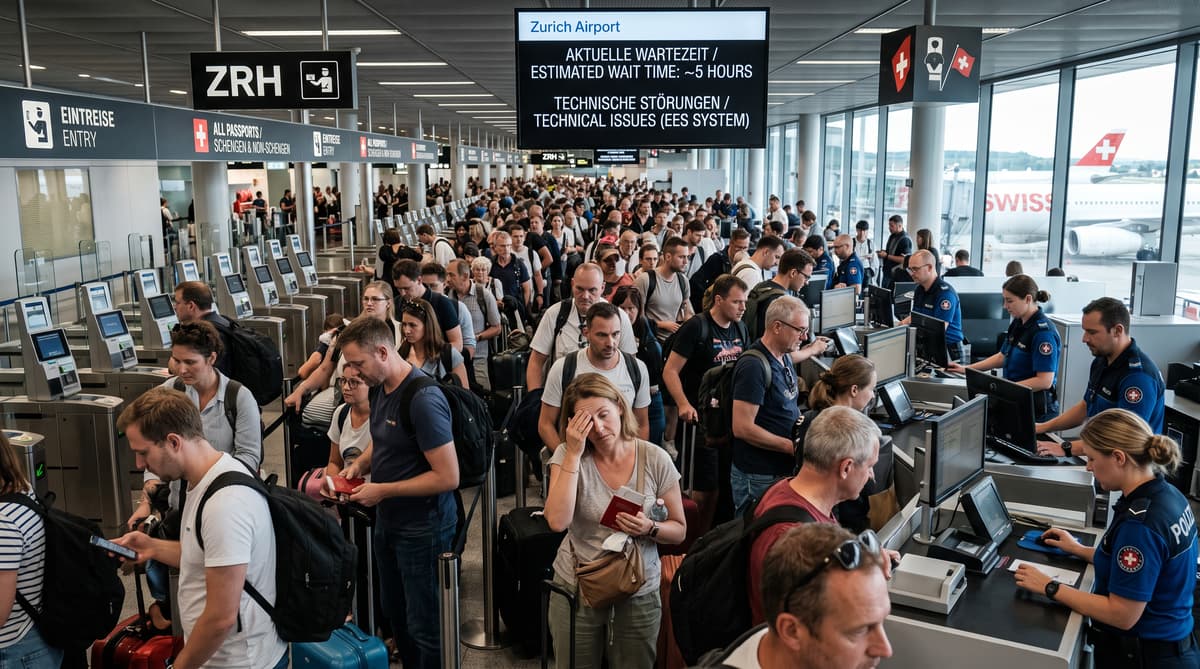
Queues of up to five hours are putting flights and connections at risk across Europe. Airports and airlines say congestion remains widespread at external Schengen borders, almost six months after the Entry/Exit System reached full implementation. At peak times, waits can reach five hours, while delays of more than two hours remain routine in the most difficult locations.
The disruption matters directly to Swiss travellers. Switzerland participates in the Schengen area, yet passengers arriving from outside the zone still pass through the system at airports and other external border points across Europe. A traveller flying from Dubai to Zurich faces one set of controls. A Swiss passenger connecting through Madrid, Rome or another major European gateway may encounter another, particularly when the first registration of biometric data takes place.
ACI Europe, representing European airports, and Airlines for Europe, representing carriers, say the queues have caused passengers to miss flights and connections. They also report pressure on airport employees, airline staff and border guards. The organisations have urged European Union authorities to act before further periods of heavy travel expose the same weaknesses. Their demands focus on faster processing, more reliable technology and greater use of automated controls.
Biometrics reshape the border
The EES requires first-time visitors to submit fingerprints and facial images before they can cross an external Schengen border. The system records the entry and exit of non-EU short-term visitors and is designed to identify people who exceed the 90-day limit in any 180-day period.
The rollout began on 12 October 2025, followed by full implementation in April 2026, according to the source. Checks were paused at many locations during the summer, and enforcement has remained incomplete at major cross-Channel ports. Airports in Italy and Spain have experienced particularly visible disruption since the system was introduced.
For Swiss travellers, the distinction between internal and external Schengen journeys remains important. A flight from Geneva to Barcelona generally does not involve an external border check. A journey from Switzerland to a destination outside Schengen, followed by a connection through an Italian or Spanish airport, can place passengers in the busiest processing streams.
The system covers 29 countries, including Switzerland, the 25 participating EU member states, Iceland, Norway and Liechtenstein. Its security purpose has received support from the airport and airline groups. Their criticism concerns the way the system is being operated at the border, where manual checks, biometric registration and passenger flows have yet to work consistently together.
Airlines target the system's weak points
Airports and airlines have identified four operational weaknesses behind the queues: staffing, unstable IT, too few kiosks and limited automated gates. They also want the EU to improve the Travel to Europe app, which allows some travellers to complete pre-enrolment remotely before reaching the border.
The industry groups say biometric verification should happen once, with a clear handover between the passenger, the kiosk and the border officer. At present, some travellers face “double verification”, first at a self-service machine and again with a guard. The groups warn that this slows the line and can create duplicate EES profiles when the system fails to match a person’s data correctly.
Their proposed fix is operational rather than cosmetic. Authorities should increase the use of self-service technology, stabilise the systems collecting biometric information and make the pre-registration app reliable across participating countries. Border agencies also need enough personnel to deal with exceptions, passengers who cannot use a kiosk and technical failures.
The organisations have asked EU authorities to restore a safeguard allowing national authorities to suspend EES checks temporarily when queues become excessive. That provision applied during the summer and ended under current rules. They want it to remain available indefinitely, with clear conditions for activating it.
Border data reveals the scale
The EES has processed almost 230 million entries and exits, while authorities have refused 80,000 entries. EU Migration Commissioner Magnus Brunner disclosed the figures in comments reported by Politico and cited by The Local. Of the refused entries, 2,000 were linked to security threats, according to Brunner.
Those figures show the scale of the system's operation as well as its purpose. The EES creates a central record of short-term visitors crossing the Schengen area's external borders. It is intended to identify overstays and support checks on people seeking entry. The airport and airline associations acknowledge that the system has strengthened external border security.
Their concern is the cost of processing that volume when infrastructure and staffing fall short. A technical interruption can affect thousands of passengers in a terminal. A second biometric check adds time to every transaction. A duplicate profile can force staff to resolve a case manually. During a holiday surge, those small delays accumulate into missed departures and crowded halls.
Brunner has placed responsibility with EU member states. In an interview with Politico, he said countries had enough time to prepare and must do their job. The industry groups are pressing the European Commission and national governments to turn that responsibility into coordinated fixes before the next major travel peak.
Swiss travellers face a longer airport calculation
Swiss passengers will continue to feel the effects whenever their journeys cross an external Schengen border. Switzerland operates inside the EES framework as one of the 29 Schengen countries, even though it is outside the European Union. The system therefore sits within the travel chain for Swiss residents heading to or returning from destinations beyond the Schengen zone.
The practical advice is simple: allow additional time at airports where first-time EES registration may be required, especially during busy travel periods. Travellers should check whether the relevant country supports the Travel to Europe app and complete any available pre-enrolment before departure. App availability and national procedures vary, so digital preparation cannot yet replace time at the border.
Airlines and airports want the EU and national authorities to publish clearer procedures, coordinate staffing and deploy more functioning kiosks and automated gates. They also want a queue-based mechanism that allows checks to be eased temporarily when passenger safety and terminal operations are under strain.
The next phase will test whether the system can match its security objectives with predictable travel. For Swiss passengers, the result will be visible in the time spent moving through a European airport, particularly when a connection depends on a border queue outside Switzerland's control.