technology
Digital twins could revolutionize Swiss democracy
Swiss researchers propose groundbreaking AI-powered digital twin technology to transform democratic participation
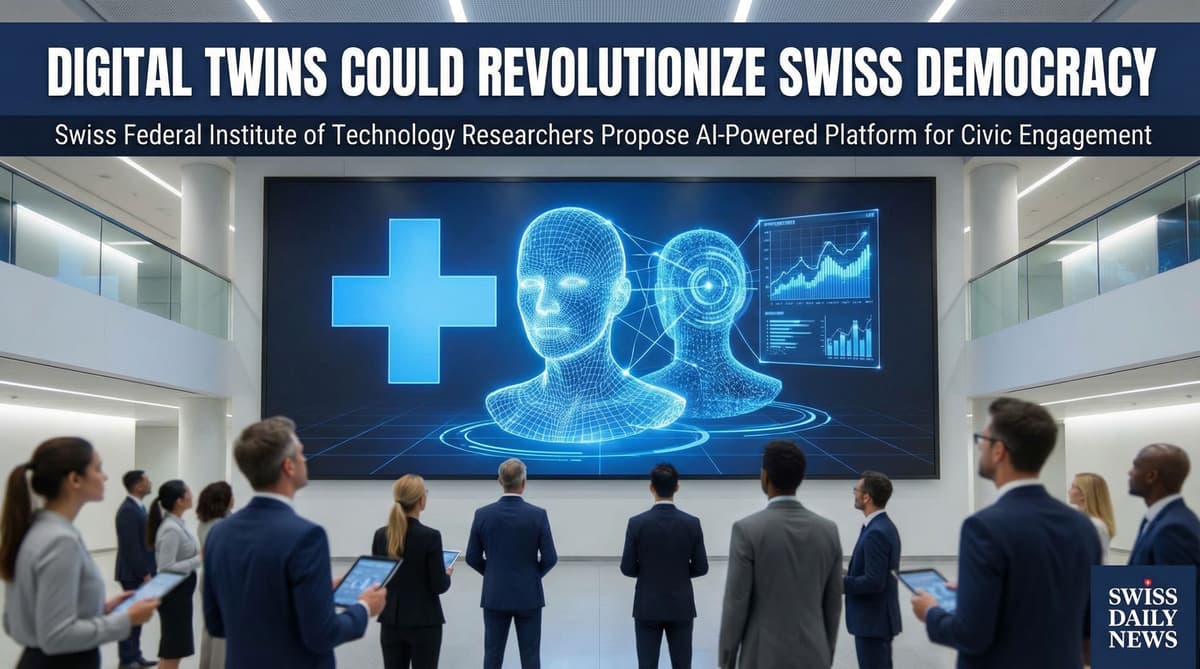
Democracy is standing on the precipice of its most significant transformation in centuries. While the world grapples with the implications of artificial intelligence, Swiss researchers are not just watching—they are leading the charge. Hans Gersbach, a macroeconomics professor at the prestigious ETH Zurich, alongside his American colleague César Martinelli, has unveiled a bold, paradigm-shifting concept: the integration of "digital citizens" into the democratic fabric. This is not science fiction; it is a calculated proposal to overhaul how we govern.
These are not mere static profiles. Digital twins are dynamic, AI-driven simulations capable of mirroring reality on a one-to-one basis. Unlike the rudimentary models of the past, today's computing power allows these twins to simulate every environmental influence and stressor a person experiences. The implication is staggering: we are moving toward a future where your digital counterpart knows your political preferences as intimately as you do, potentially revolutionizing the very definition of civic participation in Switzerland and beyond.
From Heartbeats to Votes: The Medical Precedent
The blueprint for this political revolution is already being written in our hospitals. The technology has surged ahead in the medical field with undeniable success. During last year's New York Marathon, a runner competed while accompanied by a digital twin of her heart—a real-time simulation fed by live data to monitor physical strain. The goal was not just observation, but prediction: determining exactly how the organ reacts to extreme stress.
Swiss citizens are already embracing this digital frontier. A 2023 representative survey by the University of Zurich reveals that a staggering 62% of the population favors the use of digital twins in medicine. This widespread acceptance provides a critical foundation for expanding the technology into the public sphere. If we trust an AI simulation to predict a heart attack, the leap to trusting it with complex political modeling is far shorter than skeptics might believe. The question is no longer if the technology works, but how quickly we can adapt it to serve the body politic.
Simulating Survival: The Twin4Dem Defense
While Switzerland looks to the future, Europe is using digital twins to defend the present. Democracy is under siege, and the Twin4Dem project is the new frontline. Coordinated by Erasmus University in Rotterdam, this massive initiative is simulating entire political systems to identify the cracks in our institutions before they shatter. By modeling the governments, parliaments, and courts of the Czech Republic, France, Hungary, and the Netherlands, researchers are hunting for the root causes of democratic backsliding.
This is a stress test for the state. Just as engineers simulate earthquakes to test building integrity, Twin4Dem uses real data to reveal how authoritarianism takes root. The project aims to pinpoint exactly who—and what—is responsible for the erosion of freedom. The insights gained here are critical: once the weak points are identified, institutions can be redesigned to be bulletproof. It is a proactive, aggressive approach to saving democracy, using the very technology that many fear could destroy it.