Switzerland
Crans-Montana fire report delayed as scrutiny of bar owners grows
The expert investigation into the Crans-Montana fire has been delayed, with publication now not expected before the end of January. Separately, messages indicate that the bar’s owners had been warned about the risk posed by sparklers years before the blaze.
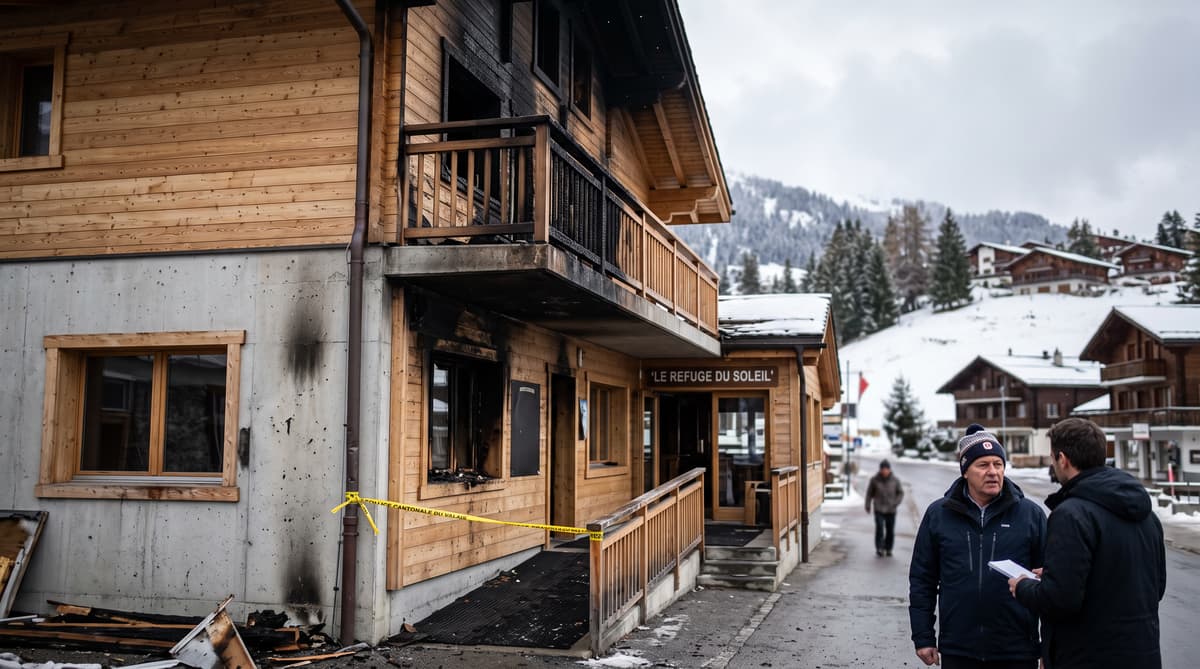
Forty one people died and 115 were injured, leaving the Valais resort facing a criminal investigation whose most important technical findings remain unresolved. The expert report into the fire at Le Constellation will not be delivered on the original timetable. Valais Attorney General Beatrice Pilloud confirmed that the deadline has been extended because of the complexity of the work.
The Zurich Forensic Institute and the Swiss Safety Centre are examining the origin and cause of the blaze for the Valais public prosecutor. The report was originally due by the end of August. The two organisations requested an extension until the end of March, while a report cited by Keystone SDA said publication was not expected before the end of January.
The delay comes as scrutiny shifts towards the bar’s owners, Jacques and Jessica Moretti. Internal WhatsApp messages from 2019, obtained by RTS, show that both warned employees about the danger of sparklers inside the premises. Lawyers for several victims’ families say those warnings could become significant evidence in determining whether the owners merely failed to prevent a foreseeable accident or accepted a risk that could kill.
2019 Warnings Put Owners Under Scrutiny
A November 12, 2019 message explicitly warned that the bar could catch fire. Jacques Moretti reprimanded an employee for giving a sparkler to a customer who left it unattended on a table. He warned staff that a sparkler falling onto the floor or sofas could set Le Constellation alight.
A month later, Jessica Moretti sent a further instruction. Customers could use sparklers, she told employees, but staff had to supervise them until they went out. She also referred to the risk of a sparkler landing on a sofa or floor, or being held near the foam on the ceiling.
The messages now form part of the criminal investigation. Lawyers for several victims’ families argue that they show the couple understood the danger and continued to accept it. Their position could support a prosecution for intentional homicide based on dolus eventualis, known in Swiss law as conditional intent. That doctrine can apply when a person recognises that conduct could cause death and accepts that possibility, even without wanting the result.
The messages do not establish criminal liability by themselves. Prosecutors must assess their wording, the owners’ actions, the premises’ safety arrangements, and the evidence about how the fire began and spread.
Defence Challenges Conditional Intent Claim
The Morettis’ defence says the same messages show prevention, not intent. Lawyers Yaël Hayat, Nicola Meier and Patrick Michod told RTS that the owners had identified a familiar hospitality risk and instructed staff on how to control it. They also noted that the messages were voluntarily submitted to prosecutors.
The defence rejects the claim that the exchanges demonstrate conditional intent. Recognising a fire hazard, their lawyers argue, is different from accepting that people might die. Their interpretation presents the instructions as evidence that the owners tried to regulate sparkler use rather than ignore it.
That legal distinction carries a substantial penalty difference. The Morettis currently face charges carrying prison sentences of less than five years. A successful case based on intentional homicide with conditional intent could expose them to a maximum sentence of 20 years.
The prosecution will need to establish more than prior awareness of a hazard. It will have to examine whether the owners took adequate steps after issuing the warnings, whether staff followed those instructions, and whether other conditions inside Le Constellation created a foreseeable path from a spark to a rapidly spreading fire. The delayed expert report may provide crucial evidence on those points.
Experts Trace How the Fire Spread
The experts are examining the foam installed in the bar’s basement and how it behaved when exposed to fire. The Zurich Forensic Institute and the Swiss Safety Centre were appointed to establish the blaze’s origin and cause. Their findings are expected to help prosecutors reconstruct how ignition occurred, how quickly flames and smoke spread, and whether the premises contained materials that worsened the disaster.
The request for more time highlights the technical demands of the investigation. The organisations initially worked towards a report due by the end of August, then sought an extension until the end of March. Pilloud confirmed the delay without giving a more detailed timetable for publication.
Those findings will be weighed alongside witness accounts, digital messages, building records, safety instructions, and any evidence concerning the bar’s operation on the night of the fire. A technical conclusion cannot by itself decide whether the Morettis acted negligently or with conditional intent. It can, however, clarify the physical sequence that prosecutors must connect to the owners’ decisions.
Families are waiting for that explanation while the criminal process continues. The report’s eventual release is likely to shape the next stage of the Valais investigation and the legal arguments over responsibility.
What the Delayed Report Must Answer
The delayed report will test both the physical and legal explanations of the Crans-Montana tragedy. For the Valais prosecutor, the investigation must establish how the fire started and whether its spread was linked to materials, layout, management decisions, or a combination of factors. For victims’ families, the 2019 messages raise a separate issue: what the owners understood about the danger before the disaster and what they did in response.
Swiss criminal proceedings will distinguish between an acknowledged workplace hazard and acceptance of a lethal outcome. The owners’ lawyers say their warnings demonstrate an effort to protect customers. The families’ lawyers say the same warnings may show that the risk was known and insufficiently controlled.
No final conclusion on those competing claims can be drawn from the messages alone. Prosecutors still need the expert evidence and the wider case file. The report’s delay therefore affects more than a publication date. It postpones a central piece of the evidence needed to assess potential charges and responsibility.
The next milestone will be the completion of the experts’ work, followed by the prosecutor’s assessment of the evidence. Until then, the 41 deaths and 115 injuries remain at the centre of a case that has drawn national attention to fire safety in Swiss hospitality venues.