Climate
Swiss research examines how Arctic shipping emissions affect clouds and ice
Research by EPFL scientists aboard an Arctic vessel examined how ship exhaust affects cloud formation and melting ice. The findings are especially relevant as climate change and geopolitical disruption push more shipping towards polar routes.
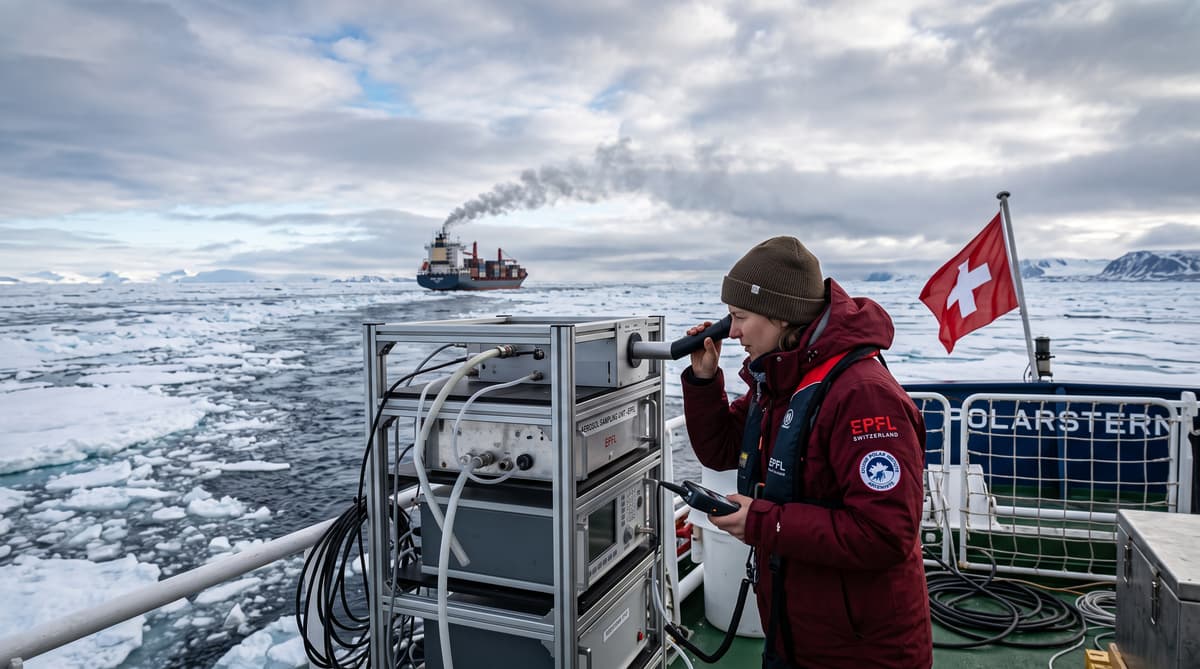
A research vessel's exhaust gave EPFL scientists a rare view of ship pollution in the Arctic. Professor Julia Schmale and PhD student Benjamin Heutte spent a year aboard a vessel in the Arctic Ocean, initially aiming to learn more about natural aerosols: how these tiny particles form, travel and influence clouds and climate.
The ship complicated that plan. Winds repeatedly blew its exhaust over the team's measuring instruments. Schmale and her colleagues chose to treat the plume as an opportunity, describing the setup as “like a controlled experiment”. Summer air pollution in the Arctic is almost non-existent, the researchers noted, making it possible to examine emissions from a single vessel against a relatively clean background.
Their work arrives as ships increasingly consider polar passages. The Northwest Passage can shorten the journey between East Asia and Western Europe by more than 10,000 kilometres. As climate change alters sea ice and geopolitical disruption redirects trade, the route has growing commercial and strategic significance. The EPFL team's observations offer a close look at one local effect of that traffic: the interaction between ship particles, clouds and ice.
Trace how ship particles affect clouds and ice
Clouds can either trap heat near Arctic ice or cool the surface, depending on their composition and location. They affect the balance of radiation by reflecting sunlight back into the sky and sending some of Earth's infrared radiation back towards the ground.
Schmale explains that clouds with a higher liquid-water content act “like a blanket”: they return more of the Earth's outgoing infrared radiation towards the surface. This matters even in icy conditions, because infrared radiation transports heat. Clouds made up more of water droplets than small ice crystals can therefore influence how quickly ice melts.
The researchers' preliminary estimate points to a local effect. When a cloud sits above ice, ship-caused pollutants affecting it within a 100-metre radius may lead to around 1 millimetre of additional ice melt per day. The relationship changes over open water: there, the cloud has a cooling rather than warming effect. The estimate describes a particular combination of cloud position and pollution exposure. It does not mean every passing ship causes the same rate of melt across the Arctic.
Track the routes opening through shrinking ice
Falling summer ice and rising ship traffic are making Arctic routes more accessible and more contested. Summer sea ice has declined by 13% per decade since the 1990s, according to the German Alfred Wegener Institute. Satellite data suggests the Arctic could experience its first ice-free summer as early as 2030.
The Arctic Council says shipping traffic in the region has risen by 40% in 12 years. Routes remain difficult: ships still have to weave through ice, but changing conditions have made passages that were once hard to navigate increasingly relevant to global transport. The Northwest Passage offers a potential distance saving of more than 10,000 kilometres between East Asia and Western Europe.
Governments are also looking beyond shorter journeys. The Arctic forms part of China's Belt and Road Initiative, and Beijing's polar strategy aims to position the country as a “near-Arctic state” by 2035. Anastasios Leonburg, a former captain and maritime risk adviser at Allianz Insurance, says: “China wants to become the leading nation in the Arctic.” Commercial opportunity and strategic competition are developing alongside the environmental changes that help open these routes.
Put the findings in climate context
The EPFL measurements add one piece to a much larger climate puzzle. Schmale and Heutte set out to study natural aerosols, but the vessel's exhaust offered a chance to observe how particles from a single ship interact with clouds in a region where summer air pollution is almost absent. That unusual setting helped the researchers examine a specific plume, rather than trying to separate it from many other sources.
The findings remain a small contribution to understanding cloud formation and climate. The researchers' estimate of extra melt is preliminary and applies to clouds above ice within a limited radius of ship-caused pollution. Over water, the cloud effect can be cooling. Those differences underline why the location and makeup of clouds matter when assessing the consequences of Arctic emissions.
For Switzerland, the work puts EPFL research into a debate shaped by climate science, trade and geopolitics. More ships may seek polar routes as ice conditions change, while the emissions from that traffic could influence local cloud processes. The team's observations give researchers a concrete case to build on as they investigate how ship activity fits into the Arctic's changing climate.