Housing
Zurich tops global property-bubble risk ranking
Zurich has recorded the highest property-bubble risk of any city in UBS’s latest global index, driven by strong demand, limited supply and historically rapid price growth. Geneva’s risk has also risen, highlighting continuing pressure in Switzerland’s housing market.
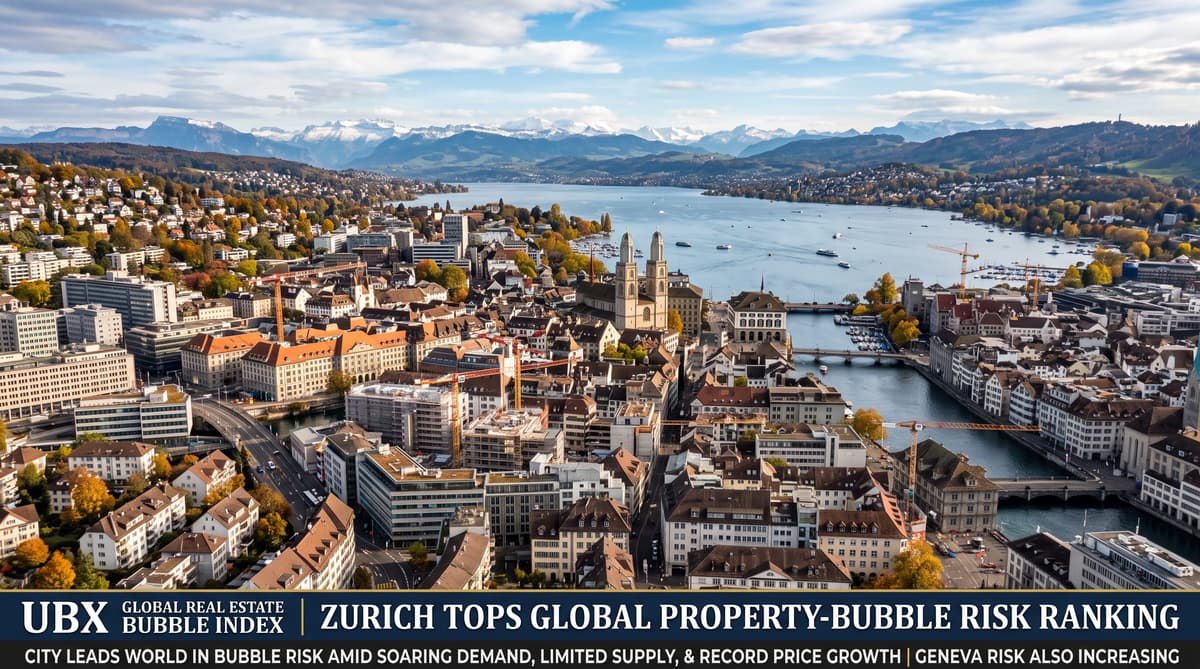
Zurich now carries the highest property bubble risk in the world, according to UBS. The bank gave Switzerland's largest city a score of 1.69 points in its Global Real Estate Bubble Index 2026, placing it ahead of Tokyo, Miami and Dubai. The result matters for a city where homes are already among the country's most expensive and where finding a vacant apartment can be difficult even for well-paid professionals.
UBS compared residential property markets in 23 major cities. Zurich's score increased from 1.55 points last year, extending a long period of concern over prices, supply and affordability. Geneva also moved further into the high-risk category, rising from 1.05 to 1.12 points and ranking sixth.
A bubble-risk score does not predict an imminent crash. It measures the gap between property valuations and underlying economic conditions, alongside market momentum, credit conditions and construction activity. Zurich's position reflects the interaction of strong employment, international migration and scarce housing.
The report places Switzerland's two main international centres at the centre of a wider housing debate. Rising prices have benefited owners, while tenants and first-time buyers face intense competition for a limited number of homes.
Talent, Jobs and Scarce Homes
Zurich has recorded the sharpest residential property price increase over the past 20 years among the cities in the UBS study. The rise reflects the city's role as Switzerland's main financial and business hub, as well as its growing importance to technology and artificial intelligence companies.
International professionals have added to demand in a market that was already constrained by geography and planning limits. Zurich combines a compact urban area, protected landscapes around the city and strong competition for centrally located housing. Employers can attract skilled workers, yet many of those workers enter a rental market with few available homes.
UBS described the influx of international talent as a driver of what it called the sharpest rise in residential property prices across the cities surveyed. Demand has also remained resilient because Zurich offers high wages, reliable infrastructure, access to universities and a concentration of global companies.
The pressure is visible beyond luxury districts. Affordability problems are widening the gap between the most sought-after neighbourhoods and other parts of the market. Buyers with substantial capital can compete for scarce homes, while households relying on salaries face higher borrowing costs, larger deposits and fewer options close to jobs and public transport.
A Supply Crisis Keeps Prices Elevated
Vacancy rates in Zurich are close to zero, leaving supply unable to match demand. UBS said the supply of owner-occupied housing also remains well below its historical level. Those conditions allow prices to keep rising when buyers compete for a small number of properties.
Interest rates have added another layer to the story. The period of low borrowing costs made mortgages more affordable and supported higher valuations across Switzerland. Even when financing conditions change, owners may be reluctant to sell, while construction can take years to move from approval to completion. New homes therefore arrive slowly in a market where demand can shift quickly.
For renters, the shortage translates into more applications, tougher selection and longer searches. For prospective owners, the hurdle is larger. A household must save a substantial deposit and demonstrate that mortgage costs remain affordable under Swiss lending rules. Price growth can push properties beyond that threshold even when mortgage rates are relatively favourable.
The imbalance also affects the wider region. Commuters look to municipalities beyond Zurich's core, placing pressure on transport corridors and neighbouring housing markets. Building more homes could ease the shortage, but land availability, local opposition and planning procedures limit the speed of any response.
Geneva Feels the Same Pressure
Geneva's bubble-risk score rose to 1.12 points, confirming that the pressure extends beyond Zurich. The lakeside city ranked sixth in the UBS index, with prices and shortages producing a market profile similar to Zurich's. Geneva's position reflects its concentration of international organisations, finance, private wealth and highly paid specialist jobs.
Zurich scored higher than every other city in the index. Tokyo followed at 1.54 points, Miami at 1.41, while Geneva stood at 1.12. The ranking also shows that high prices alone do not determine bubble risk. Paris registered 0.33 points, London 0.30 and New York 0.28, according to Swissinfo's report on the UBS analysis.
Lisbon and Seoul entered the study for the first time this year, expanding the comparison of major urban property markets. San Francisco recorded minus 0.02 points, while São Paulo registered minus 0.24 points, the lowest score among the cities cited.
The Swiss results deserve particular attention because both Zurich and Geneva combine international demand with limited housing supply. Their economies continue to draw workers and capital, while residents compete for a relatively fixed stock of homes. That combination can sustain prices for years, although it leaves the market sensitive to changes in employment, financing or migration.
The Risks of a Sudden Correction
Switzerland has not experienced a property crash of this kind since the 1990s, but the consequences of a sudden correction would reach well beyond estate agents and investors. If prices fell sharply, some owners could find that their mortgage exceeded the value of their home. Banks would face greater credit risk, construction activity could slow and households might cut spending to repair their finances.
A correction would also change the housing shortage in uneven ways. Lower prices could eventually improve access for buyers, yet falling values can reduce confidence and weaken development projects. Property owners who bought recently would face the greatest exposure, particularly if they used high levels of debt or planned to refinance soon.
UBS's ranking is a risk assessment, not a timetable for a crash. Zurich's strong economy, limited land and continuing demand can support elevated prices even as affordability deteriorates. The immediate challenge for policymakers is to expand housing supply without undermining the infrastructure and quality of life that make the city attractive.
For households, the index reinforces a practical reality: Zurich's market remains highly competitive. Renters should expect continued pressure while buyers must assess borrowing capacity against possible changes in rates and prices. The next phase of Switzerland's housing story will depend on whether supply can catch up with the people and businesses drawn to its cities.