Zurich
Zurich anti-abortion march disrupted by counter-protesters
More than 1,000 people joined Zurich’s March for Life, while masked counter-protesters disrupted the anti-abortion demonstration and prompted a major police response.
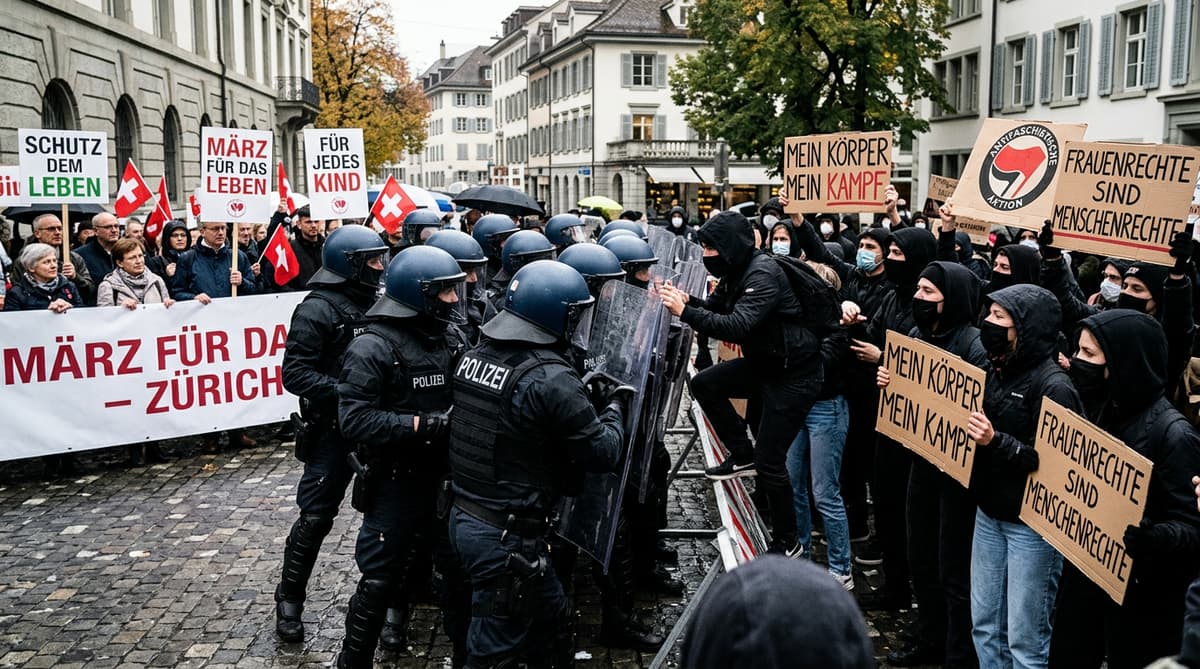
Zurich March Draws a Large Crowd
More than 1,000 people gathered in Zurich-Oerlikon on Saturday for the March for Life, an anti-abortion demonstration that drew a major police operation and an organised counter-protest. Participants assembled at the market square behind barriers under the slogan “Together for Life!”. Swiss People’s Party parliamentarian Nicolas Kolly addressed the crowd.
The authorised event proceeded under close supervision because far left-wing groups had announced counter-demonstrations, according to the Keystone-SDA news agency. Police deployed two water cannons and checked several people near the demonstration site.
The march has become a recurring fixture in Zurich’s political and religious calendar. Conservative Christian groups have organised the Oerlikon event since 2021, while the broader March for Life has taken place since 2010. Its presence continues to provoke opposition from activists who reject the organisers’ position on abortion and their public campaigning.
Saturday’s confrontation brought that dispute into the streets. The disruption affected the opening of the procession and required police intervention before demonstrators could continue along the planned route.
Masked Cyclists Block the Route
Around 200 masked counter-protesters arrived on bicycles and disrupted the start of the march. They blocked the road, overturned rubbish bins onto the carriageway and set off firecrackers, according to Keystone-SDA.
Police repeatedly ordered the group to leave. Officers then used the water cannons to clear the route. The counter-protesters later reappeared at several points along the procession, forcing police to maintain a substantial presence as the march moved through the district.
The incident illustrates the practical challenge of policing rival demonstrations in a dense Swiss city. Authorities had to protect an authorised procession while responding to an unauthorised action that obstructed traffic and created hazards on the route. The source report did not specify arrests, injuries or property damage beyond the overturned rubbish bins.
The counter-protesters’ use of masks and bicycles gave the disruption mobility, allowing the group to move away from one location and return elsewhere. Police checks near the demonstration site formed part of the wider effort to prevent further interference and keep the scheduled event moving.
Organisers Challenge the City-Centre Ban
Six consecutive years of exclusion from Zurich’s city centre have sharpened the dispute between the March for Life organisers and city authorities. Organisers argue that the restriction is a disproportionate limit on freedom of assembly and expression. They are contesting the decision through the courts.
The city has permitted the gathering in Oerlikon rather than allowing it to take place in central Zurich. That choice reflects the authorities’ approach to an event that regularly attracts opponents and requires extensive security planning. The market square was cordoned off with barriers on Saturday, while police prepared for announced counter-demonstrations.
The march’s supporters frame the event as a public expression of conservative Christian opposition to abortion. Its opponents have repeatedly staged unauthorised counter-demonstrations in Oerlikon, including on earlier occasions. The recurring conflict has turned the choice of location into a central part of the dispute.
Switzerland’s rules on public assembly give authorities responsibility for balancing political expression, public safety and access to streets and public spaces. The court challenge will determine whether Zurich’s continued city-centre restriction meets that balance.
Zurich Faces the Next Round
Since 2010, the March for Life has given anti-abortion groups a regular platform in Switzerland, while repeated counter-demonstrations have kept the event at the centre of local debate. Saturday’s confrontation shows how quickly a permitted gathering can become a large-scale policing operation when rival groups occupy the same streets.
The demonstration also sits within a wider Swiss debate over abortion policy and public attitudes. Parliament has approved a change under which Swiss health insurers will cover the full cost of abortions from 2027, a policy shift examined in a separate Swissinfo report. The March for Life organisers continue to oppose abortion and seek visibility for their position despite being kept outside the city centre.
For Zurich, the immediate issue remains how to manage future demonstrations. Police must account for the established march, announced opposition protests and the possibility of mobile groups disrupting the route. The organisers’ court challenge could also affect where similar events take place in coming years.
No further outcome from that legal challenge was reported in the source material. For now, Oerlikon remains the setting for a recurring confrontation over abortion, religious activism and the limits of public protest.