transportation
SWISS and SBB Launch New Combined Travel Routes
Switzerland's national airline SWISS partners with SBB railways to expand 'Air Rail' service, offering integrated train and air travel bookings to new destinations.
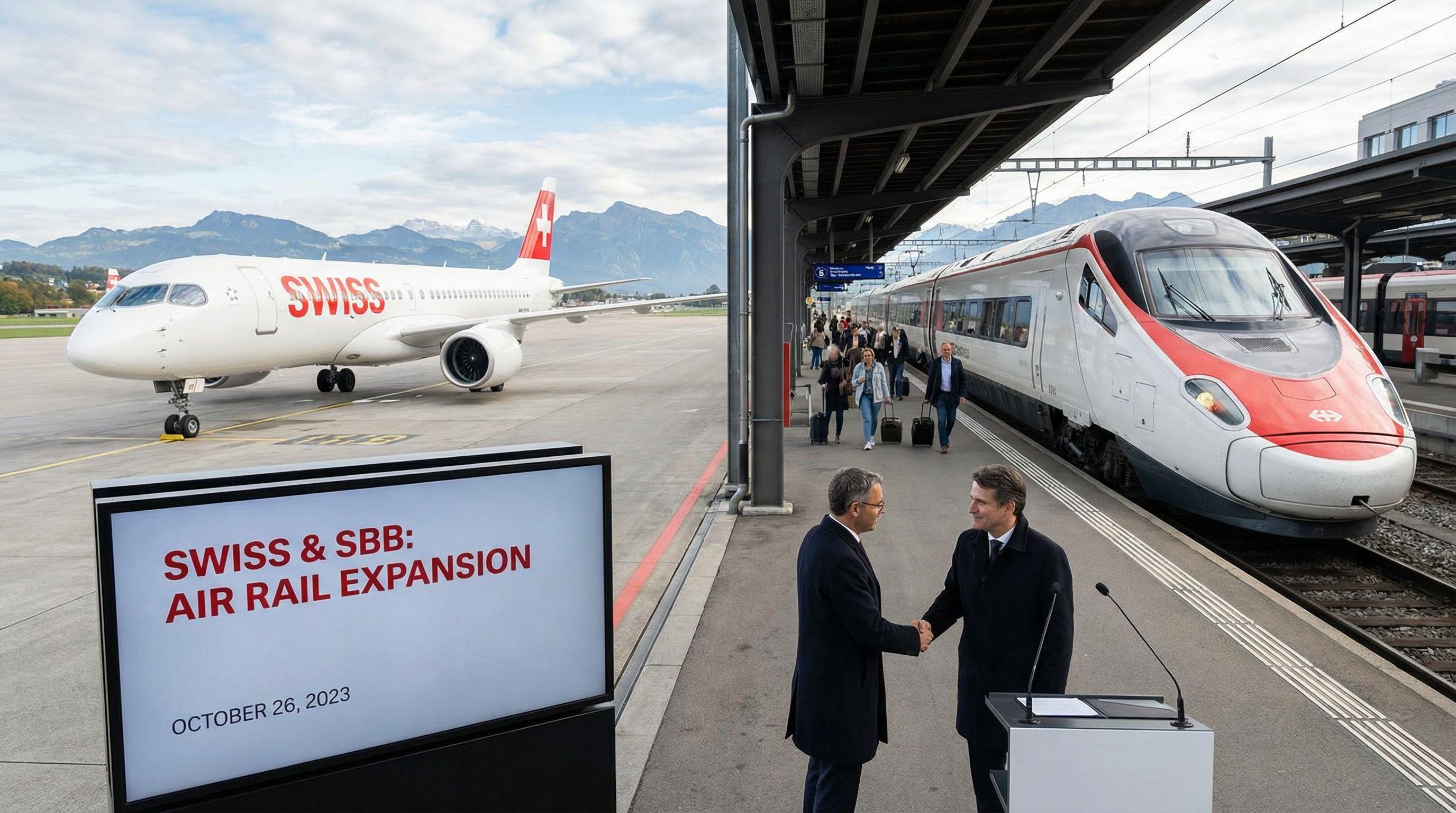
Network Surges to 24 Destinations
Switzerland’s transport infrastructure is witnessing a critical evolution as SWISS and SBB aggressively expand their combined 'Air Rail' network. Starting October 27th, the partnership will unlock three vital new arteries: St. Gallen, Konstanz, and Locarno. This strategic move propels the total number of connected destinations to a staggering 24, cementing the alliance between the national carrier and the federal railways.
The inclusion of these cities is not merely a schedule update; it represents a fundamental shift in how Swiss mobility is engineered. By integrating the eastern hub of St. Gallen, the border city of Konstanz, and the southern flair of Locarno directly into the Zurich Airport ecosystem, the operators are effectively shrinking the country. "This expansion brings the total number of Air Rail destinations to 24 and makes connecting between train and plane even easier for travellers," the companies declared in a joint press release. This bold expansion signals a clear intent: to dominate the intermodal travel market by making the train-to-plane transfer indistinguishable from a connecting flight.
Seamless Integration: The Single-Ticket Revolution
Bureaucracy is being slashed in favor of efficiency. The days of juggling disjointed bookings and managing separate itineraries are rapidly vanishing for savvy travelers. The core value proposition of the Air Rail system is its ruthless simplicity: one booking, one ticket, total coverage. Travelers no longer need to navigate the SBB interface separately from the SWISS booking engine.
This system eliminates the friction of multi-modal travel. A passenger can book a journey from Locarno to New York in a single transaction. As the airline clearly states, "When embarking on the journey, the traveller needs to check-in only once, and will then be issued with their boarding pass (which includes their rail ticket) directly from SWISS." This level of integration provides a critical safety net as well; because the train is treated as a flight leg, connections are guaranteed. If the train is delayed, the airline takes responsibility, a massive advantage over booking separately. This is not just convenience; it is the modernization of the passenger experience.
From Alpine Resorts to Cross-Border Hubs
The network's reach now extends far beyond the major metros. While heavyweights like Geneva, Bern, and Lausanne remain central pillars, the system has aggressively penetrated the tourism-heavy canton of Graubünden. The capital, Chur, along with elite Alpine resorts such as Davos, Klosters, and St. Moritz, are fully integrated. This ensures that the journey to Switzerland’s most exclusive ski slopes begins the moment a passenger steps off the plane in Zurich.
Furthermore, the ambition of this partnership ignores national borders. The network creates a seamless corridor into neighboring countries, incorporating Munich in Germany and Bregenz in Austria. By treating these foreign stations as extensions of Zurich Airport, SWISS is effectively capturing a broader European market. Whether for the business traveler commuting from Munich or the tourist heading to the Ticino region via Bellinzona and Lugano, the infrastructure is being rewired to funnel traffic through Switzerland's primary aviation hub with unprecedented ease.
Born from Crisis: The Strategic Pivot
Innovation often rises from the ashes of disruption. The Air Rail service was forged in the fires of the 2020 Covid pandemic, a time when the aviation industry faced an existential threat. When demand plummeted and the frequent short-haul flights between Zurich and Geneva dwindled from ten daily to a mere two, the operators were forced to adapt. Trains were deployed to fill the void, replacing wings with wheels to maintain essential connectivity.
What began as a crisis management measure has matured into a permanent, sustainable strategy. Replacing short domestic feeder flights with high-speed rail is no longer just a stopgap; it is the future of environmentally conscious travel in Europe. By solidifying this partnership, SWISS and SBB are acknowledging that for distances within the compact Swiss geography, the train is not a competitor to the plane—it is the superior partner. As the network hits 24 destinations, this model proves that the pandemic-era pivot has permanently reshaped the Swiss travel DNA.