privacy
Swiss pools move to ban camera-equipped smart glasses
Switzerland’s swimming pools and saunas are calling for camera-equipped smart glasses to be banned across their premises. Operators say the devices make it difficult to detect filming and threaten privacy in pools, changing rooms and sauna areas.
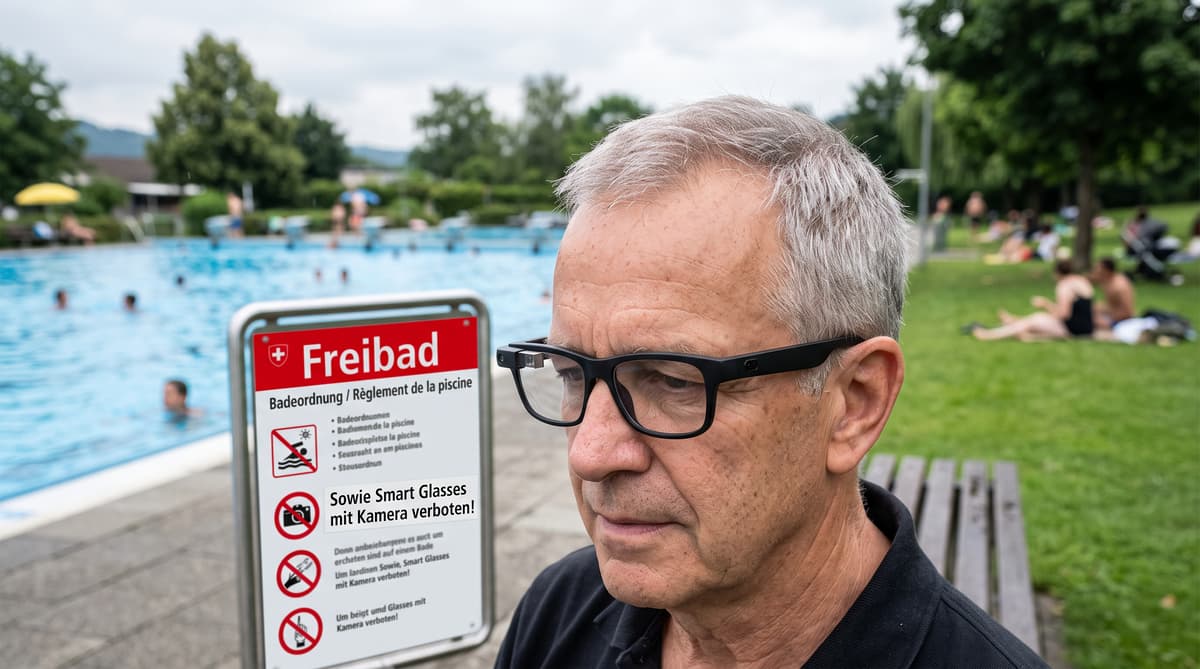
On October 12, Swiss pool and sauna organisations asked local authorities to close a privacy gap created by camera-equipped eyewear. The Swiss association of swimming instructors, the association of swimming pools and the Swiss sauna federation issued a joint warning in German-speaking Switzerland. They urged municipalities to amend their operating rules so that glasses with a recording function cannot be worn anywhere on pool premises.
The concern reaches beyond the water. Changing rooms and sauna areas present the same risk, while the devices can resemble ordinary prescription glasses or sunglasses. That makes a suspicious lens harder for staff or other bathers to identify than a mobile phone held openly at shoulder height.
The associations’ intervention comes as smart glasses become more visible in Swiss cities and as local councils consider how existing privacy rules apply to them. Bern, Zurich and other municipalities have already seen motions calling for restrictions in public swimming pools and sports facilities.
No national law has been announced in the source material. The immediate push is local: operators want clear wording, consistent signage and a rule that staff can enforce without having to determine whether a pair of glasses is actively recording.
Target the Recording Function
The proposed rule targets the recording function, not the appearance of the eyewear. Under the associations’ recommendation, optical devices capable of recording would be prohibited throughout pool premises. That approach avoids asking reception staff or lifeguards to distinguish one brand from another, or to prove that a camera is switched on.
The practical difficulty is detection. Traditional cameras and smartphones are usually visible when someone photographs or films. Smart glasses place the lens at eye level and can record while the wearer appears to be looking normally across the pool, a locker area or a sauna. The joint statement warns that bathers may be filmed without their knowledge.
The groups have prepared a guide for staff and an information poster for visitors. Those materials are intended to give facilities a common basis for explaining the restriction, handling disputes and directing people to remove the glasses or leave them outside restricted areas.
The proposal also reflects the character of Swiss pool governance. Many facilities operate under municipal or local regulations, so implementation will depend on town councils, pool operators and the wording of each house rule. A ban may be straightforward to post, but its effectiveness will depend on consistent enforcement at the entrance and on the pool deck.
Push the Debate Into Town Halls
Pressure on Swiss municipalities has grown over recent months. Motions seeking bans have been submitted in Bern, Zurich and other cities, extending a debate that has already reached public pools in Basel, Lucerne and elsewhere. The issue is therefore moving from individual complaints to questions about municipal policy.
A local rule can give operators a clear answer when a visitor challenges a restriction. It can also align pool facilities with the heightened privacy expectations already associated with changing rooms and saunas. Those spaces are designed for personal privacy, and operators have limited visibility into what visitors may be recording.
The associations’ recommendation does not provide figures on reported incidents, nor does it identify a specific manufacturer or model. Its case rests on the difficulty of recognising the devices and on the possibility of filming without consent. That distinction matters for policymakers weighing a preventive restriction against incident-by-incident enforcement.
Municipalities will now have to decide whether to revise their regulations, how widely to define pool premises and what penalties or removal procedures should apply. The guide and poster give operators a starting point, while the political motions indicate that some councils are already preparing for more formal action.
Watch the Regional Split
The response is divided by region, with French-speaking Switzerland and Ticino taking a watch-and-monitor approach. The association representing pools in French-speaking Switzerland and Ticino, APRT, told Keystone-SDA that it is not introducing measures for the time being. It said it had received no specific reports about smart glasses, a relatively new phenomenon, while staff have been trained and made aware of the issue.
That position contrasts with the German-speaking associations’ call for local regulations to prohibit camera-capable eyewear. The difference does not indicate a national disagreement over privacy. It reflects different levels of reported activity and the way Switzerland’s pool sector is organised through regional and local bodies.
For bathers, the result may be a patchwork of rules. One facility may require smart glasses to be left at reception, while another may rely on staff awareness and existing privacy provisions. Visitors using corrective eyewear could also face questions about whether their glasses include a recording function, making clear communication important.
The next phase will depend on municipal decisions, reports from operators and how quickly the technology spreads. For now, Swiss pool associations are asking facilities to treat recording-capable glasses as a category of their own, even when the devices look like ordinary eyewear.