animal health
Twenty Swiss pig herds to be culled after lung disease outbreak
Twenty pig farms in six Swiss cantons must cull their herds after an outbreak of enzootic pneumonia. Around 1,500 breeding sows and their piglets are affected, while animal movements have been restricted at dozens of other farms.
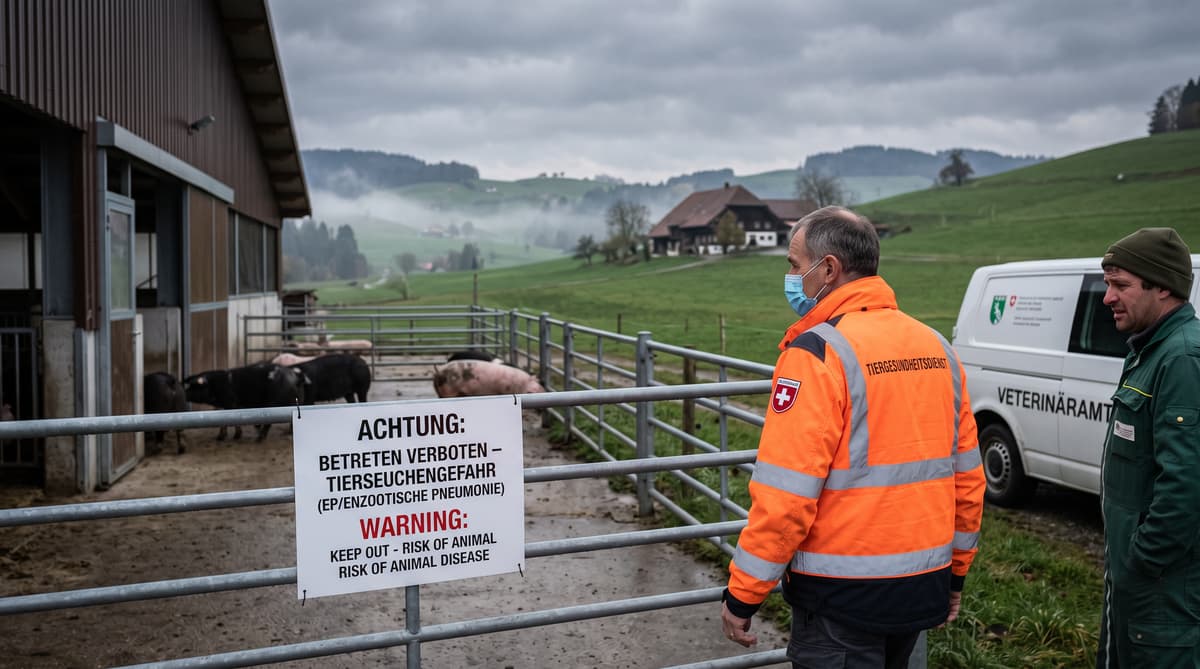
Twenty pig herds across six Swiss cantons face complete culling after an outbreak of enzootic pneumonia. The measure affects farms in Bern, Lucerne, Solothurn, Schwyz, Thurgau and Vaud, with the largest concentration in Lucerne, where 11 farms are involved.
Authorities ordered the culls to contain the contagious lung disease and prevent transmission through Switzerland’s interconnected pig sector. Around 1,500 breeding sows and their piglets are affected. The animals will be humanely euthanised, according to a statement cited by Keystone-SDA.
The operation reaches beyond the 20 farms facing depopulation. Authorities have restricted animal movements at 40 fattening farms in 14 cantons, limiting the transfer of pigs while officials assess the risk of further spread. On Wednesday, September 16, 60 holdings in a network of pig farms and breeding facilities were placed under quarantine.
The outbreak creates an immediate logistical and financial challenge for producers, particularly farms that depend on moving animals between breeding and fattening facilities. The measures also place the focus on rapid containment, as a disease that travels through a connected production network can affect farms far from the initial cases.
Lucerne carries the largest share of the cull
Lucerne accounts for more than half of the farms ordered to cull their herds. The canton has 11 affected farms, while nine others are spread across Bern, Solothurn, Schwyz, Thurgau and Vaud. The distribution shows how the response spans several important agricultural regions rather than a single isolated site.
The affected holdings include breeding operations, where the loss of sows also removes the next generation of piglets. Around 1,500 animals in total are covered by the order, according to the report. Authorities have not published a farm by farm breakdown of the affected herds or identified a single source for the outbreak.
Enzootic pneumonia is a contagious disease that attacks pigs’ lungs. Infected animals can suffer respiratory problems and weaker growth, while the pathogen can circulate within a herd and move through contact between holdings. The containment plan therefore combines full depopulation at designated farms with restrictions on movement elsewhere.
The authorities have stressed one point for the wider public: the pathogen poses no danger to humans. The public health risk is absent, but the agricultural impact is direct. Producers must manage animal losses, disrupted movements and the uncertainty created by quarantine orders across the sector.
Authorities widen the net with movement restrictions
Movement controls now extend to 40 fattening farms across 14 cantons. These farms are not listed as sites where herds must be culled, but the restrictions prevent animals from moving freely through the production network while authorities work to contain the disease.
The controls follow a quarantine order imposed on 60 holdings last Wednesday. Those holdings belong to a network of pig farms and breeding facilities, linking the current response to the way animals and breeding stock circulate between operations. The measures can affect deliveries, production schedules and the timing of transfers even where no clinical outbreak has been reported publicly.
The six cantons named in the culling order are Bern, Lucerne, Solothurn, Schwyz, Thurgau and Vaud. The wider movement restrictions cover 14 cantons, indicating that the containment perimeter is broader than the farms facing depopulation.
The source report does not provide a timetable for lifting quarantine or movement controls. Their duration will depend on surveillance and the authorities’ assessment of whether the pathogen has spread to additional holdings. Until then, farms must operate under tighter controls designed to reduce contact between herds and limit the routes by which the disease can travel.