Switzerland
Swiss voters question politicians’ ability to handle global crises
A representative survey finds that fewer than one-third of Swiss voters believe politicians can respond effectively to global crises. The findings show strong support for closer cooperation with other democracies and security partners, while revealing uncertainty about Switzerland’s preparedness and future relationship with the EU.
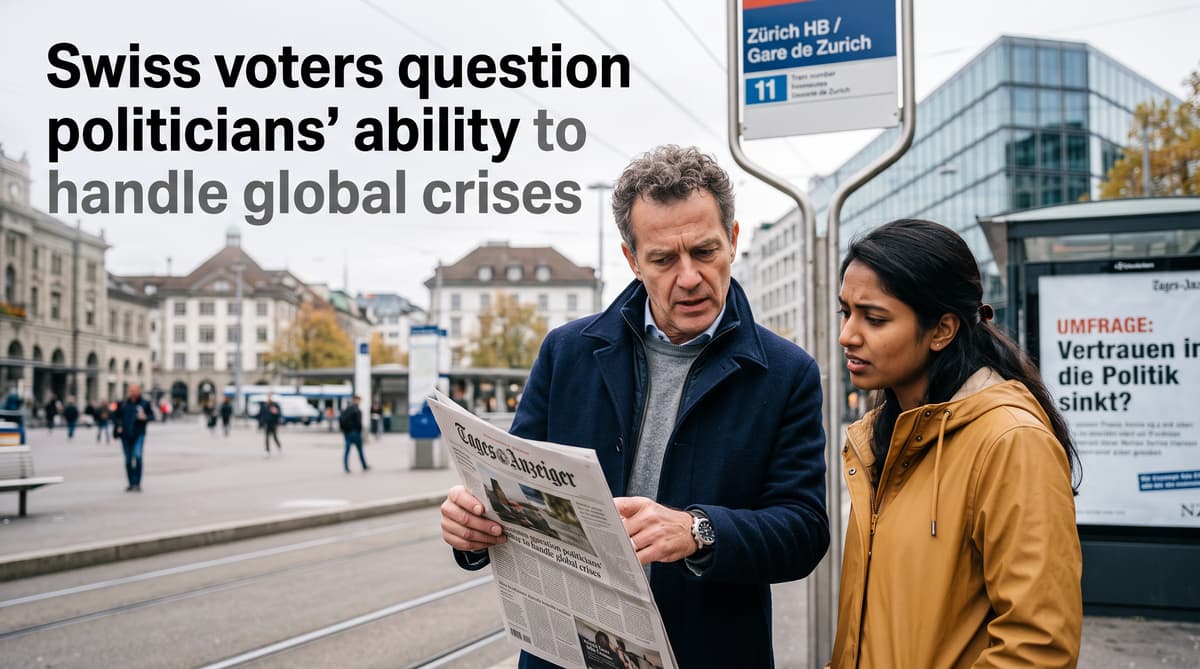
Fewer than one-third of Swiss voters believe the country’s politicians can respond to global crises at an appropriate pace, according to a representative survey published on September 10, 2026. A relative majority also considers Switzerland poorly prepared for geopolitical and security challenges.
The results place public confidence in Swiss decision-making under pressure as governments confront war, economic shocks, cyber threats, energy risks and rapid technological change. The survey does not identify one single event driving the concern. It records a broad judgment about the country’s ability to act when developments move faster than Switzerland’s political and administrative processes.
The Swiss Society for Social Welfare commissioned the survey through its think tank, Pro Futuris, and the University of Bern. The society presented the findings as the starting point for “Mission Suisse”, a non-partisan, cross-sectoral initiative intended to strengthen democracy’s capacity to act.
For a country that places a high value on consultation, federalism and political restraint, the findings highlight a difficult demand: voters want institutions to preserve democratic legitimacy while responding more quickly to external threats.
Voters Push Switzerland Toward Stronger Partnerships
Around 75% of respondents favour closer cooperation with other democracies, giving international engagement a clear mandate in the survey. The figure cuts across Switzerland’s long-running debate over neutrality, autonomy and the country’s role in a more contested Europe.
Support is also strong for practical security partnerships. Around 60% prefer security cooperation with partners such as the European Union or NATO to extensive autonomy. The result suggests that many voters distinguish between political independence and the ability to coordinate with states that share democratic institutions and security interests.
Views on closer ties with the EU remain mixed. The survey does not provide a single majority position on the broader relationship, reflecting the unsettled debate over how Switzerland should manage access to European markets, institutional links and national decision-making.
The findings arrive as Swiss officials continue to balance neutrality with sanctions, defence cooperation and cross-border risks. They also point to a public appetite for more structured partnerships, particularly when cooperation can improve preparedness without requiring voters to abandon Switzerland’s established political identity.
The Public Wants Capacity Built at Home
Around 73% of respondents support greater state investment in research, education and infrastructure. The figure reflects a broad expectation that government should build long-term capacity, even as voters question its ability to manage immediate crises.
Healthcare costs, immigration and housing costs rank as the leading domestic challenges identified in the survey. These pressures are visible in household budgets, rental markets and the political debate across cantons. They also shape how voters judge the state’s effectiveness. International preparedness carries less weight when families are struggling with premiums, rents or access to housing.
Economic policy produces a more divided picture. A relative majority of 40% wants fewer economic regulations. At the same time, just under 80% believes businesses should take more responsibility for Switzerland’s economic standing. The combination points to demand for a clearer division of duties, rather than a simple call for either more government or less government.
A majority also expects the state to act on artificial intelligence. Respondents therefore want public authorities to set direction in emerging fields while easing pressure and unnecessary constraints in parts of the economy.