science
Swiss research supports theory that the Moon once had a magnetic field
Researchers from ETH Zurich and other Swiss institutions say the Moon once generated its own magnetic field. Their analysis of probe data supports the theory that movement in the lunar core powered an ancient geodynamo.
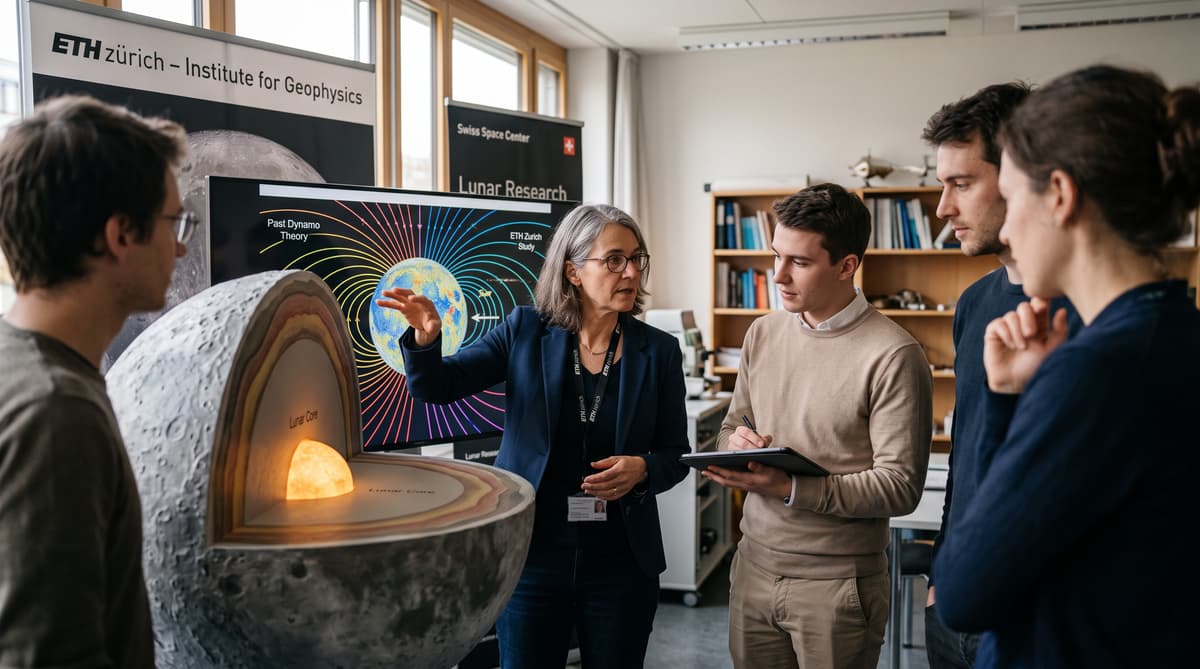
At least 10 microteslas: that is the minimum strength Swiss researchers estimate for the Moon’s magnetic field 4.2 billion years ago. A study led by researchers from ETH Zurich and other Swiss institutions has added new weight to the theory that the young Moon powered its own geodynamo, a process similar to the one that generates Earth’s magnetic field.
The findings appeared on September 23, 2026, in Science Advances. The team examined gravity and magnetic measurements gathered by probes orbiting the Moon, focusing on the Dewar region on the far side. Those readings point to a buried geological structure that is denser and strongly magnetised.
The result matters because the Moon has no global magnetic field today. Scientists have debated whether it ever possessed one, with Apollo rock samples producing conflicting evidence. The new analysis brings a different line of evidence from above the surface and links the magnetic signature to the Moon’s internal history.
Earth’s field shields the planet from charged particles carried by the solar wind. The ancient lunar field was weaker, yet its estimated strength would have made the Moon a very different environment in its early history.
A smaller core, a powerful ancient dynamo
Earth’s field is about 50 microteslas today, while the ancient lunar field reached at least 10 microteslas, according to the study. That places the Moon’s former field at roughly one fifth to one third of Earth’s current strength.
The mechanism proposed is a geodynamo. On Earth, electrically conductive liquid iron moves within the outer core. That movement generates electric currents, and the currents create a magnetic field extending far beyond the planet. The process resembles a bicycle dynamo, where motion is converted into electricity.
The Swiss analysis supports the possibility that movement inside the early Moon also sustained such a process. It does not establish every detail of that interior motion. The Moon’s core is much smaller than Earth’s, and researchers say it remains unclear how it could have produced a field of the estimated power.
That uncertainty keeps the result within the boundaries of active scientific debate. The study supports an ancient dynamo, while leaving open questions about the core’s composition, temperature and movement. Better measurements of the lunar interior could determine whether the field lasted for millions of years or followed a more complex pattern.
Probe data opens a window beneath Dewar
A structure around 60 kilometres wide and up to 9 kilometres deep lies beneath the Dewar region on the Moon’s far side, according to the model developed from probe measurements. The formation appears denser than the surrounding lunar crust and strongly magnetised.
Researchers combined the gravity and magnetic data with geochemical information and topography. Together, those clues suggest that the structure consists of solidified magma left by an underground volcanic complex. Its iron content helps explain why it retained a magnetic signature over geological time.
The location is significant. The Dewar region is outside the exposed areas where scientists can directly inspect lunar material. Its buried setting means the researchers had to reconstruct the subsurface through remote measurements rather than field sampling.
The team also considered a competing explanation: that a massive meteorite impact created the magnetisation. The researchers ruled out that possibility. The remaining interpretation connects the magnetic rocks to the Moon’s volcanic and internal evolution, strengthening the case for a field generated deep within the early lunar body.
The model remains an interpretation of indirect measurements. Future missions could test its geological structure and establish whether similar magnetised formations exist elsewhere on the far side.