Transport
Stadler tests world’s first narrow-gauge hydrogen train
Stadler Rail has developed the world’s first narrow-gauge hydrogen-powered train, designed for regional lines in Sardinia. The train is undergoing tests on a dedicated track in canton Schaffhausen.
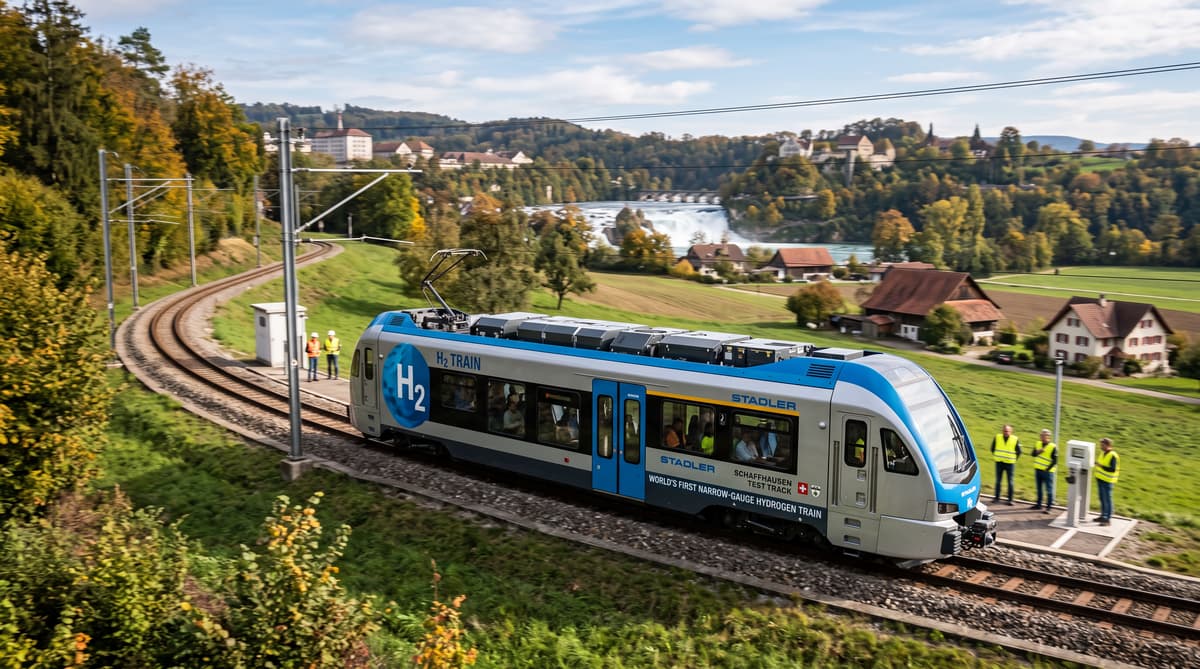
A nearly 4-kilometre stretch of railway in Schaffhausen is now carrying a new kind of passenger train. Stadler Rail is testing what it describes as the world’s first hydrogen-powered train built for narrow-gauge networks, with the first deployment planned for Sardinia.
The test line runs between Hemishofen and Ramsen, where Stadler created a third rail inside an existing standard-gauge track. The arrangement allows the company to reproduce the 950-millimetre gauge used on several regional networks in southern Italy without building an entirely separate railway.
The project places a Swiss industrial site at the centre of a transport programme aimed at replacing diesel trains on lines that are not fully electrified. Stadler is developing the rolling stock for the Sardinian Regional Transport Company, known as ARST. Systems will be examined in Switzerland before the trains undergo final trials on their intended network.
The work also builds on Stadler’s earlier hydrogen project. A FLIRT H2 train developed for California was tested on the same standard-gauge line, prompting the extension that now supports the narrow-gauge programme. The Schaffhausen facility gives engineers controlled conditions to assess the trains before they enter regular regional service.
Engineer for Italy’s narrow-gauge networks
The train is designed around a 950-millimetre track gauge used across several southern Italian regions. That measurement is narrower than the standard gauge found on most of Switzerland’s main railway network, making the engineering task more specialised.
Regional lines using the gauge operate in Puglia, Sicily, the Naples area and Sardinia. Stadler’s new train is intended for the conditions of these routes, where infrastructure, gradients and station layouts differ from those served by larger intercity trains. The company has built the vehicle for ARST, which operates regional services in Sardinia.
Hydrogen propulsion can provide an alternative on lines where continuous electrification is difficult or costly. The train stores hydrogen for use in a fuel-cell system, which produces electricity for traction. The source material does not provide technical specifications such as range, capacity or refuelling time, so those performance measures remain to be established through testing.
The programme will also cover Calabria and Sicily. Stadler expects the Schaffhausen track to support commissioning work for 21 vehicles over the next three years. Engineers will use the Swiss facility to test the rolling stock’s systems and prepare the trains for final trials on Italian infrastructure.
Prepare Sardinia for final trials
ARST says the trains will arrive in Sardinia after a major phase of testing in Switzerland. Carlo Poledrini, the company’s director-general, called the delivery a decisive step and said the completed testing would allow ARST to begin final trials on its own network quickly.
“The trains arriving in Sardinia will have already completed a major phase of testing,” Poledrini said in a statement quoted by Stadler. He linked the project to zero-emission transport and greater energy self-sufficiency, while describing the cooperation with Stadler as an operational milestone.
The sequence matters for a regional operator. Testing in Schaffhausen gives Stadler and ARST the opportunity to identify technical issues before the trains face Sardinia’s operating conditions, timetable demands and local infrastructure. Final trials in Italy will still be required before passenger service can begin.
The project’s climate impact will depend on how the hydrogen is produced, transported and supplied, as well as on the trains’ reliability in daily operation. The source does not specify the hydrogen’s origin or provide an emissions comparison with diesel. Those details will shape the practical value of the technology once the fleet enters service.
Build Switzerland’s hydrogen rail expertise
Stadler’s hydrogen programme gives Switzerland an industrial role in a wider European rail transition. The company is based in Bussnang, canton Thurgau, and employs 18,000 people, including 6,000 in Switzerland. It reported CHF 3.7 billion in turnover in 2025.
The Schaffhausen test track adds another specialised capability to that manufacturing base. It sits alongside Stadler’s work on regional trains, trams, metro vehicles and high-speed rolling stock. The company’s earlier FLIRT H2 project for California helped establish the technical basis for extending the test facility to narrow-gauge vehicles.
Stadler’s share price had increased 44% since the start of January and 57% over the previous 12 months as of October 17, 2026. Market performance does not determine whether the trains succeed in service, but it reflects investor attention around the company’s order book and transport technologies.
For Switzerland, the project demonstrates how domestic engineering expertise can support rail decarbonisation abroad. The immediate test is practical: complete the Schaffhausen programme, transfer the trains safely to Italy and prove that hydrogen propulsion can meet the demands of regional routes.