Defence
Ruag and Lockheed Martin formalise F-35 assembly deal in Switzerland
Switzerland’s Ruag and Lockheed Martin have formalised a deal to assemble and test three F-35A fighter jets at Emmen in canton Lucerne. Production is scheduled to begin in autumn 2027, making the site one of only four worldwide involved in the programme.
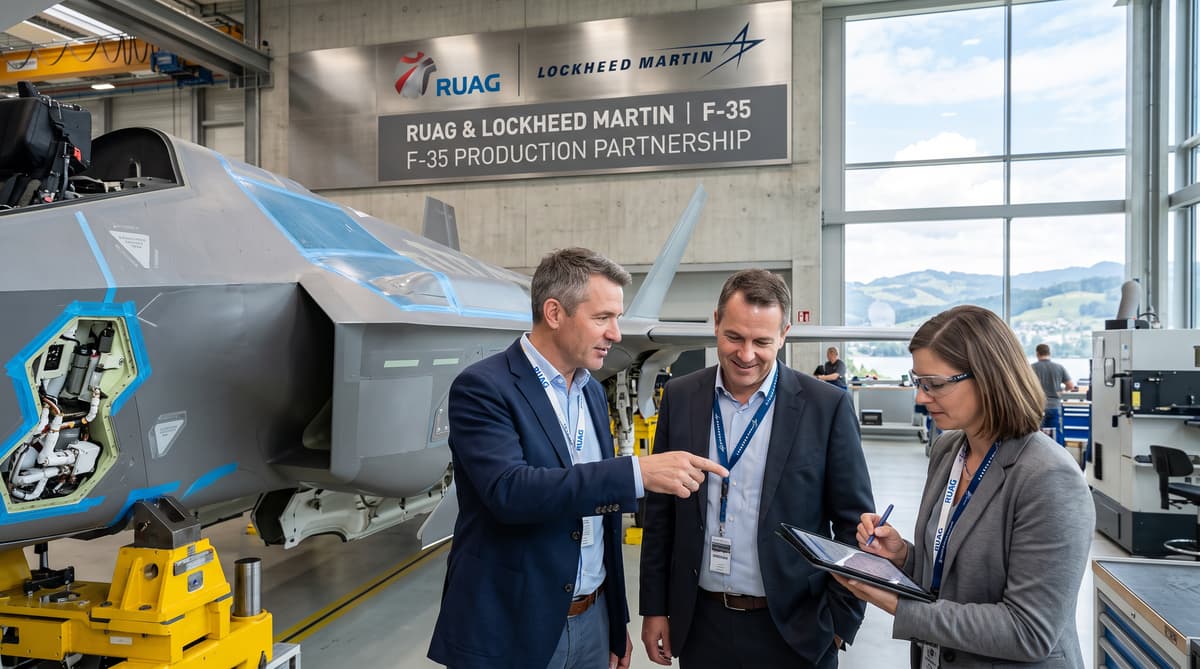
Three F-35A aircraft will be assembled and tested in Emmen under a newly formalised agreement between Ruag MRO Holding and Lockheed Martin. The deal gives the Swiss military technology company a defined role in the production programme for the US-built fighter and places the Lucerne site among a very small group of facilities worldwide with that responsibility.
Ruag announced the agreement on Thursday, October 15, 2026, under the name Rigi. The contract covers final assembly and testing of three aircraft, one fewer than the four jets originally planned. The change narrows the immediate production run, while preserving Emmen’s role in the F-35A programme.
The first components are scheduled to arrive in the first half of 2027. Production is expected to start in autumn 2027, giving Ruag and its Swiss-based workforce several months to prepare the facility, establish processes and coordinate with Lockheed Martin.
For Switzerland, the announcement links a domestic industrial site to one of the world’s most advanced fighter programmes. It also sets a clear timetable for a project that will affect aviation specialists, military planners and the wider defence-industrial sector in central Switzerland.
Put Emmen on the global map
Emmen will be one of only four sites worldwide for F-35A final assembly. That status gives the Ruag facility a role that extends beyond ordinary maintenance work. The site will also be one of only four locations worldwide involved in testing the aircraft, according to the company’s announcement.
Final assembly requires components produced elsewhere to be brought together and integrated into a complete aircraft. Testing then verifies that the finished jet meets the required technical and operational standards before it enters service. The source material does not provide details on the equipment, workforce size or specific test procedures that Ruag will use.
The global scarcity of these capabilities makes the Emmen assignment significant for Switzerland’s defence-industrial base. It gives local specialists direct experience with the F-35A and its systems, while connecting the Swiss operation to Lockheed Martin’s international production network.
Ruag describes the collaboration as a way to build expertise in the latest-generation fighter. The company also says it will strengthen Switzerland’s independence in maintenance. That objective matters across the aircraft’s service life, because domestic technical knowledge can support readiness and reduce reliance on overseas facilities for some work. The formal agreement now turns that ambition into a scheduled industrial project.
Build the first three jets
The contract covers three jets, compared with four in the earlier plan. Ruag’s announcement does not give a reason for the reduction, and neither the company nor the source material sets out any change to Switzerland’s broader F-35 procurement programme.
The distinction matters because the Rigi project concerns work carried out at Emmen, not the total number of F-35A aircraft Switzerland may operate. The agreement defines the local industrial contribution: final assembly and testing for a limited number of aircraft at the Lucerne site.
Ruag and Lockheed Martin have presented the arrangement as an expansion of their collaboration. For Ruag MRO Holding, it creates a practical pathway into the production and validation of a fifth-generation fighter. For Lockheed Martin, it adds Swiss industrial capacity to a programme already operating across several international locations.
The work will begin only after the initial preparation period. Components are due during the first half of 2027, followed by production in autumn 2027. Those milestones provide the immediate test of the agreement. They will show how the companies translate the formal contract into a functioning assembly line and how quickly Swiss personnel can build the required expertise.
Build Swiss expertise
Ruag chairman Jürg Rötheli has called Rigi a key strategic project for military aviation. His assessment reflects the project’s wider purpose, which reaches beyond the three aircraft listed in the contract. Ruag says the collaboration will help Switzerland develop expertise in the F-35A and reinforce its ability to maintain the fighter domestically.
That capability is especially relevant to a country that operates a geographically compact but technically demanding defence system. Skilled personnel, specialised facilities and familiarity with the aircraft’s systems can support future maintenance work in Switzerland. The announcement does not specify how much maintenance will be conducted at Emmen, nor does it quantify expected economic benefits or employment.
The project also gives Swiss technicians exposure to Lockheed Martin’s production standards and procedures. Such knowledge can strengthen Ruag’s position within the F-35A supply and support network, although the source does not identify additional contracts or suppliers that will benefit.
For canton Lucerne, the agreement places Emmen at the centre of a high-profile military aviation project. The next concrete steps will be the arrival of components and the preparation of the production process. Those stages will determine how the strategic language translates into lasting technical capacity.
Prepare for the 2027 deadline
Autumn 2027 is the project’s first major deadline. Before production starts, Ruag must receive the first components, prepare its Emmen operation and coordinate the assembly and testing process with Lockheed Martin. The timetable announced by the company places those preparations in the first half of 2027 and production later that year.
The schedule also gives Switzerland a visible marker for progress on its F-35A industrial participation. If the milestones are met, Emmen will move from a planned collaboration to active work on complete aircraft. The source material does not state when the three jets will be delivered, how long assembly will take or whether further aircraft could be assigned to the site.
What is clear is the strategic direction. Ruag wants to use the Rigi project to deepen its knowledge of a next-generation fighter and increase Switzerland’s independence in maintenance. Lockheed Martin is formalising a partnership that brings the Swiss company into a tightly controlled global production and testing structure.
The coming months will therefore focus on execution rather than announcements. Component deliveries, workforce preparation and the opening of the production line will establish whether Emmen can turn its designation as one of only four worldwide sites into a durable role in the F-35A programme.