Switzerland
Gaza protests draw thousands in Swiss cities, with clashes in Lausanne
Thousands protested against the war in Gaza in Zurich and Lausanne on Saturday. The demonstrations were peaceful in Zurich, while masked protesters in Lausanne damaged a UBS building and clashed with police, who used tear gas.
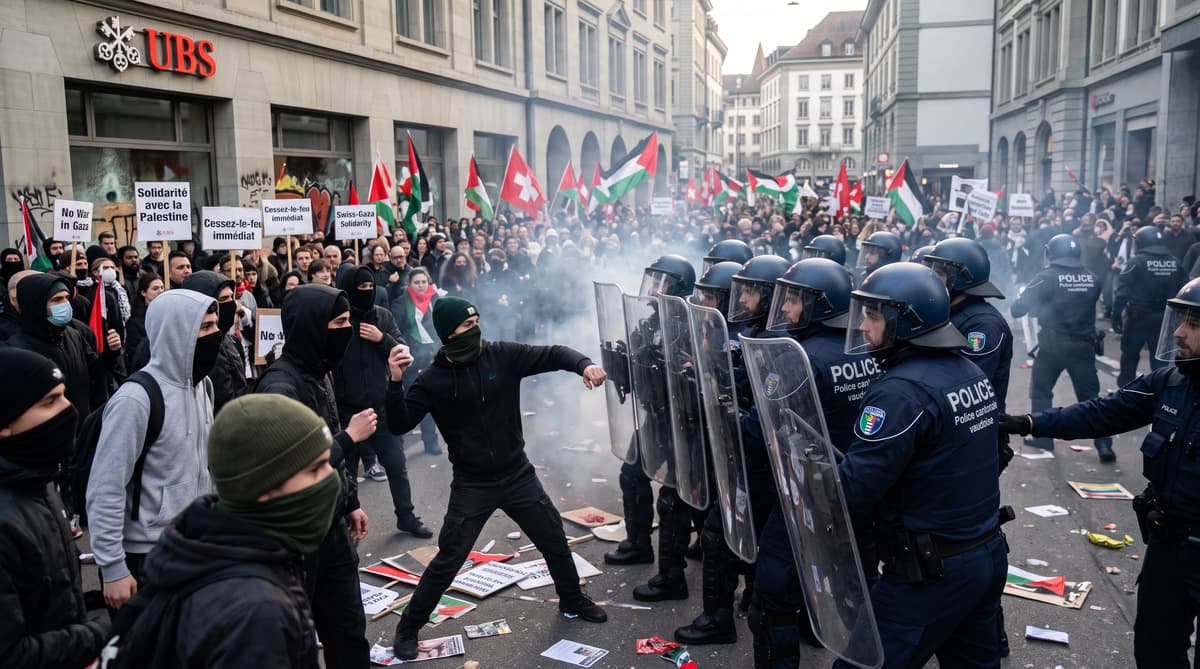
Around 2,000 people gathered in Lausanne on Saturday, October 10, 2026, as demonstrations over the war in Gaza spread across Swiss cities. Protesters assembled at Place de la Riponne at 3pm before moving through the railway station area to the Montbenon Esplanade later in the afternoon.
The Lausanne rally brought together supporters of the Palestinian cause from across French-speaking Switzerland. Organisers included the Lausanne-Palestine collective and Association Palestine, with support from groups including the UNIL-EPFL Feminist Strike collective and Antifascist Action Lausanne.
The protest remained peaceful for much of the day. Tensions escalated in Place St-François, where masked individuals smashed windows, threw red paint and spray-painted a UBS building, according to Lausanne police. A Keystone-SDA journalist reported that firecrackers were also thrown at police. Officers responded with tear gas.
Zurich also hosted a pro-Palestinian demonstration attended by thousands. The event there remained peaceful, highlighting differing conditions at rallies held in Switzerland on the same day. Police in Lausanne later said the situation was under control.
Police Contain Clashes in Lausanne
About 60 masked protesters came into direct conflict with police in Lausanne. The confrontation occurred in Place St-François after damage was reported at a UBS building. Windows were smashed, red paint was thrown and graffiti was sprayed on the bank’s exterior, Lausanne police told the Keystone-SDA news agency.
The use of masks and firecrackers marked a sharp change in the character of the rally. According to a Keystone-SDA journalist at the scene, protesters threw firecrackers at officers. Police used tear gas to disperse or contain the group.
A police spokesperson said, “We have the situation under control.” The source report did not provide details of arrests, injuries or the cost of the property damage. It also did not identify the people responsible for the vandalism.
The incident places a familiar Swiss tension in view: demonstrations remain protected as a form of political expression, while police and prosecutors can intervene when property is damaged or officers face thrown objects. In Lausanne, the response turned a largely political gathering into a public-order operation lasting into the afternoon.
Organisers Challenge Swiss Neutrality
Organisers used the Lausanne march to accuse Switzerland of enabling Israel’s conduct in Gaza. Their statements denounced what they described as Switzerland’s “complicity in the genocide, famine and colonisation” of Gaza and the occupied Palestinian territories. One banner carried the message: “Neutrality stained with blood.”
The groups called on the Swiss government to impose sanctions on Israel, arguing that Bern’s failure to act, its stated justifications for Israeli conduct and changes to legislation affecting the arms trade made the authorities responsible for violence against Palestinians. These are the organisers’ political claims, not findings established by the Keystone-SDA report.
The demonstration also exposed divisions within the Swiss left. Organisers urged some left-wing political leaders to move beyond what they called moralising rhetoric and to support active Palestinian resistance. The coalition included feminist and antifascist groups alongside Palestine solidarity organisations.
The rally’s message reflects a wider debate in Switzerland over neutrality, arms exports, sanctions and the country’s responsibilities under international law. The same debate has also reached Geneva, where investigations into alleged crimes linked to the war remain under discussion.
The Debate Moves Back to Bern
Saturday’s protests put Gaza policy back on the streets of Switzerland, with Zurich and Lausanne offering sharply different scenes. In Zurich, thousands demonstrated without reported violence. In Lausanne, the rally’s political demands were followed by vandalism and clashes involving masked protesters and police.
The divergence matters for cities preparing to manage further demonstrations. Lausanne’s organisers sought to mobilise supporters across French-speaking Switzerland, while police had to respond to damage at a prominent bank and objects thrown at officers. The source report gives no indication that the Lausanne incident represented the conduct of the wider crowd.
For Swiss authorities, the protests will keep attention focused on the balance between public safety and the right to demonstrate. The arguments raised by the organisers will also continue to test Bern’s position on neutrality, sanctions and arms trade rules as international scrutiny of the Gaza war persists.
The next steps remain procedural and political. Police investigations would have to establish responsibility for the damage and clashes. Parliament and the Federal Council will face continued pressure from activists who want a tougher line on Israel, while the government’s policy will remain contested in Swiss cities.