ETH Zurich
ETH Zurich research reshapes understanding of asteroid Bennu’s origins
Analysis of dust returned from asteroid Bennu by NASA’s OSIRIS-REx mission suggests the asteroid formed near the Solar System’s water-ice boundary rather than in its distant outer reaches. ETH Zurich researchers say the findings revise assumptions about Bennu’s origins and the early architecture of the Solar System.
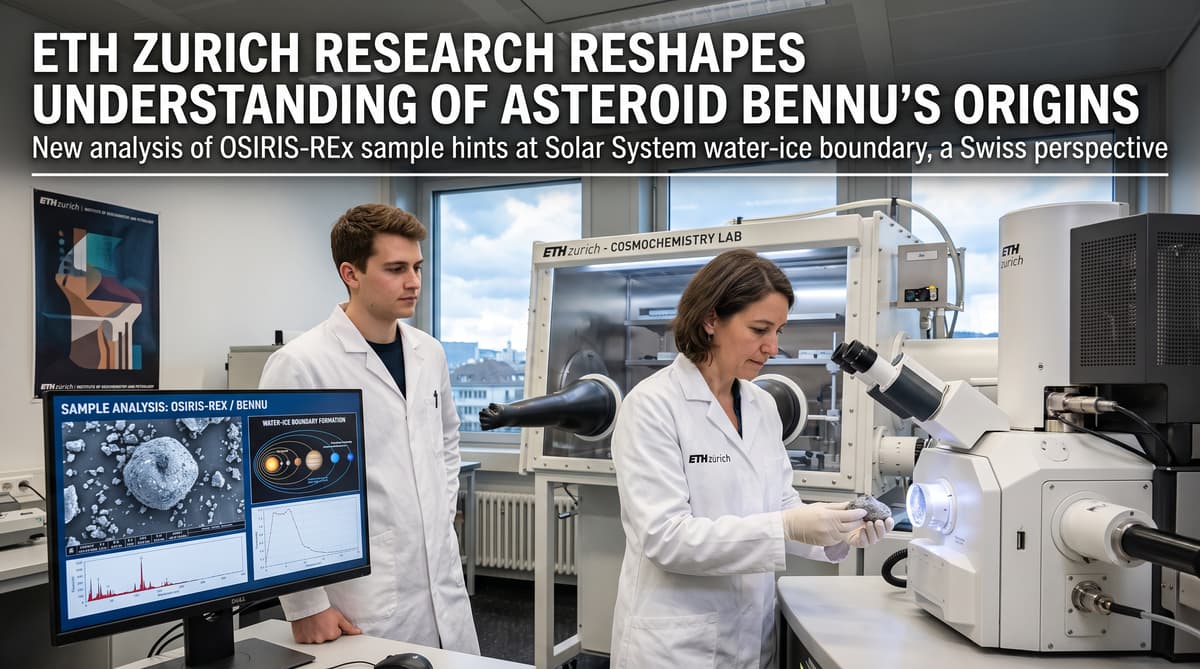
Half a gram of asteroid dust is forcing scientists to redraw Bennu's family history. Researchers at ETH Zurich have analysed material delivered to Earth by NASA's OSIRIS-REx mission and found chemical evidence that Bennu probably formed near the boundary where water could freeze into ice in the young Solar System. The result challenges the long-standing view that the asteroid formed much farther out, in the cold region associated with comets.
NASA returned 120 grams of Bennu samples in 2023. ETH Professor Maria Schönbächler's laboratory received only 0.5 grams, yet that small portion carried clues from the Solar System's earliest period. The team examined the signatures of iron, titanium and chromium, elements that preserve information about the environment in which the asteroid's building material first gathered.
The findings, reported in Science Advances and described by ETH Zurich on September 24, 2026, reach beyond Bennu itself. They offer a revised picture of how material moved through the young planetary system, and how bodies containing water and organic compounds could form closer to the Sun than scientists had assumed.
Chemical Signatures Locate Bennu
The chemical fingerprints came from three elements: iron, titanium and chromium. Their relative signatures in Bennu's dust point to formation in a transition zone near the Solar System's water-ice boundary, often called the snow line. This region marked a major divide in the early planetary disc. Beyond it, water could remain frozen and become part of the material assembling into larger bodies.
Scientists had previously placed Bennu's origins in the outer Solar System, a setting associated with the formation of comets and other icy objects. The ETH analysis supports a more mobile and mixed early environment. Dust could travel across the young disc before being incorporated into the asteroid's parent body.
That interpretation matters because Bennu is a carbon-rich, water-bearing object. Its composition records the ingredients available during the first stages of planetary construction. Reading those records requires extremely small samples and highly sensitive measurements. Schönbächler's team used the returned material to connect elemental chemistry with the location of Bennu's birth, giving researchers a new way to test models of Solar System formation.
Jupiter Shaped the Dust Highway
Jupiter may have acted as a traffic barrier in the young Solar System. ETH researchers propose that the gas giant formed early enough to interfere with the movement of larger solids. Coarse material became difficult to pass through the region around Jupiter, while fine dust from different parts of the young planetary disc continued to flow into a nearby transition zone.
That process could have created a chemically mixed reservoir. The dust later became part of the precursors of Bennu, combining material that originated in more than one part of the early Solar System. The model gives Jupiter a structural role in the architecture of the planetary system, beyond its familiar status as the largest planet.
The finding also illustrates why asteroid samples matter. Telescopic observations can reveal an object's surface, but returned grains allow laboratories to examine elemental signatures directly. NASA's OSIRIS-REx mission therefore turned Bennu into a physical archive. ETH Zurich's analysis uses that archive to test how barriers, transport and mixing shaped the bodies that eventually became asteroids and planets.