aviation
Swiss Senate rejects short-haul flight tax
The Senate has rejected a proposal for a tax on short-haul flights, despite record passenger numbers and arguments that some routes could easily be replaced by rail. Examine the vote, the environmental and regional arguments, and what it means for Switzerland’s aviation policy.
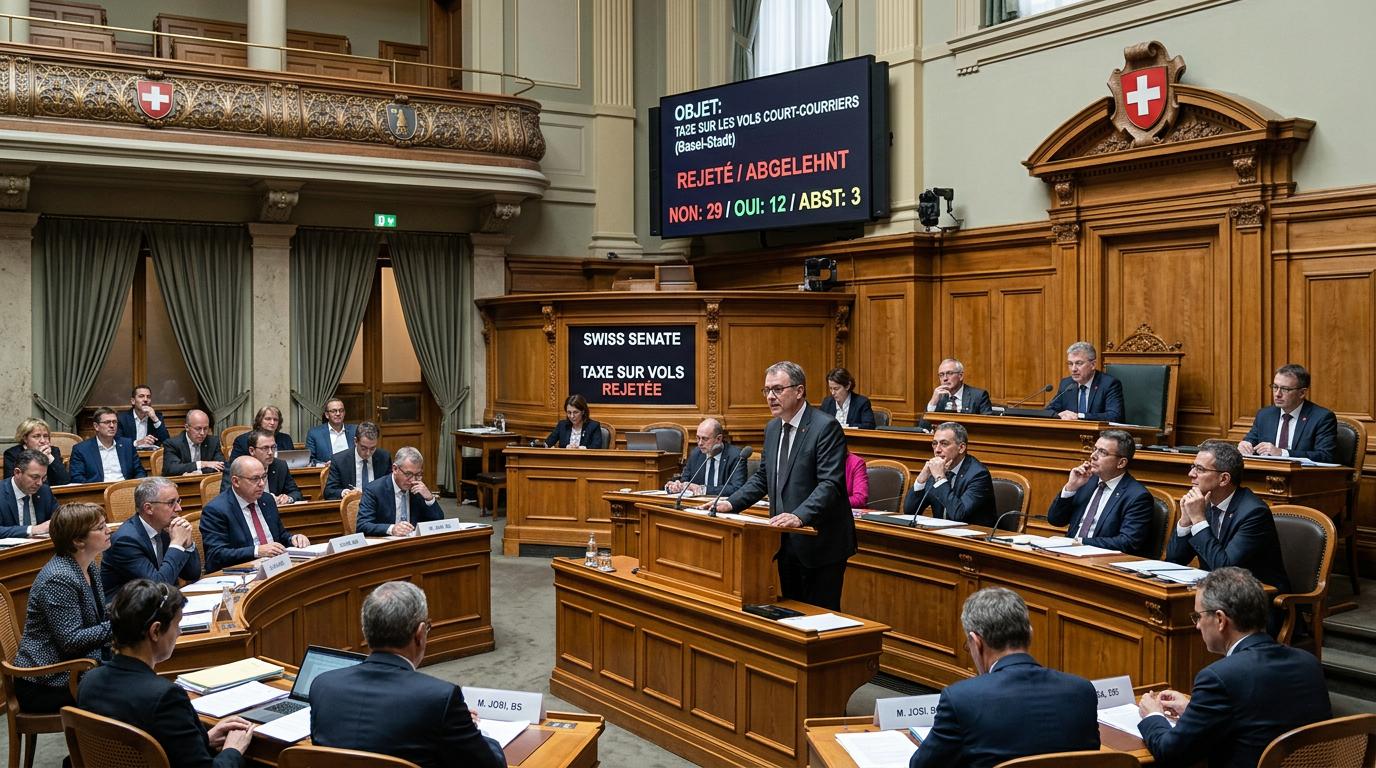
Senate Blocks Basel-City’s Flight Tax
A 20 to 17 Senate vote has stalled Basel-City’s push to tax short-haul flights. The decision came on Wednesday, September 16, after Green parliamentarian Maya Graf argued that Switzerland’s aviation growth was imposing costs on communities and the climate. The Senate rejected the initiative’s request to move forward, leaving the House of Representatives to deliver the next parliamentary verdict.
Graf pointed to record passenger numbers at Swiss airports in July, during a summer of high temperatures. She also highlighted the daily noise burden around Basel-Mulhouse Airport, which serves one of Switzerland’s most densely populated metropolitan areas. In her argument, some short flights provide little additional value for the region’s economy, tourism or leisure sector while remaining accessible by train.
The initiative sought an incentive tax on tickets for flights covering routes that rail could serve reasonably well. Its authors avoided a fixed kilometre threshold, which would have treated every route of the same distance alike despite major differences in rail connections. The Senate’s rejection keeps Switzerland from adding a new national measure aimed specifically at replacing short air journeys with rail travel.
Basel Links Airport Noise to Rail Alternatives
Basel’s geography placed noise and rail access at the centre of the debate. Basel-Mulhouse Airport sits in France but serves the cross-border metropolitan region, making aviation policy especially sensitive to national boundaries. Residents in and around the city live with aircraft movements, while travellers can reach several nearby European destinations by rail.
Graf argued that the economic gains from every short-haul connection should not be assumed. Where trains offer a practical alternative, a ticket levy could change travel decisions and discourage journeys that add limited value. The proposal therefore focused on accessibility, rather than declaring every flight below a particular distance unnecessary.
That approach would have required authorities to assess routes individually. A destination with frequent, direct rail service could have fallen within the policy, while a similarly distant city with poor connections might not. The source does not specify the proposed tax rate, the routes that would have been covered or how the revenue would have been used.
For Basel, the issue links local quality of life to national climate policy. Aircraft noise is experienced locally, while emissions from short flights extend beyond the airport and canton. The Senate’s decision leaves those competing costs outside a dedicated short-haul tax for now.
Cross-Border Airports Complicate the Climate Case
The opposition warned that a Swiss-only tax could redirect passengers rather than reduce flying. Radical Liberal representative Severin Brüngger said travellers might shift to airports in neighbouring countries, particularly EuroAirport Basel-Mulhouse. His objection reflects the practical difficulty of regulating aviation in a country surrounded by major foreign airports and deeply integrated into cross-border transport networks.
Brüngger also argued that effective action requires international coordination. Aviation fuel taxation, airport competition and passenger behaviour all extend beyond Switzerland’s borders. A measure applied at Swiss airports could produce different effects from one adopted across neighbouring states, especially for travellers who can reach foreign terminals by road or rail.
Social Democratic senator Eva Herzog rejected the idea that international coordination should prevent Switzerland from acting. She cited France’s ban on short-haul flights and Belgium’s tax on flights of less than 500 kilometres as evidence that national measures are possible. Those examples became a central part of the Senate exchange, although the chamber ultimately sided with the initiative’s opponents.
The debate exposed a familiar fault line in Swiss climate policy: whether domestic measures should proceed while broader international agreements remain incomplete, or whether fragmented rules risk shifting activity without cutting emissions.
House Vote Will Decide the Next Stage
The proposal’s defeat does not close Switzerland’s aviation debate. The House of Representatives still has to give its verdict on the Basel-City initiative, although the Senate’s vote signals that a national short-haul tax faces a difficult path. Any further parliamentary discussion will have to address the risk of passengers moving to foreign airports, the reach of Swiss legislation and the practical definition of a rail-accessible route.
The Senate also rejected a separate petition calling for a ban on private jets in Switzerland. That vote reinforces the chamber’s reluctance to adopt targeted restrictions on aviation through the measures considered on Wednesday. It does not resolve the broader questions about airport noise, rising passenger numbers or the balance between air travel and rail.
For Basel residents, the immediate result is straightforward: no new Swiss tax on short flights follows the Senate decision. For climate campaigners, the vote leaves the incentive question open. For airlines and airports, cross-border competition remains a decisive argument against unilateral action.
Switzerland’s next steps will depend on the House, as well as on whether cantons and policymakers pursue other tools to shift journeys from planes to trains. The source provides no timetable for the House debate or any alternative federal measure.