Housing
More homes may finally begin to ease Switzerland’s housing shortage
A new property-market study predicts that housing construction will accelerate in 2026 and 2027, potentially easing Switzerland’s severe shortage, although relief is likely to vary by region.
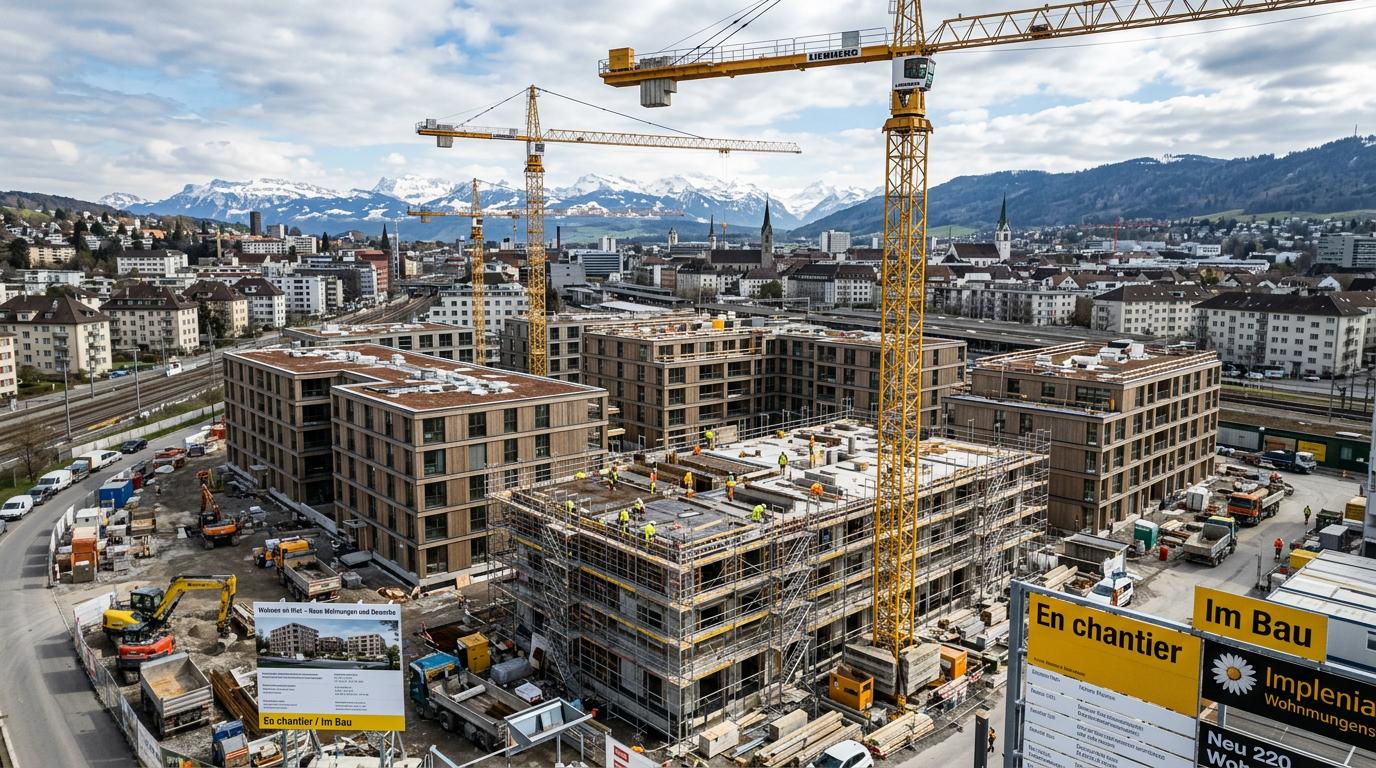
Switzerland Bets on a Building Recovery
Switzerland could add 95,000 homes over the next two years, according to a new analysis by property consultancy Wüest Partner. The forecast points to roughly 45,000 net additions in 2026 and 50,000 in 2027, a meaningful recovery after several years of weak construction.
The timing matters. On June 1, Switzerland had just 45,493 vacant homes, equivalent to a national vacancy rate of 0.93%, according to the Federal Statistical Office. The rate has fallen for six consecutive years and has dropped by 0.79 percentage points since 2021. For tenants, that has meant fewer options, stronger competition and rising rents, particularly in the largest employment centres.
Wüest Partner says the construction cycle has reached its lowest point. Switzerland added around 40,000 homes in 2024, while the consultancy estimates that only 39,000 were added in 2025, the weakest result since 2009. If the forecast holds, annual production will move above those recent levels and provide some relief by the end of 2027.
That relief will arrive gradually. The study describes the 2026 increase as sporadic across regions, with a broader recovery expected in 2027. The national figures therefore offer a direction of travel, rather than a guarantee of cheaper or easier housing for every household.
Unlock the Projects Stuck in the Pipeline
The forecast rises from 39,000 homes in 2025 to 50,000 in 2027, but the path to that increase began several years ago. Wüest Partner links the expected revival to a shift in market conditions that started around 2020.
Vacancy rates had been rising for years before they began to fall rapidly in 2020. At the same time, residential property values increased sharply. Those two developments changed the calculation for developers and investors, creating stronger incentives to prepare new schemes and seek planning approval.
Housing projects, however, move slowly in Switzerland. Developers have faced more complex planning procedures, additional building rules, higher construction costs and changing interest rates. Those pressures delayed some projects and made others harder to finance. A project can take several years to pass through design, approvals and construction.
Many schemes launched after 2020 have now completed those stages and are approaching delivery. That backlog explains why construction may accelerate even though the current pipeline does not point to another increase by 2028. The expected rise is therefore partly the delayed result of earlier decisions, rather than evidence that the underlying development process has become faster.
For households, the distinction matters. More completed homes can ease competition, but the number of homes delivered, their location and their price will determine who benefits.
Follow the Cantons Where Supply Will Rise
Geneva’s vacancy rate stands at 0.31%, while Zug’s is just 0.20%, showing why a national construction recovery will not affect every part of Switzerland equally. The pressure is most severe in sought after urban and economic centres, where available homes remain scarce despite the prospect of more building.
Wüest Partner expects the 2026 upturn to be strongest in selected cantons in western Switzerland and the Alpine regions. In 2027, production is forecast to rise sharply in Thurgau, Geneva, Valais and Neuchâtel. Large parts of the Swiss Plateau are also expected to benefit.
The supply picture remains uneven. Around half of the cantons are likely to stay below their long term construction average. In the vacancy data, Jura recorded the highest rate at 3.35%, followed by Solothurn at 1.91%, Ticino at 1.78% and Neuchâtel at 1.64%. These figures underline the gap between places with available stock and the markets where workers and households are competing for a limited number of homes.
Greater Zurich was the only major region to record a slight increase in its vacancy rate, yet it remained very tight at 0.52%. Wüest Partner also says a broad easing is not yet in sight in the major urban centres. Location will determine whether the coming construction wave feels like relief or simply a modest improvement.
Test New Supply Against Renters’ Budgets
Only 0.93% of Swiss homes stood vacant in 2026, and the rental market accounted for most of the decline. Of the 45,493 empty homes counted on June 1, 34,690 were available to rent and 10,803 were for sale. Rental vacancies fell by 6.7% in one year, while homes for sale declined by 4.1%.
Vacancies fell across homes of every size, with two room flats recording the sharpest percentage decline. Even newly built homes and detached houses were less likely to remain empty. The figures point to demand that is broad across the market, although the squeeze is especially visible for households seeking smaller rental units.
The ownership structure has also shifted. Between 2000 and 2023, the share of rental housing held by institutional investors, including pension funds, insurers and property companies, rose from about 31% to 44%. Private and non profit landlords lost share over the same period.
The Swiss Tenants’ Association has warned that construction alone will not guarantee affordability. It argues that much new supply is aimed at the expensive end of the market while cheaper homes disappear. The association has also accused some landlords of demanding excessive rents and exceeding legal limits on returns, claims that remain part of the wider political debate over housing costs.
For renters, the test of the construction recovery will be simple: whether new homes become available within reach of ordinary incomes.
Measure Relief Beyond the Completion Numbers
Wüest Partner expects the housing shortage to ease somewhat by the end of 2027, yet its own analysis offers no clear prospect of a sustained construction surge beyond that point. Building applications currently on file do not indicate further acceleration in 2028.
That leaves Switzerland facing a narrow window. Projects already developed since 2020 can lift completions in 2026 and 2027, but the next phase will depend on whether developers can overcome the costs and delays that weakened output in the first place. Planning complexity, building regulations, financing conditions and construction prices will continue to shape what gets built and where.
The regional pattern will remain decisive. A new apartment block in Thurgau, Valais or Neuchâtel can expand local choice, while households in Geneva, Zug or the Zurich area may see little change if demand continues to outpace deliveries. National totals can conceal that imbalance.
Switzerland’s housing shortage will therefore be measured in lived experience as much as in completion figures. A higher number of homes should give tenants more room to search, especially in regions receiving substantial new supply. It will take sustained production, suitable locations and a wider range of price points to change the affordability picture across the country.