Politics
Swiss election poll signals stronger right and growing polarisation
The Swiss People’s Party is on course for its strongest projected result since 2015, while the political centre is losing ground, according to a new election poll. The findings point to increasing polarisation ahead of the 2027 federal elections.
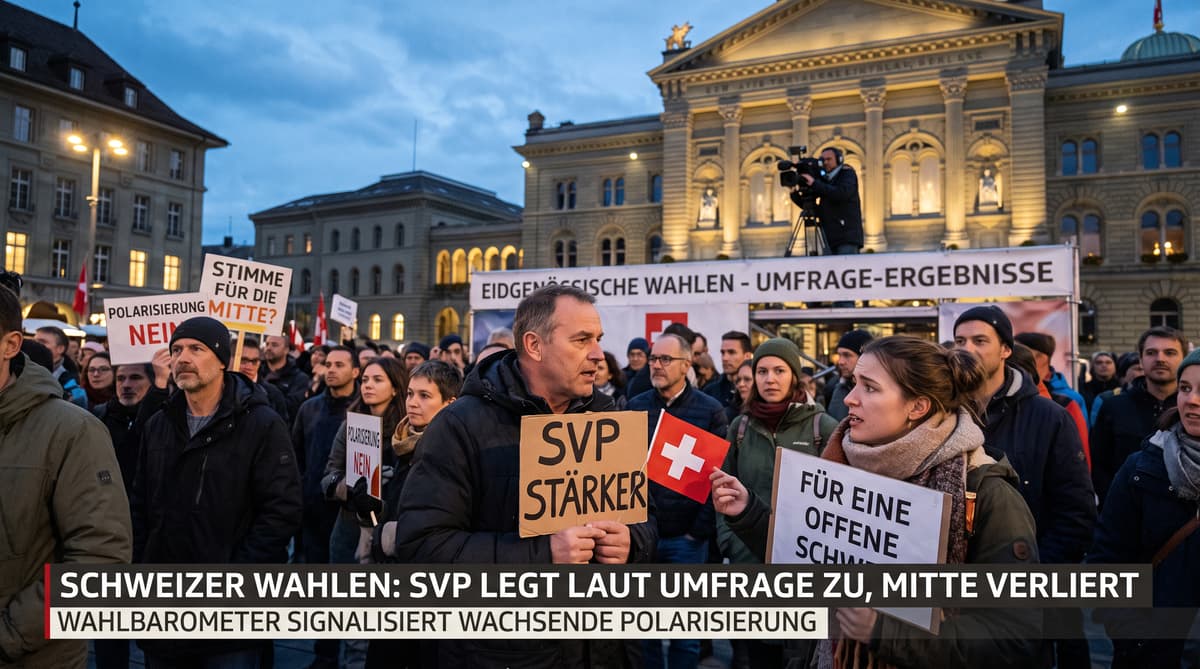
The People’s Party is polling at 29.9%, a level that would set a new high for Switzerland’s strongest national party. The figure comes from the Sotomo election barometer, commissioned by the Swiss Broadcasting Corporation and published on October 16, 2026, just over a year before voters choose a new Federal Assembly on October 24, 2027.
The result would edge past the party’s previous House of Representatives record of 29.4%, recorded in 2015. It also represents a 2 percentage point gain since the 2023 federal elections, the largest increase among the parties highlighted in the survey. Marcel Dettling, the People’s Party president, therefore enters the next campaign with a stronger electoral base and a clear lead over every rival.
The poll points to a more divided party system. The Social Democrats and Greens are making modest gains on the left, while the Radical Liberal Party and Centre Party are losing support. The centre right parties remain essential to Switzerland’s governing arithmetic, yet together they now command a projected 26%, four points less than the People’s Party alone.
The figures do not predict the final result. They do show where the campaign begins: with the right consolidating its position, the left recovering some ground, and the political centre under pressure.
Centre Right Loses Ground
The two centre right parties would collect 26% between them, while the People’s Party would take 29.9% on its own. That arithmetic captures the scale of the shift recorded by Sotomo.
The Radical Liberal Party stands at 13.3%, down one point from 2023. Sotomo says that result would be the party’s weakest in the history of elections to the House of Representatives. The party did move slightly ahead of the Centre Party compared with a similar 2025 poll, but that short term improvement has not reversed its longer decline.
The Centre Party is projected at 12.6%, a loss of 1.5 points since the last federal election. Switzerland’s traditional conservative parties have long played a central role in coalition building and in the country’s consensus driven political culture. Their combined decline gives the People’s Party more room to define the national debate, even though it still needs partners to pass legislation and shape parliamentary majorities.
The movement also complicates the Federal Council’s familiar balance. A stronger People’s Party can press harder on migration, sovereignty and the cost of living, while the weakened centre must decide whether to compete on those issues or defend its moderate profile. The poll offers no guarantee of seats, since Switzerland’s proportional voting system produces different outcomes across cantons. It does establish a clear national direction.
The Left Finds Openings
The Social Democrats are projected at 19.3%, their best result since 2007 if the poll’s numbers hold. The party has gained 1 percentage point since 2023, helping the left increase its combined strength by 1.5 points alongside a slight improvement for the Greens.
The result gives the Social Democrats a stronger platform on issues that reach beyond traditional ideological divides. Health insurance premiums rank as voters’ most urgent concern, cited by 39% of respondents. Household budgets have become a central political test in a country where compulsory health insurance premiums continue to shape monthly spending for families and pensioners.
Climate change follows at 36%, a nine point rise in one year. Sotomo linked the increase to the heatwave-hit summer of 2026. The shift brings an issue associated with the 2019 green surge back into the campaign conversation, although the poll does not show a repeat of that breakthrough.
The Greens have advanced only marginally, while the Liberal Greens have slipped. Their weaker electoral movement despite rising climate concern illustrates the limits of issue ownership. Voters may rank climate policy highly without automatically backing the parties most closely associated with it. The Social Democrats could benefit if they connect environmental policy to premiums, rents and purchasing power, while the Greens face pressure to convert concern into votes.