Nobel Peace Prize
Navi Pillay’s Nobel Peace Prize sends a strong signal for international justice
The Nobel Peace Prize awarded to Navi Pillay has drawn strong support from the UN High Commissioner for Human Rights in Geneva.
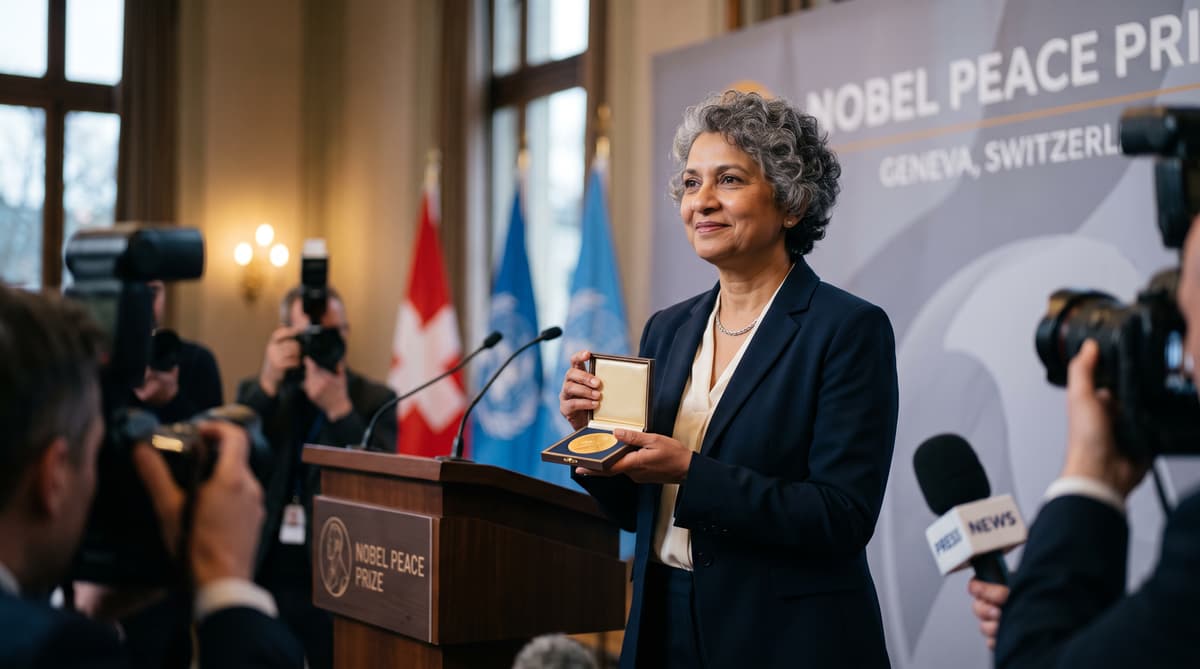
The Nobel Peace Prize has placed international justice at the centre of the political conversation in Geneva. Navi Pillay, the South African jurist and former UN High Commissioner for Human Rights, received the award as governments and courts face mounting pressure over alleged abuses and accountability claims.
Volker Türk, the current UN High Commissioner, welcomed the decision during a press briefing in Geneva on October 9, 2026. He described it as a “very strong signal” for international justice and said the award represented a collective success for human rights defenders.
Türk linked the prize to the institutions that investigate crimes, preserve evidence and pursue suspects across borders. “It is clear that international justice mechanisms are indispensable,” he said, naming the International Criminal Court in particular.
The setting mattered. Geneva hosts the UN human rights office, diplomatic missions and a dense network of humanitarian and legal organisations. Pillay's recognition therefore landed in the city where international standards are debated, documented and tested. For Switzerland, the award highlights the continuing relevance of Geneva's institutions at a time when their authority is under direct political challenge.
Pillay Built Her Case Across Three Legal Fronts
Pillay's career spans the courtroom, the UN and the struggle against apartheid. She first became known as a lawyer challenging South Africa's apartheid system, then built an international record that placed equality and accountability at the centre of her work.
She served as a judge at the International Criminal Court and presided over the International Criminal Tribunal for Rwanda. Those roles connected her directly to the prosecution of grave international crimes and to the difficult work of translating legal principles into cases, testimony and judgments.
Pillay later led the UN Office of the High Commissioner for Human Rights from 2008 to 2014. Türk, who succeeded her, referred to her as an eminent legal scholar and his “big sister”. He also praised her as a feminist and as an embodiment of international law.
Her record gives the prize a clear institutional dimension. The Nobel committee has honoured a figure whose work has moved between national liberation, international criminal justice and the UN system. That history also explains why Pillay's name carries particular weight among lawyers and human rights officials in Geneva.
The Prize Lands Amid Pressure on the ICC
The award arrives as the International Criminal Court faces open hostility from Washington. Donald Trump has long criticised the ICC, whose jurisdiction the United States does not recognise. His administration took the further step of imposing sanctions on the institution and members of its staff.
The political context was visible in Geneva, even when Türk declined to frame the Nobel as a direct response to the US president. He avoided answering questions about whether the prize should be read as a rebuke to Trump. He did point to attacks against the UN human rights office, UN special rapporteurs and the ICC.
The distinction is significant. A Nobel citation can elevate a principle without settling a diplomatic dispute. Pillay's award gives international justice greater public visibility, while governments retain the power to withhold cooperation, funding and political support.
The United States was also among the few countries that did not support Türk's reappointment for a further four-year term at the UN General Assembly. His second term is his last, allowing him to speak with greater latitude. Even so, his remarks in Geneva kept the focus on institutions and legal accountability rather than a personal confrontation with Trump.