wildlife
Switzerland struggles to contain the spread of invasive raccoons
Raccoons are continuing to spread gradually in Switzerland, with Zurich authorities acknowledging that the invasive species is unlikely to be stopped.
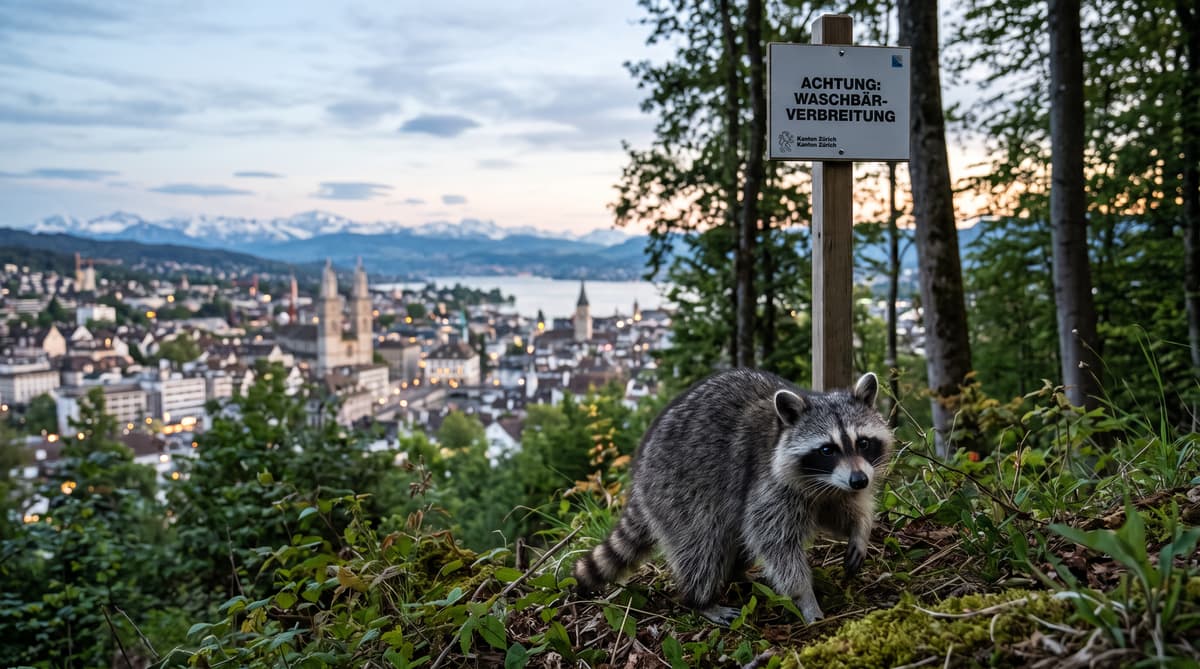
Switzerland recorded 84 raccoons shot in 2025, yet authorities have no reliable national estimate of how many remain in the country. The figures offer a partial view of a species that has established itself quietly, moving through forests, settlements and agricultural areas while attracting growing attention from residents and wildlife cameras.
In Zurich, officials acknowledge that the spread will probably continue. Reto Muggler, co-head of the cantonal fisheries and hunting authority, describes the increase as “not exponential, but gradual”. The number of raccoons shot in the canton has stayed between one and five for decades. That low figure does not prove that the population is stable. It reflects the difficulty of detecting a nocturnal animal and the limited scale of current control efforts.
Sightings of young raccoons are becoming more common, Muggler said. He cautioned that more cameras may also explain part of the increase. Even with that qualification, the animals are appearing often enough for officials to prepare for a longer-term presence rather than expect a quick disappearance.
Zurich currently has no dedicated plan aimed at preventing further spread. Officials regard hunting as the existing response.
Track the Damage to Native Wildlife
Raccoons can damage buildings and disrupt native wildlife, giving Swiss authorities reasons to treat the animal as an invasive species rather than simply an urban nuisance. Their climbing ability allows them to reach attics, roofs and nesting sites. Their diet is broad, and that flexibility helps them exploit both natural habitats and human settlements.
The ecological concern extends beyond property damage. Raccoons are capable hunters and nest predators. They can prey on birds, amphibians and other animals that evolved without a comparable predator. Swiss native species may also lack immunity to diseases carried by introduced animals. The raccoon roundworm is particularly significant because it can endanger humans, although the source does not provide figures for infections in Switzerland.
The species is native to North America. European populations grew after raccoons were imported for the fur trade. In 1934, several were released in Hesse, Germany. From there, the animals expanded through the country and into neighbouring regions. Europe provides few natural controls capable of limiting their numbers.
For Switzerland, the threat lies in accumulation. A gradual increase can still produce more encounters, more pressure on nesting wildlife and more costly damage if the population becomes established across additional cantons.
Test the Limits of Hunting
Aargau accounted for 54 of the 84 raccoons shot in Switzerland in 2025, while Basel-Country recorded 23. The remaining seven animals were shot in other cantons. The distribution points to a concentrated challenge in northern Switzerland, the region where the first Swiss raccoons were reported in the 1990s.
Aargau is working with hunting associations to prepare for a larger presence. Hunters there have 11 specially designed box traps fitted with catch baskets. When a raccoon enters, the trap holds it securely and the hunter kills the animal with a well-aimed shot. This approach allows officials to target individual animals near known activity without relying solely on chance encounters during ordinary hunts.
The numbers also expose the limits of the current policy. Hunting removes animals, but it does not establish how many remain, where breeding populations are concentrated or how quickly they are moving between cantons. Zurich has not created a separate prevention programme because raccoons are already hunted as an invasive species.
That policy may be adequate while sightings remain scattered. It offers less certainty if young animals continue to appear across a wider area. A national picture will require cooperation between cantonal authorities, hunters and wildlife monitoring networks.
Improve the Map Before Numbers Rise
Switzerland does not know exactly how many raccoons live within its borders, and that uncertainty shapes every decision about control. The animals began appearing in hunting statistics about ten years ago, but annual removals provide only a record of detected and killed animals. They do not measure the hidden population in forests, ravines, farm buildings or urban fringes.
Authorities are using sightings and cameras to follow the spread. Muggler noted that reports of young raccoons are increasing, while also warning that the number of cameras has risen sharply. Both developments matter. More young animals may indicate reproduction in Switzerland. More cameras may simply reveal behaviour that previously went unrecorded.
The distinction is important for Zurich. A handful of confirmed sightings could represent isolated movement from neighbouring regions, or the early stages of a breeding population. Without consistent monitoring across cantonal borders, officials may struggle to separate those possibilities.
The available evidence supports a cautious conclusion. Raccoons are present, they are reproducing or moving through parts of Switzerland, and their spread is difficult to halt. Better surveillance could map hotspots, identify breeding areas and show whether hunting is reducing local numbers or merely documenting a wider expansion.
Prepare for a Permanent Presence
Germany's estimated two million raccoons show how quickly an introduced population can become established, and Swiss officials are watching that experience from close range. Raccoons spread through Germany after releases in Hesse in 1934, then benefited from abundant food, adaptable behaviour and few natural predators. In some places, they now damage buildings and threaten birds and amphibians.
Switzerland is trying to contain the species and prepare for a possible infestation. The approach depends on early detection, hunting and cooperation with local hunting associations. Aargau has already assembled a practical trapping response. Zurich, by contrast, is relying on existing hunting arrangements while officials assess the evidence.
For residents, the most likely signs are sightings around settlements, damage in attics and images from wildlife cameras. People should not treat a raccoon as a harmless pet or attempt to handle one. The source does not set out a national public reporting system, so suspected sightings should be directed to the relevant cantonal wildlife or hunting authority.
Switzerland may still limit the animal's density in sensitive areas. The available figures do not show that it can eliminate the species. Officials now face the more measured task of tracking where raccoons settle, protecting vulnerable wildlife and adapting control efforts as evidence develops.