Switzerland
Swiss researchers identify new species of prehistoric reptile
Swiss researchers have identified a new species of prehistoric reptile from a 156-million-year-old fossil found in Wyoming. The specimen is also the most complete early choristodere known and the oldest record of the group in North America.
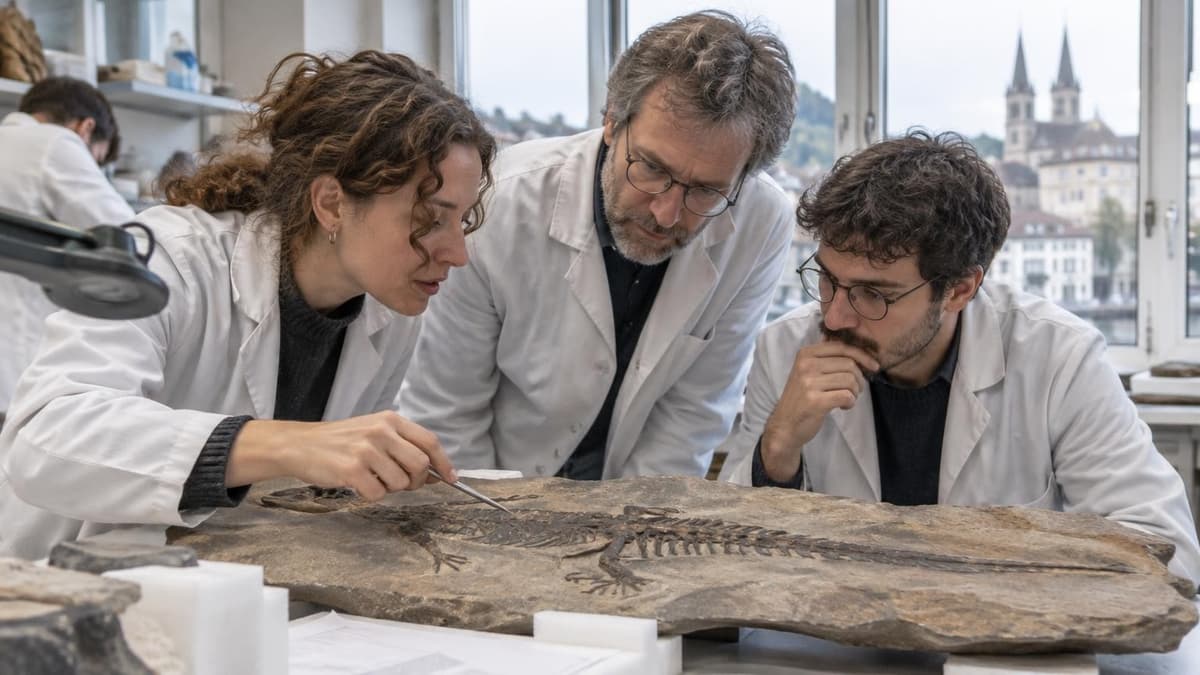
A sandstone slab from Wyoming has revealed a reptile species unknown to science. Swiss researchers named the 156-million-year-old animal Meilynodraco amonamarthi. It is the oldest known North American record of choristoderes, a long-extinct group of reptiles, and the most complete early example of the group identified so far.
The story began in 2022, when an excavation team from the Aathal Dinosaur Museum in canton Zurich uncovered the slab at a Wyoming quarry. Vertebrae from a tiny skeleton showed on the sandstone. The animal’s head and torso lay separately within the rock, leading researchers to suspect that a predator killed it.
The find travelled from the United States to Switzerland, where specialists set out to identify the remains. Their work brought together researchers at the Paul Scherrer Institute (PSI), which led the international team, and the University of Zurich.
Scan the hidden bones
Neutron and X-ray scans let the team see bones hidden inside the rock without damaging the fossil. Researchers at PSI and the University of Zurich used both forms of tomography to examine the sandstone. The scans produced tens of thousands of cross-sectional images, which the team had to work through before the reptile’s anatomy emerged.
The images revealed pelvic bones, parts of a hind limb and a tiny skull with an almost completely preserved braincase. PSI called the skull “the real sensation”. Its preservation gave researchers important anatomical evidence while keeping the original fossil intact.
That mattered because the remains were small and embedded in dense sandstone. Rather than removing the bones from the slab, the team could inspect the hidden structures through imaging. The process turned a scattering of visible vertebrae into a much fuller picture of the animal, including features crucial to identifying its place among prehistoric reptiles.
Read the clues in the skull
A skull smaller than two centimetres carries the strongest clues to the reptile’s ancestry. The animal measured around 45 centimetres long and belongs to the Choristodera, a group of reptiles that has been extinct for a long time. The group’s exact position in the reptile family tree remains a puzzle.
Researchers focused on tiny bones in the inner-ear region. Their shape resembles bones found in the crown group of reptiles, the group that includes all living reptiles. PSI said that resemblance could mean choristoderes are more closely related to living reptiles than earlier fossils had suggested.
The finding gives palaeontologists a new anatomical point of comparison. The specimen’s completeness is especially useful: pelvic bones, hind-limb parts, the skull and much of the braincase allow researchers to assess a range of features in one early choristodere. Its skull, despite its small size, is central to the classification.
Bring the fossil to the public
The fossil is due to go on public display in Switzerland in early 2027. The Aathal Dinosaur Museum in canton Zurich plans to include Meilynodraco amonamarthi in a travelling exhibition. The specimen’s journey from a Wyoming quarry to a Swiss research team and then a museum display links field excavation, advanced imaging and public access to palaeontology.
For the Swiss team, the discovery establishes a new species and adds the oldest known North American record of choristoderes to the group’s history. It also gives researchers a particularly complete early specimen to study, with preserved elements ranging from pelvic bones to a nearly complete braincase.
Visitors will be able to encounter the fossil through the Aathal museum’s exhibition. The scans have already allowed researchers to examine the concealed bones without harming the sandstone, while the original specimen remains the centrepiece of the find.