Partners Group
Partners Group set to wind up London-listed private-equity fund
Investors have backed the winding-up of Swiss asset manager Partners Group’s London-listed private-equity fund after 74.12% of shareholders supported converting their holdings into realisation shares. The decision highlights investor pressure for liquidity amid concerns about the private-equity market.
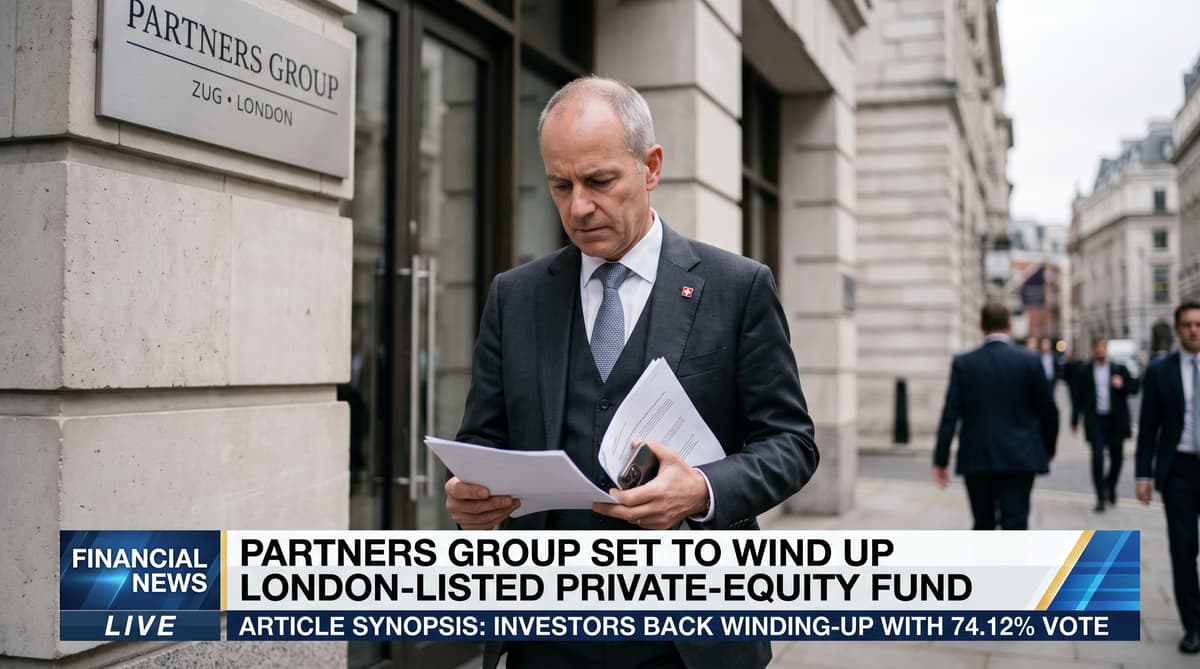
74.12% of shareholders have backed an exit from Partners Group’s London-listed private-equity fund, putting PGPE on course for a controlled wind-up. Investors voted to convert their holdings into so-called realisation shares, securities designed to give them a tradable route to liquidity.
The result exceeds the 40% threshold required to approve the proposal. The decision still goes before an extraordinary general meeting scheduled for Wednesday, where shareholders will formally consider the conversion. If adopted, Partners Group’s board will begin liquidating the fund’s entire investment portfolio in a controlled process.
PGPE, or Partners Group Private Equity, is listed on the London Stock Exchange but managed by the Baar-based Swiss asset manager. Its proposed closure comes as investors have become more focused on how quickly they can access capital held in private markets. Private-equity funds typically invest in assets that cannot be sold as readily as publicly traded shares, making liquidity a central concern when market confidence weakens.
The vote removes the previously proposed reorganisation from the agenda. Investors will now be asked to approve the realisation-share route alone. The outcome gives Partners Group a clear mandate to prepare an orderly realisation of the portfolio, subject to the formal meeting and the fund’s governing process.
Shareholders Choose Liquidity Over Long-Term Exposure
The realisation-share proposal emerged in June after PGPE offered investors a choice over the fund’s future. One path would have allowed shareholders to remain invested in the company’s long-term strategy after a restructuring. The other offered a tradable security intended to provide liquidity.
The second option won the decisive support. That preference reflects the practical pressure facing investors in private equity: capital can remain committed for years, while public markets allow holders to sell more quickly. The source does not identify individual shareholders or disclose the fund’s portfolio composition, so the vote’s financial impact will depend on the assets ultimately sold and the prices achieved during liquidation.
Partners Group has withdrawn the reorganisation proposal. If the extraordinary general meeting rejects the realisation-share plan, PGPE would remain under its current investment objective and policy, with directors reassessing the available options. The shareholder vote therefore sets a strong direction, but the formal approval and subsequent portfolio realisations will determine how the process unfolds.
For London-listed investment companies, the episode highlights the importance of matching a fund’s market structure with investors’ expectations. A listed vehicle can be traded on an exchange, yet the underlying private assets may still take time to realise. That gap has become more visible as investors reassess valuations, distributions and exit routes across private markets.
Partners Group Faces Wider Private-Markets Pressure
Partners Group’s PGPE decision follows a turbulent period for the asset manager and the wider private-markets industry. In June, the firm restricted redemptions from evergreen funds, vehicles with no fixed maturity date. The move was followed by a decline in Partners Group’s share price, according to the report.
Evergreen funds promise continuing access to private-market strategies, but their liquidity depends on the assets they hold, available cash and the pace of investor withdrawals. Restrictions can therefore expose the tension between offering investors flexibility and holding assets that require time to sell. The PGPE vote adds a listed-fund example to that broader debate.
Partners Group has also changed the structure of its Global Value SICAV. The vehicle, with €6.6 billion in assets under management, equivalent to CHF 6.16 billion, was incorporated into a fund with separate sub-funds. Those sub-funds will be divided into two portfolios. One will seek long-term capital gains, while the other is intended to make exits easier.
The measures show the firm adapting fund structures around different investor needs. They also underline why Swiss asset managers are facing close scrutiny from investors who want clearer terms on valuation, dealing frequency and access to their money. The available source does not quantify the impact of the redemption restrictions on individual clients.
Wednesday’s Meeting Sets the Next Test
The next milestone is Wednesday’s extraordinary general meeting, followed by the mechanics of turning a shareholder mandate into cash realisations. Approval would leave the board responsible for managing the controlled liquidation of PGPE’s full portfolio. That process can involve selling investments, distributing proceeds and closing positions over time, although the source gives no timetable or forecast for final returns.
For Swiss investors and observers, the case offers a direct view of how private-equity vehicles respond when demand for liquidity rises. Partners Group is headquartered in Switzerland, while PGPE’s listing gives the fund access to London’s public market. The cross-border structure means investors will watch both the corporate decision in London and the asset-management response from Switzerland.
The firm’s recent actions point to a broader effort to separate strategies for long-term growth from vehicles built to facilitate exits. The reorganisation of Global Value SICAV follows the same direction, although it involves a different fund structure and should not be treated as the same liquidation process as PGPE.
The immediate test is procedural: whether shareholders formally approve the realisation shares. The longer test will be financial: how efficiently Partners Group can realise the underlying investments and return capital while maintaining orderly governance. Those outcomes will shape investor confidence in the firm’s listed and evergreen private-market products.