Geneva
South Korean composer wins Concours de Genève final
South Korean composer Hanurij Lee, 20, has won the composition final of the 80th Concours de Genève with his work “Stuff #1”. He also received the audience prize and other special awards.
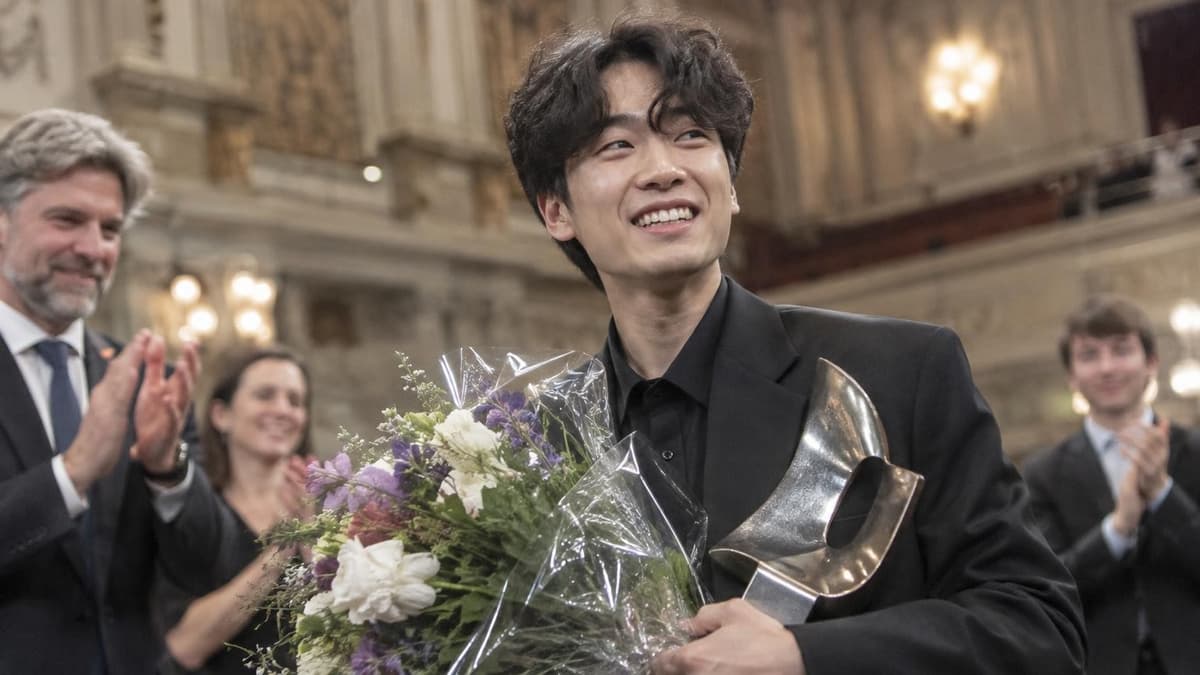
Hanurij Lee’s “Stuff #1” took the top prize at the 80th Concours de Genève, bringing the 20-year-old South Korean composer the competition’s first prize and audience award. The work was performed on Wednesday evening at Victoria Hall, where the composition final brought three newly written orchestral scores to the stage.
Lee also received several special prizes, organisers announced. His win places a young composer at the centre of one of Geneva’s major international music competitions, which this year paired its composition final with the closing rounds of its conducting contest for the first time.
The final’s format put the new works in performance, with conductors from the conducting competition leading the Orchestre de la Suisse Romande. The three scores had been chosen from 188 submissions. Their brief called for a symphony orchestra piece lasting 12 to 16 minutes, with no soloists or electronic systems. Lee’s victory was announced on November 12, following the Wednesday evening performance.
Show how the prizes stack up
Lee’s first prize was worth CHF 15,000, the largest cash award among the three composition finalists. Brazilian composer Rafael Marino Arcaro, 36, received second prize of CHF 10,000. Third prize, worth CHF 5,000, went to 26-year-old Sing-Yat Chen from Hong Kong.
Lee’s recognition extended beyond the ranking: he also won the audience prize and several special awards. The organisers announced the awards after the finalists’ works were heard live, giving the audience a role alongside the jury in recognising the compositions.
The three prize amounts form a clear descending scale, with CHF 5,000 separating each place. Arcaro’s second-place result and Chen’s third-place finish completed a final featuring composers from South Korea, Brazil and Hong Kong. Lee’s first-place finish combined the jury’s top award with the audience prize, making his work the evening’s leading result.
Trace the jury’s brief
The jury selected its finalists from 188 submitted scores, under a brief that set precise limits for both instrumentation and length. Each work had to be written for symphony orchestra and run between 12 and 16 minutes. Composers could not use soloists or electronic systems, and each piece had to be composed after March 2024.
South Korean composer Unsuk Chin chaired the jury. The selected works then moved from scores to the concert stage, where conductors from the competition’s conducting final led the Orchestre de la Suisse Romande. The composition final therefore linked the work of composers and conductors in a live performance setting.
The requirements focused the contest on new orchestral writing within a defined format. Lee’s “Stuff #1” emerged from that field to win the first prize and audience award. Arcaro and Chen completed the three-composer final, each presenting work shaped by the same orchestra, duration and instrumentation rules.
Put conductors at the centre
The 2026 competition joined its composition final to the conducting contest’s final rounds for the first time. Organisers allocated the three selected compositions by lot to the three conducting finalists, who led the Orchestre de la Suisse Romande in the performance of the new works.
German conductor Mats Thiersch, 23, conducted Lee’s winning piece. South African conductor Jacobus De Jager, 29, and Swiss conductor Gabriel Pernet, 27, were the other finalists in that round. All three were due to meet again on Friday for the conducting competition’s second final, where they would lead the orchestra in classical repertoire.
The combined format connected the composition and conducting contests through the same three finalist works and the same Geneva orchestra. After the new music final, attention shifted to the conducting competition’s classical programme, with Thiersch, De Jager and Pernet set to compete once more before the Concours de Genève audience.