ETH Zurich
ETH researcher tipped for Nobel as Swiss science draws attention
ETH Zurich professor Nicola Spaldin has been named among Clarivate’s researchers considered to have Nobel-level influence in physics. Explain the work behind her nomination, what such citation-based predictions can and cannot establish, and Switzerland’s broader position in international science.
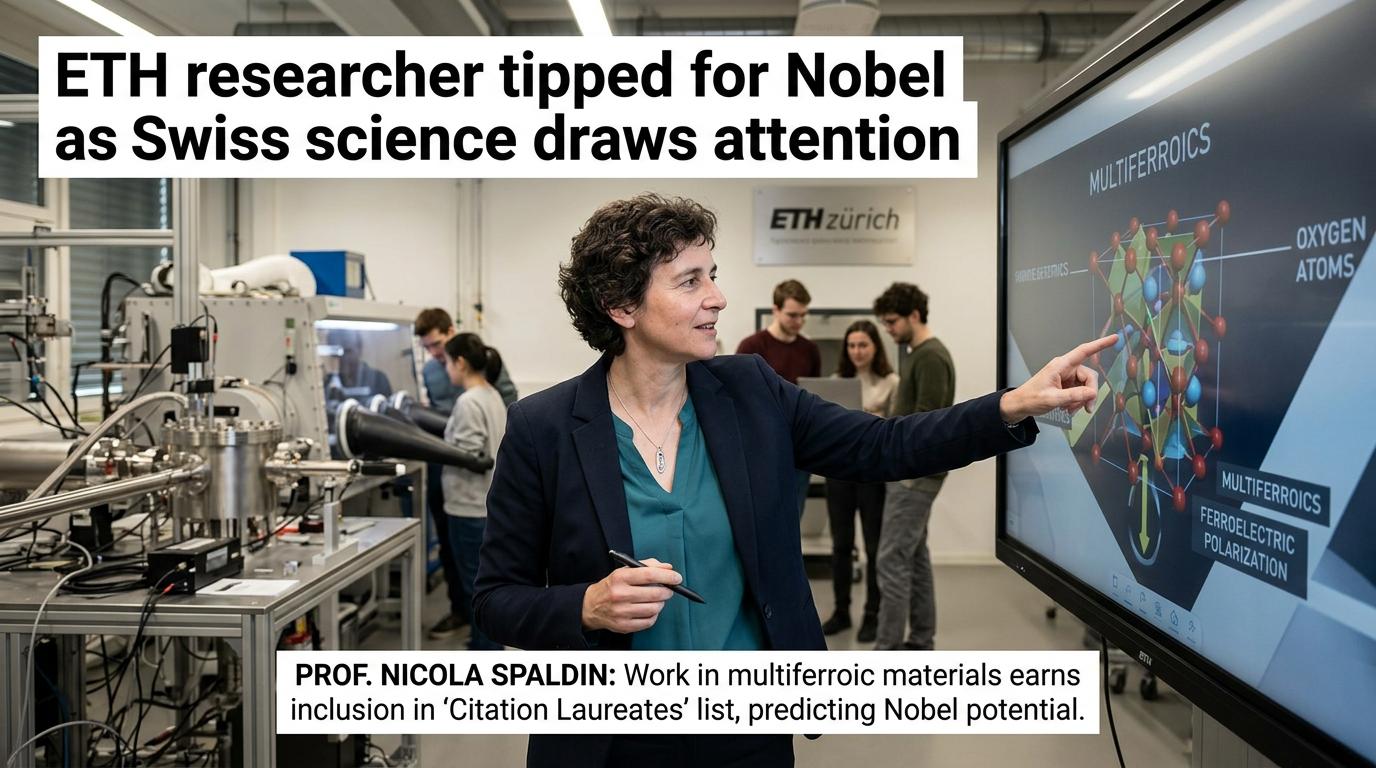
ETH Zurich enters Nobel season
October 6 is the date circled by physics departments around the world. On that day, the Nobel Committee will announce the 2026 Nobel Prize in Physics in Stockholm, with ETH Zurich professor Nicola Spaldin already attracting attention as a possible laureate.
Clarivate, the British American data company, included the Swiss British researcher in its annual list of scientists whose work has reached Nobel level influence. The 2026 list contains 22 researchers from countries including Switzerland, the United States, Canada, Denmark, Israel, Japan and China.
The distinction places Spaldin at the centre of a familiar Nobel season ritual: informed speculation before the committee reveals its decision. Nobel nominations remain secret for 50 years, and committee deliberations are not made public. Laureates learn their fate only shortly before the official announcement.
That secrecy limits what any prediction can establish. Clarivate's list signals strong recognition within the research community, measured through scholarly citations. It does not disclose a nomination, confirm contact with the Nobel committee or guarantee an award. For Spaldin, however, the listing gives international visibility to a body of theoretical work developed at ETH Zurich and tied to a class of materials with potential technological uses.
Spaldin builds the case with new materials
Spaldin's research targets materials that answer to two forces at once. Magnetoelectric multiferroics can be influenced by both magnetic fields and electric fields, a combination that gives physicists a route towards new forms of electronic control.
Spaldin laid the theoretical foundations for understanding this class of materials. Her work helped define why these properties can coexist and how researchers might study and exploit them. The field sits between condensed matter physics, materials science and possible engineering applications.
The practical interest is clear. Materials with coupled magnetic and electric behaviour could contribute to energy efficient data storage, where controlling information requires less power. They could also be used in high precision magnetic field sensors, opening possibilities for more sensitive measurement technologies.
The Nobel speculation rests on the influence of this scientific foundation, rather than on a single commercial product or laboratory demonstration. Citation data can show that other scientists repeatedly build on a researcher's papers. It cannot, by itself, measure every form of scientific importance. Young fields, interdisciplinary work and research published in less cited venues may receive less recognition in citation counts, even when they prove influential later.
Read the prediction without mistaking it for a verdict
Clarivate's record gives the forecast weight, but no certainty. Since 2002, the company has named 487 Citation Laureates. Of those, 89 later won a Nobel Prize, a historical success rate of about 18%. The interval can be long. In the case of Swiss physicists Didier Queloz and Michel Mayor, Clarivate's prediction came six years before their Nobel recognition.
Those figures explain why the annual list draws attention from universities, journalists and researchers. A high citation record can identify work that has shaped a field, especially when scientists across institutions repeatedly rely on the same findings. It offers a data based indicator at a time when the real Nobel process remains closed.
The figures also define the limits of the exercise. An 82% majority of Clarivate's historical selections did not go on to win a Nobel Prize, based on the company's reported totals. The list includes more candidates than the committee can honour, and citation volume may reflect the size of a field, publication practices or the age of a research programme.
The Nobel committees apply their own confidential assessment of discovery, impact and lasting significance. Clarivate's analysis can identify momentum around a scientist's work. It cannot reproduce that judgment or reveal whether Spaldin is under formal consideration.
Switzerland keeps its place in global science
Spaldin's nomination spotlight adds to a wider Swiss science story. Swiss universities have produced a steady stream of internationally recognised researchers, supported by institutions including ETH Zurich, EPFL, the University of Basel, the University of Zurich and Università della Svizzera italiana.
Several researchers working at Swiss institutions have appeared on Clarivate's earlier lists without yet receiving a Nobel Prize. They include chemist Michele Parrinello, biochemist Michael N. Hall, chemist Michael Grätzel, economist Ernst Fehr, physicist Daniel Loss and immunologist Andrea Ablasser. The group reflects the breadth of Swiss research, from computational chemistry and solar energy materials to cell biology, economics, quantum physics and immunology.
Switzerland's position depends on more than prize predictions. International laboratories, stable research institutions and collaboration across borders help Swiss based scientists compete in fields that require expensive equipment, large datasets and long development cycles. ETH Zurich's role in Spaldin's career illustrates how theoretical research can gain global reach from a Swiss base.
The next test arrives on October 6, 2026. If Spaldin wins, Switzerland will celebrate another Nobel connection. If she does not, the Clarivate listing will still mark substantial influence in physics, while leaving the committee's final assessment exactly where it has always been: behind closed doors.